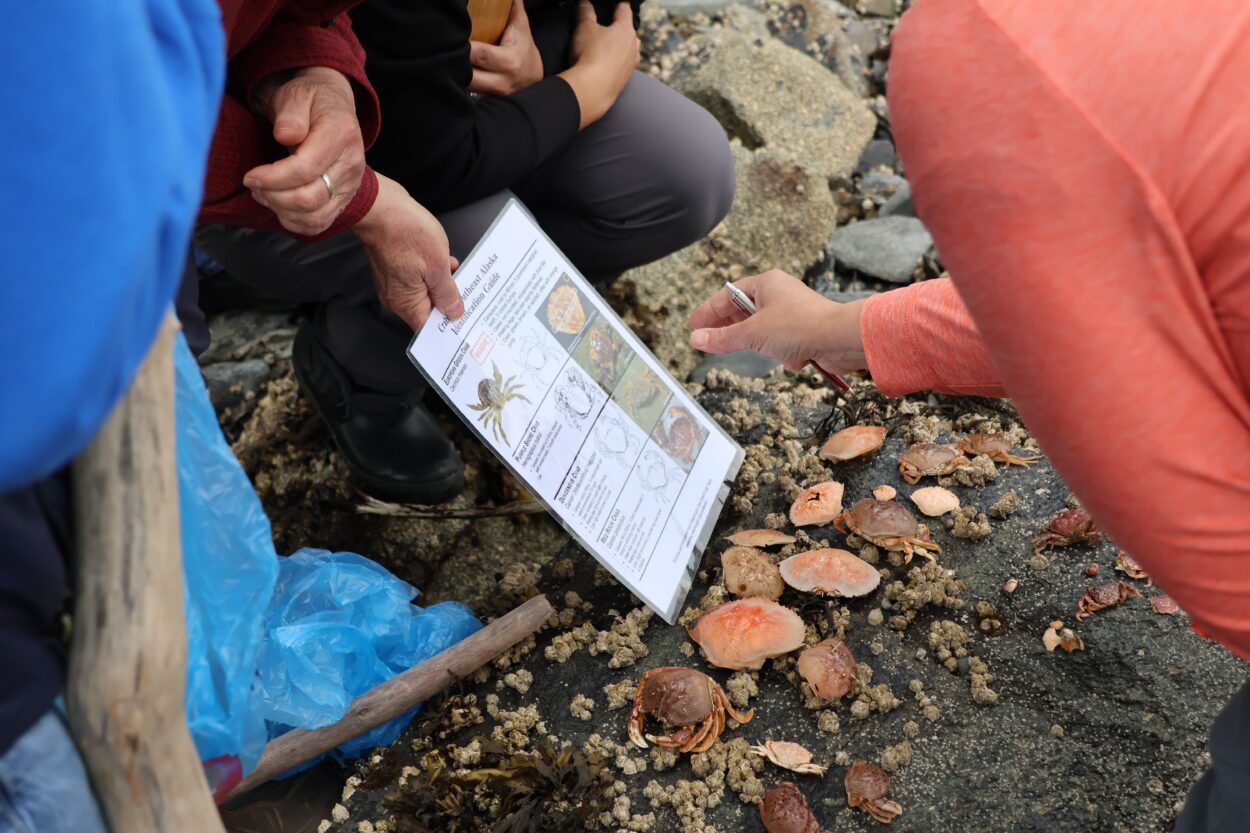
A group of volunteers searched the south end of Mitkof Island for European green crab on July 18, looking for any sign that the highly invasive species had reached central Southeast Alaska after other sightings southward.
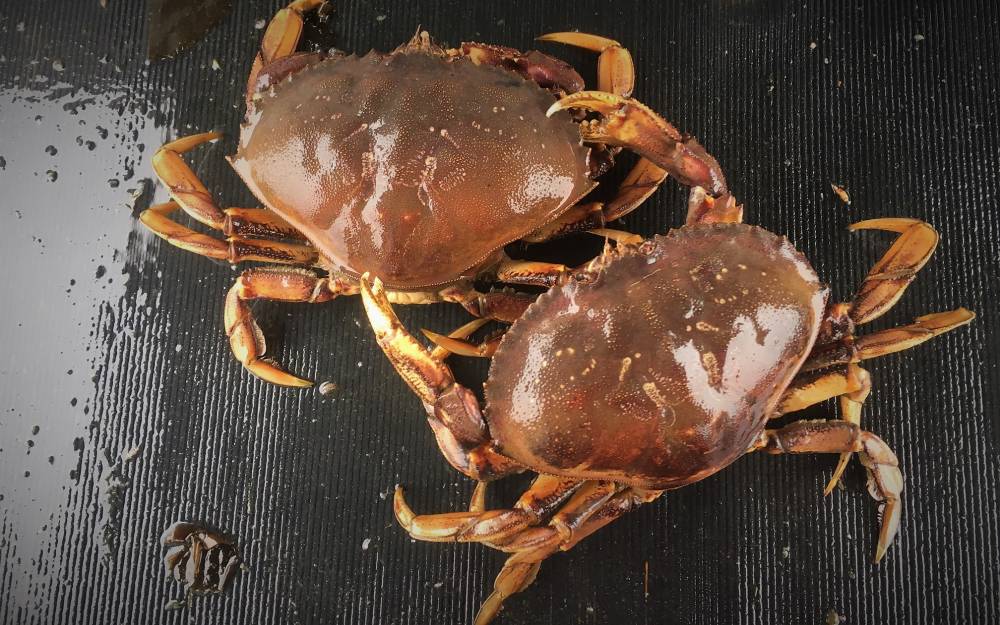
After a couple hours of scouring a rocky beach near Woodpecker Cove for crab carapaces (molted shells), there was a close call with a live green crab that the group captured.
Sunny Rice, an agent of marine conservation group Alaska Sea Grant, hurried over to inspect it. After studying its shell, Rice determined that it was not a European green crab, despite its color.
A European green crab is best identified by the three bumps between its eyes and five spines on each side. That’s why the name “green crab” can be confusing, Rice said.
“Maybe we should just give them a different name, because the ‘green crab’ kind of throws you [off],” she said to the group. “They can be green, but that’s not the best characteristic, right?”
Rice said it’s only a matter of time before the invasive crustaceans reach Mitkof Island.
“They’re not here yet, but they’re very close,” she said. “That could definitely change by next year.”
The crab, originally from Europe, were first spotted on the West Coast by San Francisco in 1989. In recent years, they have spread north to Alaska, sighted as far up as the Ketchikan area. July 19 is now recognized as European Green Crab Awareness Day by the Metlakatla Indian Community, where they were first found in 2022. Since then, they’ve been seen in Gravina Island in 2024 and most recently a beach in Ketchikan.
“When you get an aggressive new crab species into different habitats, it could be disastrous for the habitats and the other native animals,” said Brandon Thynes, director of the Indian Grant Assistance Program at the Petersburg Indian Association.
What makes European green crab especially disastrous is that they tear up eelgrass, which is a key habitat for species like pink salmon.
“Our fisheries right now are really kind of in the slump,” Thynes said. “So if you get this invasive species coming in and tearing stuff up, it’s not good.”
Thynes helped Rice organize the crab carapace hunt, and a similar one last year. They’ve narrowed their focus to this southern beach because of its distance from the Stikine River, which they suspect has too strong a current for crabs to survive.
Rice said citizen science projects like these are essential, especially when staffing is low. Right now, the Alaska Department of Fish and Game has only one invasive species coordinator for the whole state.
“We don’t have enough bodies to get the data in enough different locations, and so let’s enlist the public to help us,” Rice said of citizen science projects. “This is definitely a case of that.”
Rice and Thynes plan to set up traps on the same beach to continue the search for European green crab. And while no evidence of that invasive species has been found on Mitkof Island so far, they encourage people in the region to keep an eye out for their bumpy, spiny crab shells.