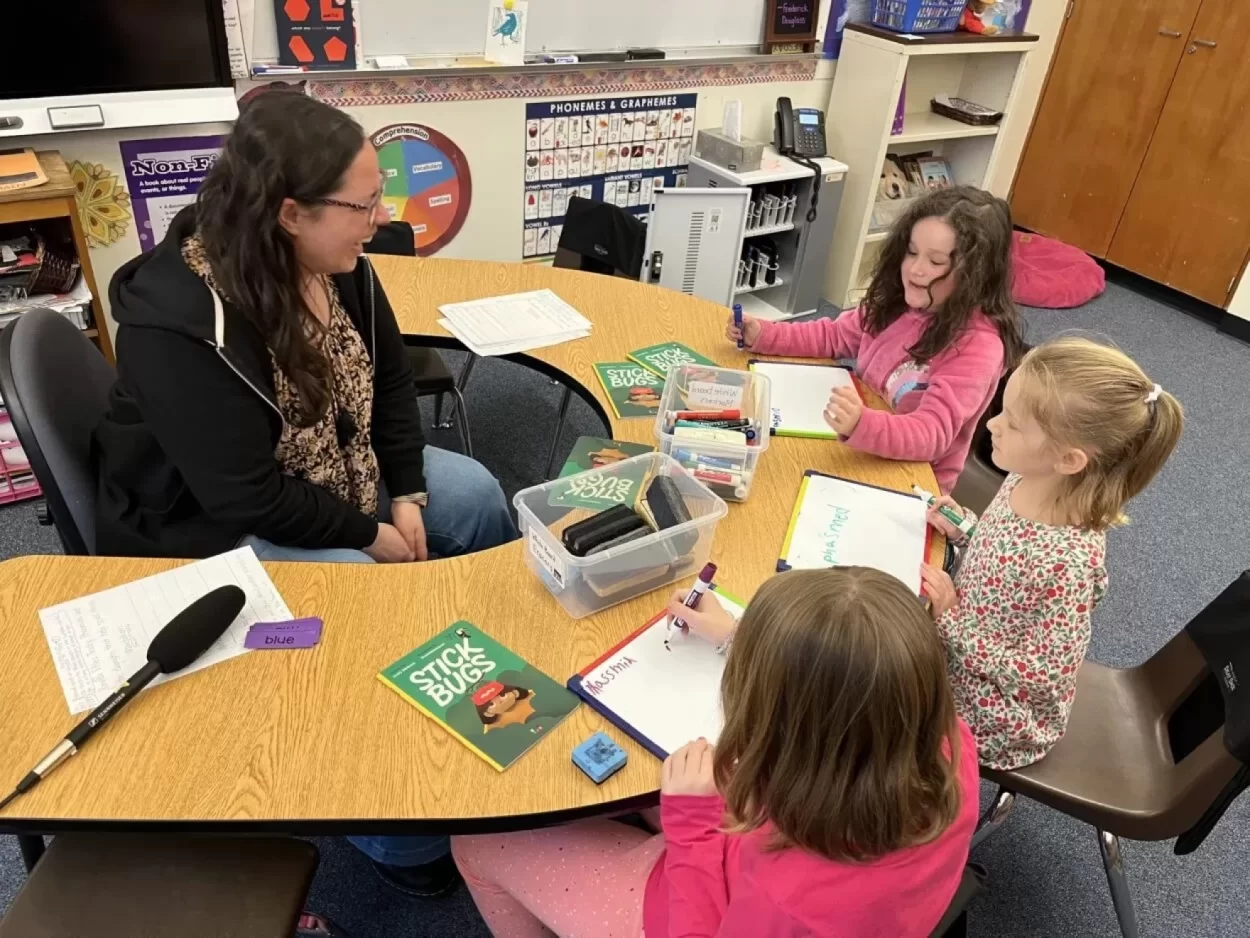
For years, Petersburg’s Rae C. Stedman Elementary School didn’t have consistent reading programs. Heather Conn, the elementary school principal, said that a reading program in one grade wouldn’t carry through to the next.
“So it was kind of a hodgepodge,” said Conn.
Conn said the school needed a consistent curriculum that gave students the skills they needed from the very start.
“We really didn’t have a reading curriculum that addressed the foundational needs, like the fundamental skills that the kids needed,” she said.
Getting a new curriculum would be expensive — Conn said a curriculum for the elementary school was quoted at around $130,000. The district applied for a grant from the state Department of Education and Early Development (DEED) to cover that cost.
Since 2023, the Petersburg School District has been using a reading curriculum from an organization called Amplify, which is rooted in the science behind how people learn to read. The curriculum is approved by DEED as a part of the Alaska READS Act, which tries to get all students reading at grade level by third grade. So far, the district has been seeing strong results.
Mary Midkiff is a third grade teacher, and she’s been teaching for over 20 years. She was on the team that helped pick the curriculum.
Midkiff said that before the new curriculum, teachers still worked hard to teach students how to read. She said that many students would end up learning how to read “very well,” but their system wasn’t always the most efficient. That meant teachers would have to spend a lot of time catching students up later.
She said that science has come a long way in understanding exactly how people learn to read.
“I think a lot of people, even in the education field, thought or hoped that it was similar to learning to talk— that if you were just around it, you got read books, you were just exposed to it— that you would naturally learn to read the same way we learn to talk,” she said. “And they have found out that’s not true.”
This reading program has two components. The first part is the “skills” portion, where students learn letters and sounds. They also learn how to break words into parts they can understand.
The curriculum also has a “knowledge” portion.
“The knowledge piece is that assumption or the fact that in order to read, you kind of have to have some background knowledge,” Midkiff said, “If I go and pick up one of my husband’s electrical manuals, I can decode the words, but I have no idea, and I can’t remember it. I can’t use the information because it means nothing to me.”
That’s why Midkiff teaches units in her classroom about the human body, light and sound. Students learn how to read while also learning the background information that makes them better readers.
Erin Hofacre is a second grade teacher entering her third year teaching. She was also on the curriculum team.
Hofacre didn’t have this curriculum during her first year teaching, and she said that the change has allowed her to be more present and involved in her classroom. It’s been a big benefit to her and her students.
“When the teacher’s excited about it, they are obviously so much more excited and into it,” she said. “So we’re seeing they’re excited about the learning, and then also, we’re seeing amazing growth in their data.”
The numbers are looking promising so far. By the first year alone, Kindergarteners and 1st graders saw 30% more growth than state and national averages. In the first and second year, more than 85% of kindergarteners tested at or above grade level by the end of the year. In that same time, about 75% of second graders ended the year at or above grade level.
It also took more than just a new curriculum to make these results happen. On top of their full-time jobs, some teachers took a 12-credit course about how kids read. The school also has a reading intervention program that helps get kids back up to speed if they’re falling behind.
Hofacre said this progress was a community effort.
“The community that we live in is really special, because everybody’s involved,” she said. “And that makes a huge difference.”
Stedman Elementary School is going into its third year using the curriculum, and the district is expanding the reading curriculum to 6th and 7th grades.