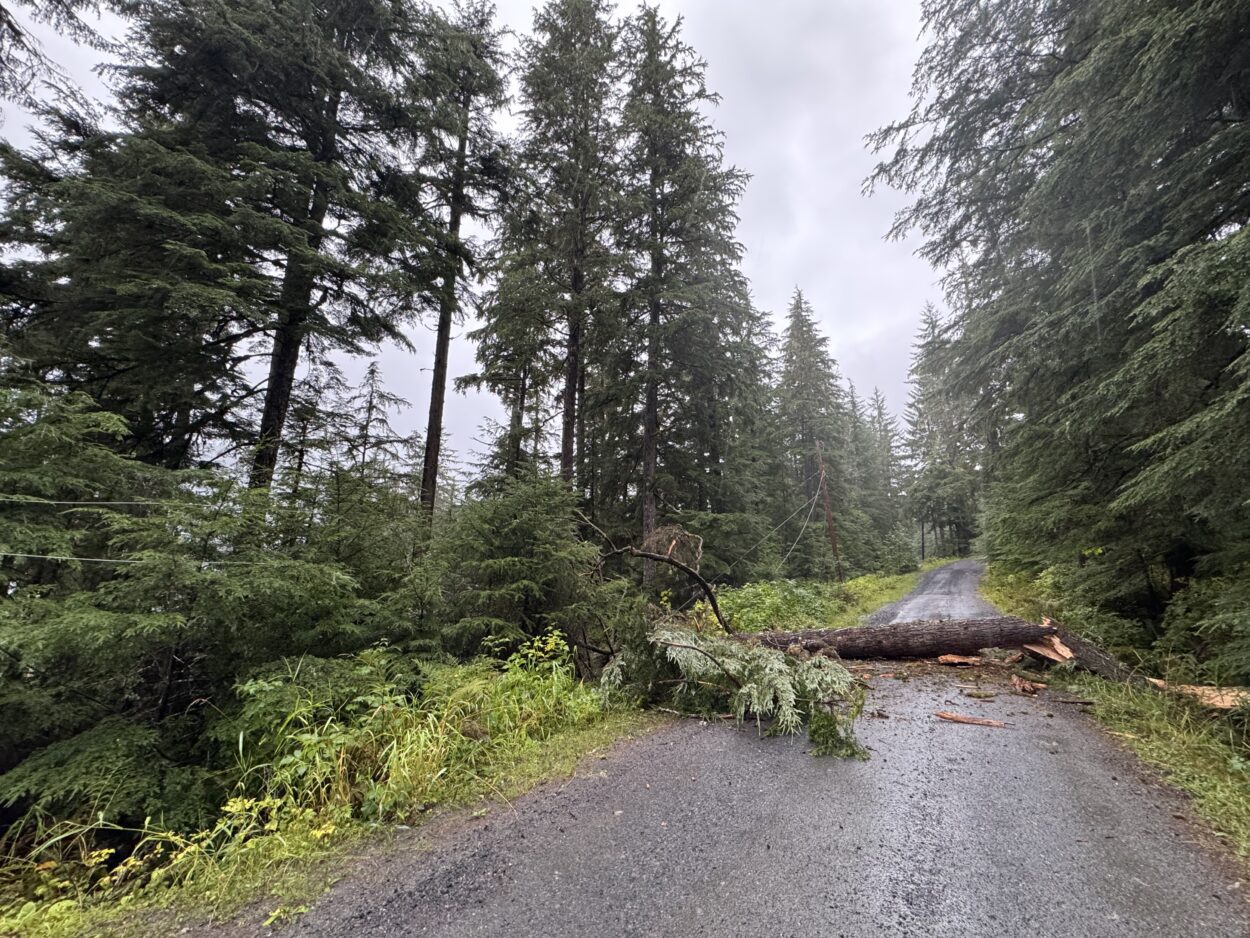
Communities in Southeast Alaska braced for hurricane-force winds forecasted to sweep the region on Sept. 26. While much of the Panhandle avoided catastrophic damage, residents are still cleaning up the mess.
In Petersburg, the National Weather Service observed wind speeds of nearly 50 mph during the storm. While not quite hurricane-force winds, the gusts still packed a punch in the town of 3,400.
Petersburg resident, Jenn Hess, lives about nine miles south of town in a waterfront home. She said the Wrangell Narrows looked unusually rough while the storm rolled through that afternoon, with wind gusts blowing mist from whitecaps and rolling waves crashing onto the beach.
“It turned the Narrows into … something I’ve never seen before, how rough it was,” she said. “It was crazy.”
She described feeling like “a sitting duck” during the storm, watching several trees fall around her road.
The power went out in the small neighborhood for several hours because trees hit a transformer, collapsed on overhead wires and brought down the power supply. This isolated power outage was the only one to happen that day in Petersburg. Utility Director Karl Hagerman said the power department’s crew worked through heavy wind and rain for five to six hours to restore power.
“Those guys did a fantastic job in absolutely miserable conditions,” Hagerman said.
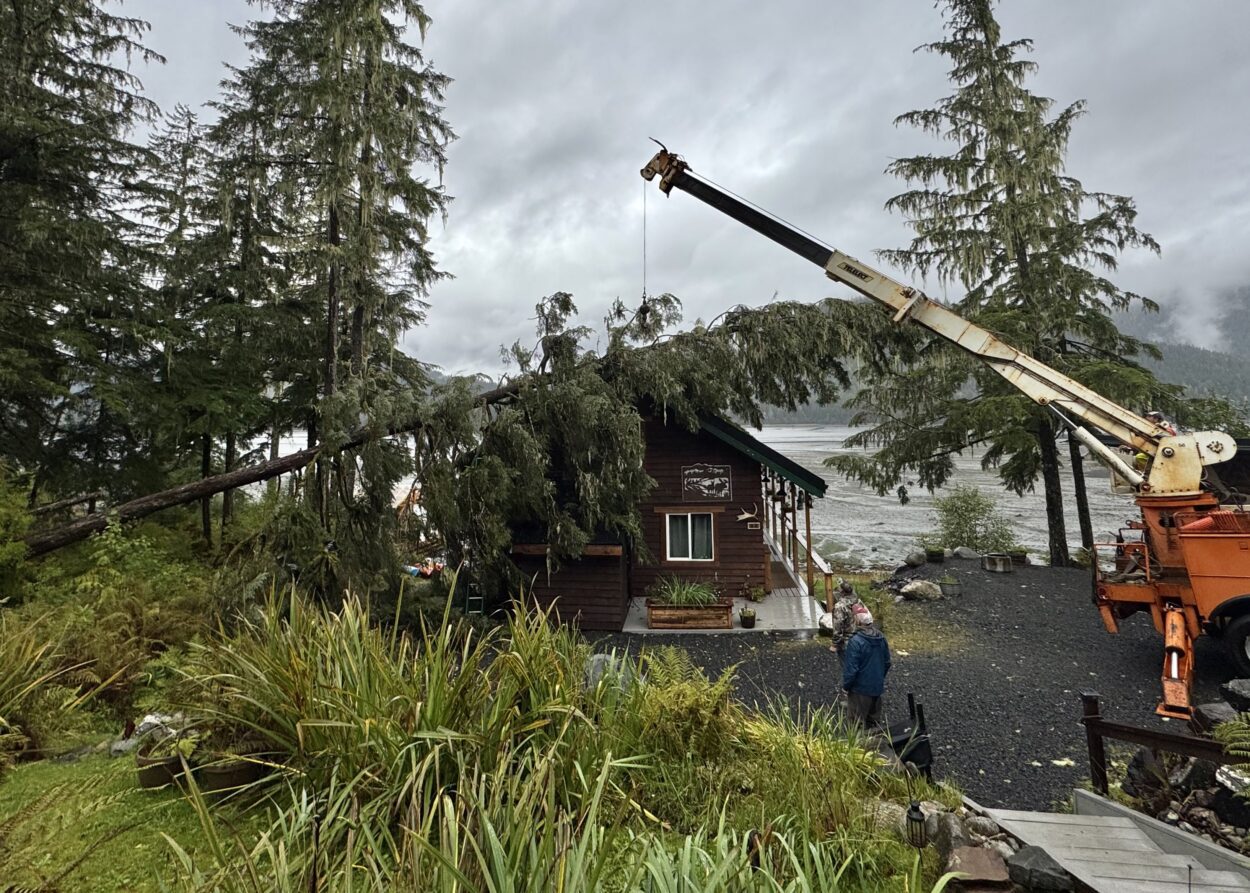
Hess’ husband, who works for the borough’s power department, was down the street working to fix the outage when a wind gust uprooted a tree by their home around 8 p.m.
From inside, Hess heard cracking as the tree let loose from the ground.
“Let’s just say, it sounds like the world was ending,” she said with a laugh.
Their home rocked on its pilings.
“It shook the house very violently. Stuff fell off the walls. And so I ran outside to look and see what had happened, and that’s when I saw the big tree on the house. It was about two feet wide,” she explained. “One of the branches, you know, pretty much harpooned the roof and put a big hole in it.”
Fortunately, the tree fell in between two rafters, so it didn’t do a lot of damage — but they did have to patch up a 6-inch hole in the roof. She said the power turned back on about 15 minutes after the tree came down, and the winds diminished in the next hour or so. Their neighbors used a crane to help remove the tree when the storm passed.
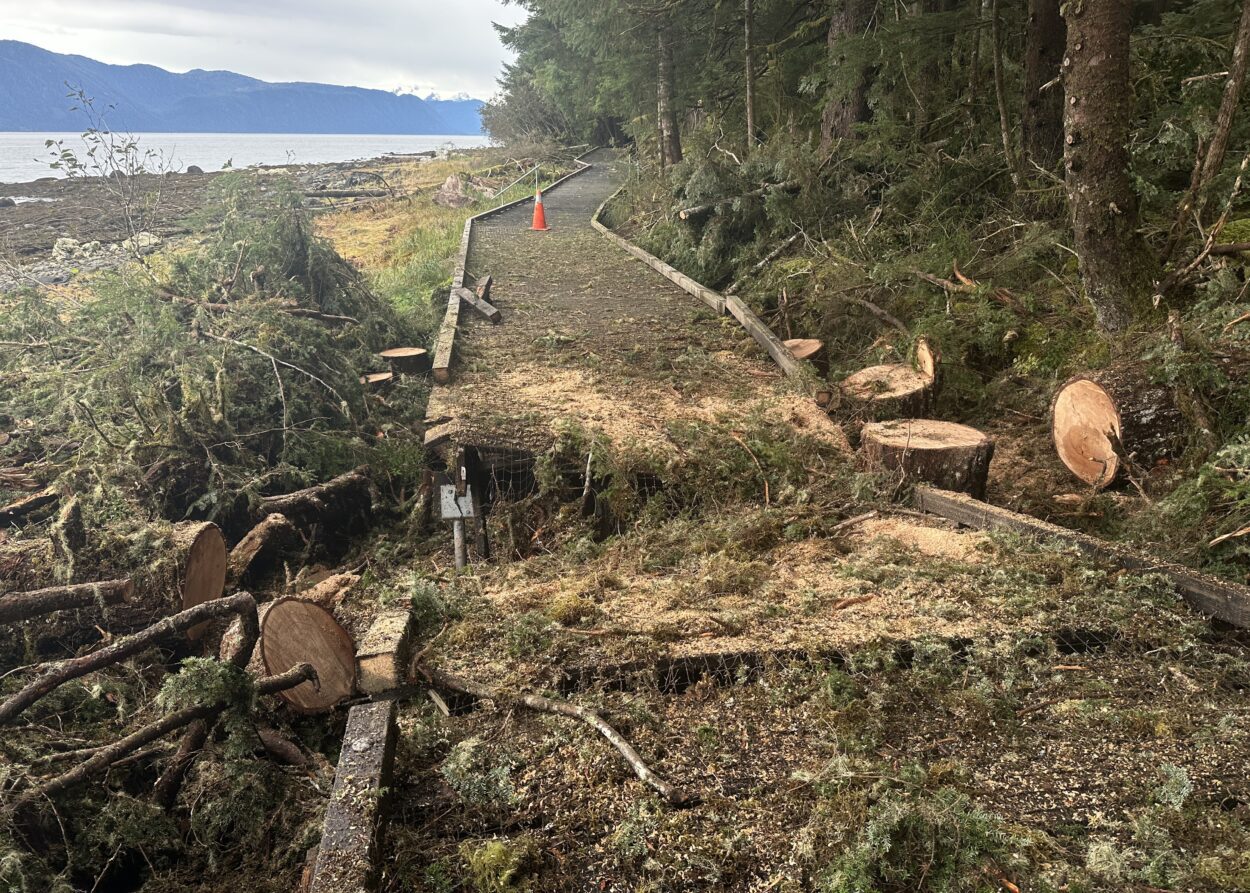
The next day, residents recreating on City Creek trail by Sandy Beach found a cluster of fallen trees had smashed into a part of the waterfront boardwalk, severely damaging it.
Petersburg Indian Association staff, who maintain the trail, cleared the trees off the boardwalk. However, the section is closed while repairs are done, and signage is redirecting recreationists around the damaged section using the old trail. This boardwalk extension was part of a substantial upgrade to the trail completed last year.
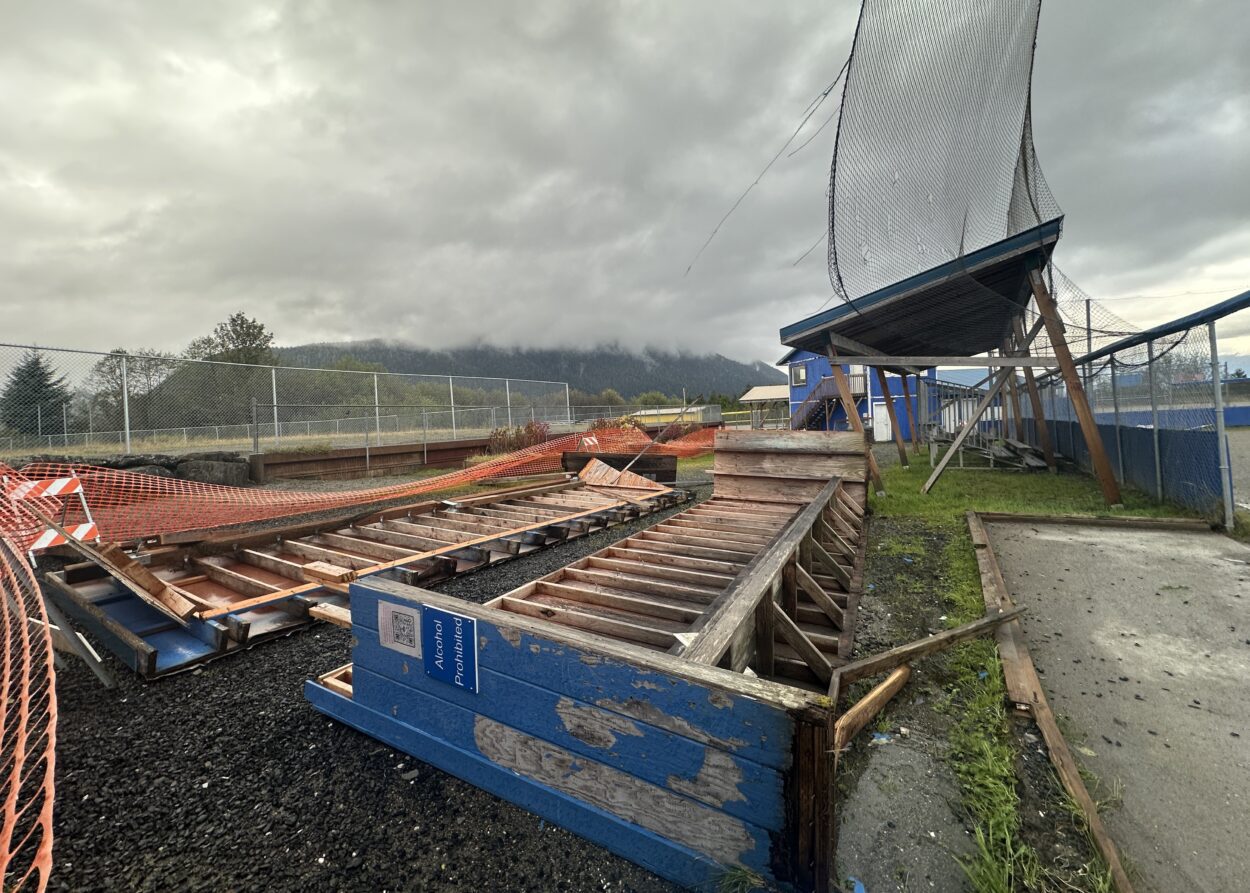
Uphill at the town’s borough-owned ballfield, the wind caused a dugout to completely collapse. And the structure next to it is leaning significantly. Access to the area has been taped off. The borough and partners involved at the ballfield have yet to sort out how the damage will be addressed.
Borough Manager Steve Giesbrecht said the structure was old and “has been on our list for a long time to replace.” However, he added, “I just don’t think we have the money budgeted for replacement.”
He did not have a cost estimate for the repairs yet; Giesbrecht expects the issue will eventually go before the Petersburg Borough Assembly.
Stephanie Payne works for the Parks and Recreation department. Although it’s not baseball season, she stressed that repairs should start before winter comes and the ground freezes.
“Goodness knows, this may not be our last storm this winter,” said Payne. “So I kind of feel like it’s something that might need to start to happen soon — sooner than later.”
Although “the jury is still out on what needs to be done,” she said the Petersburg community has a knack for helping out in times of need.
“People will jump in on that kind of stuff,” she said. “The ball field’s important.”
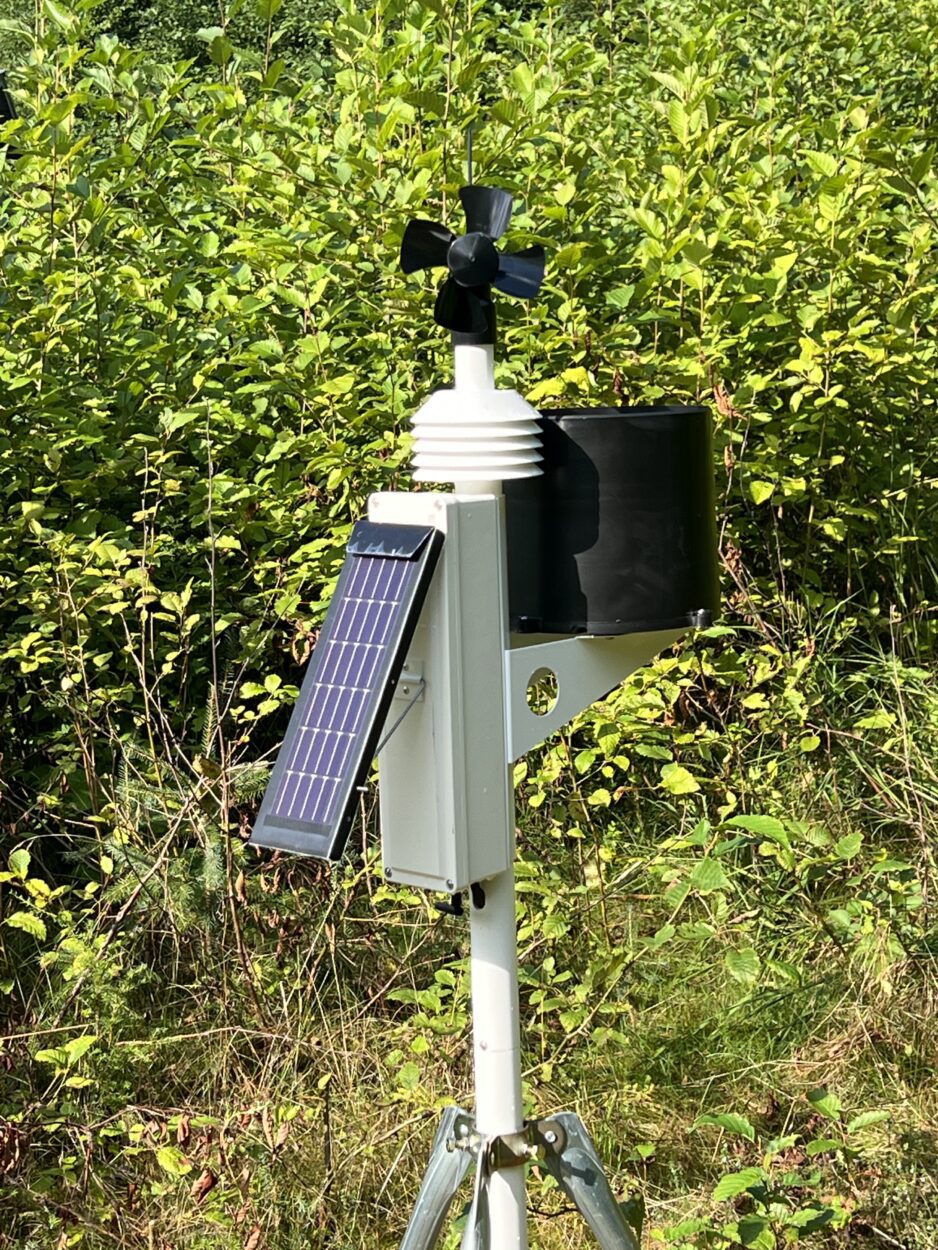
The weather service’s wind sensor at Petersburg’s airport detected a 30 mph gust around 3 p.m. — which was when the dugout collapsed.
Greg Spann is a meteorologist with the National Weather Service in Juneau. He explained that the sensor’s uphill location is fairly sheltered from the wind, while much of the town is not.
“That 30 mile-per-hour wind gust at the airport should not be discounted, because that’s a pretty good indicator that Petersburg itself and areas around it were experiencing some extremely impressive wind speeds,” said Spann. “And when your most protected locations you have are blowing like there’s no tomorrow, that’s usually a bad sign for everyone else.”
He noted other parts of the Panhandle had wind gusts in excess of 70 mph, and gusts above 60 mph on Prince of Wales Island.
On the western side of the island, in Klawock, the city’s water treatment plant was hit by lightning during the storm. That knocked its automated system offline, which has left staff manually adjusting and backwashing the water. The city is working to resolve the issue with Anchorage-based Alaska Native Tribal Health Consortium. City staff told KRBD that they don’t expect the issue to impact residents, and they’re waiting for parts to be shipped from Anchorage to resolve the issue; as of Oct. 1, the system was still offline.
Residents in Craig and Hydaburg say the storm didn’t cause any significant damage. But it was different further north.
Port Protection and Point Baker are small, neighboring communities located on the northern tip of the island where big bodies of water converge near Sumner Strait. Residents were bracing for sustained winds up to 50 mph.
Ben Houdek lives in Port Protection. He said the surge was building all day, with big gusts of wind every 10 minutes or so, and the tide coming up higher than it should be. Through the rain on his windows, he could see whitecaps all around in the bay, trees whipping around and boats pulling hard on their lines.
“It’s intense. It’s a disconcerting feeling when they pound,” Houdek said. “And it’s also kind of cool. I mean, it’s exciting, and it’s cool to sit, sip your coffee by the wood stove at the window and feel like you’re having an adventure just watching the wind blow and the waves crash … but still on edge, sitting in your living room with your Xtra Tufs on, ready to run outside and deal with whatever might come down in the storm.”
He said, “Hopefully we just get to watch the waves crash and then it dissipates, and call our neighbors and make sure everybody’s house is fine.”
The next morning, he shared that a neighbor’s private dock ramp was destroyed, but besides numerous trees and branch debris scattered everywhere, he hadn’t heard of any major damage otherwise.
Don Hernandez has lived in Point Baker for 40 years. He said this storm was one of the strongest he’s experienced.
“I think that this is probably some of the highest seas I’ve ever seen out there in Sumner Strait,” he said, estimating the seas were about 12 feet. “It was very impressive to watch.”
A spruce tree he’s watched grow for decades out on the rocks by a tall concrete navigation marker, called West Rock, got swept away in the high seas. He said the marker is “probably 20 feet tall” and the waves were “going clean over it.”
“It’s been there ever since we’ve been here. Now it’s gone,” he said of the lost spruce. “Things like that kind of tell you that, yeah, this has got to be one of the worst ones, because that tree survived a heck of a lot of storms over the years, but didn’t survive this one.”
He said numerous trees fell in the storm throughout the area; people using the road to Craig cleared a path through —and under— down trees; his son’s truck parked at the old Labouchere Bay logging camp got smashed. Hernandez said no serious damage was dealt to buildings. Overall, just messes to clean and hazardous trees to deal with.
On his property, about 15 trees or more have come down just in the last few years from storms. He noted dead-standing hemlock trees from previous sawfly infestation are rotting and coming down more regularly.
“You just look up at the tree canopy here, and there’s just all kinds of holes in the sky where, you know, the big hemlocks are dead, and the branches start dropping, and then the trees break off, and the storms … it’s been a real, real impact to our little forest around here, around our houses,” Hernandez said. “A lot of people have been taking trees down, you know, over the last several years because they’re getting real dangerous. And ones that haven’t been taken down are now blowing down, and then when a good number of trees come down … that exposes the living trees to more wind, and they’re starting to blow down. So, yeah, it’s getting to be kind of a hazardous situation around here.”
Hernandez said the storms seem to be getting more intense in recent years.
“You know, 40 years that I’ve lived here, you’d expect … a certain number of storms during the fall. It seems like you always get a bad one. But, I mean, we’ve had two major blows here in the last two weeks, and it’s only September. That’s kind of not normal.”
Houdek in Port Protection also said it’s strange to have such an intense storm in September. And the Weather Service agrees.
“This system is definitely not typical for this time of year or just in general for this area … this is a lot stronger than what we would typically see,” staff said in a livestream update during the storm.
Back in Petersburg, a similar storm four years ago resulted in power outages, closed roads and other property damage, including the Hess’ shed. Borough Manager Giesbrecht said this storm “could’ve been a lot worse.”
“We got through it pretty well,” said Giesbrecht. “We were expecting a whole lot more damage, and [it] really didn’t happen. So, I mean, there’s some things, but nothing major.”
Utility Director Hagerman said power department crew removed some smaller trees that were leaning near powerlines to mitigate damage in the storm.
“This could have been much, much worse, with, you know, widespread outages for lots of people,” he said.
Other than the isolated outage around the Hess’s home, he said utilities were largely unaffected.
No major issues happened dockside, according to the harbormaster’s office.
The Red Cross has resources available for damage assessments, temporary shelter needs, and insurance advice. If your property or home was damaged in the storm, the Red Cross can be reached by calling 800-733-2767.
KRBD’s Hunter Morrison contributed to this story.