Initial survey results from Petersburg’s ninth annual Project Connect resource fair estimate that more people are experiencing homelessness in Petersburg than identified in previous years, organizers say.
Local nonprofit Humanity in Progress (HIP) put together the event in Petersburg in partnership with other local organizations and volunteers.
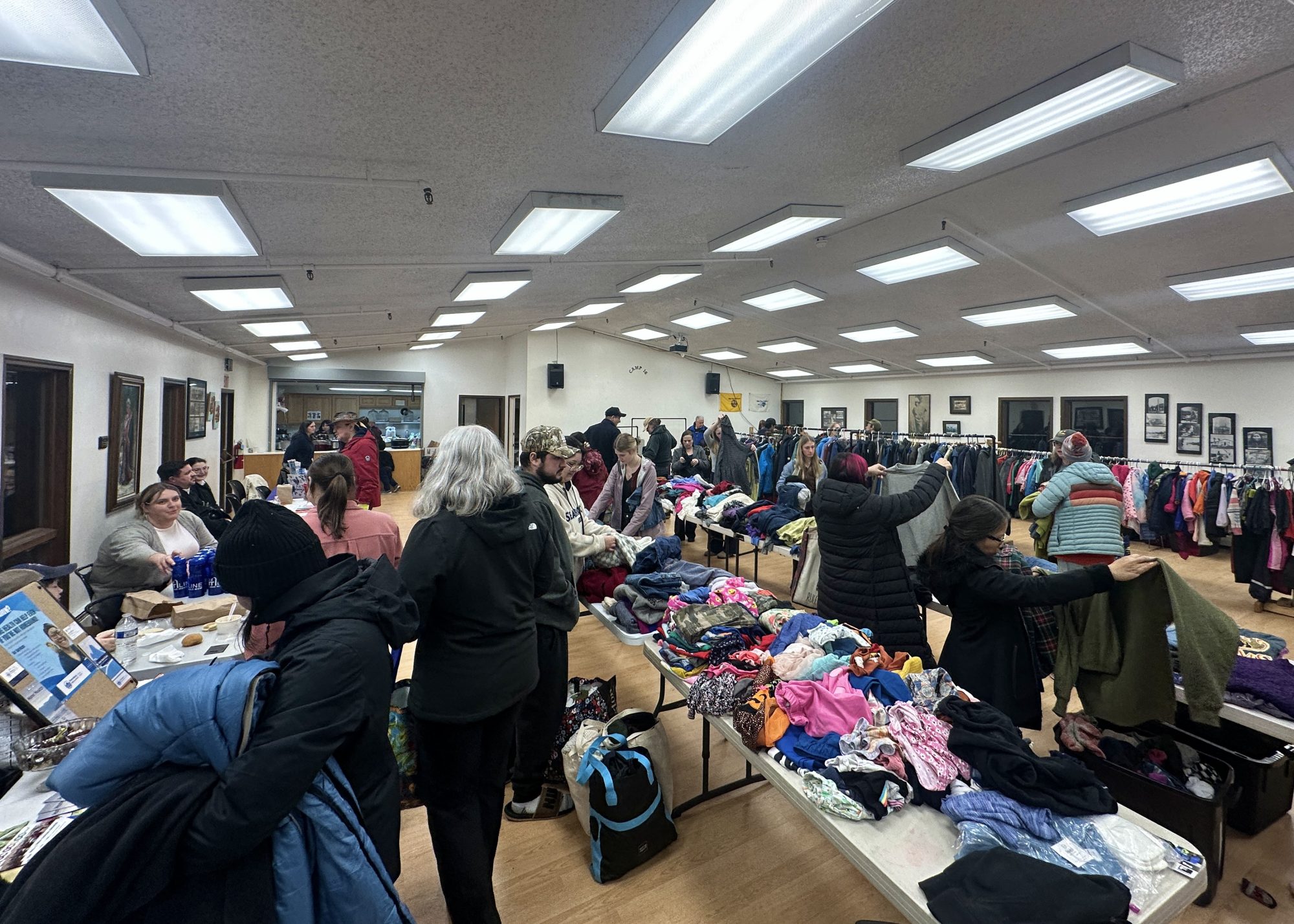
Project Connect aims to serve anyone experiencing housing insecurity by providing access to resources. People could take home free clothing, camping gear, hygiene items, and a hot meal. Several local organizations were there to help as well, offering assistance with things from vouchers to flu shots.
In addition to connecting people with resources, Project Connect was an opportunity to hear from community members and record data about housing insecurity.
The number of people sleeping in places not meant for habitation was “quite a bit higher than what we’ve surveyed in the past,” HIP President Ashley Kawashima said after the event.
Participants took a survey about their housing situation that asked where they had slept the night before as part of a nationwide Point In Time count; results are shared with the U.S. Department of Housing and Urban Development. The data helps measure the extent of homelessness in Alaska, and can be used to request federal and state funding for projects like building low-income housing in a given community.
Of the 165 people who attended this year, 50 took the survey, and roughly half reported staying in a place not meant for habitation or were couch surfing the previous night. But Kawashima explained that’s just an initial estimate; organizers are still reviewing the data. She also noted it doesn’t account for people who could not attend Project Connect that day.
“We do know that number is higher,” she said.
In an interview with KFSK, Kawashima said the information collected over just a few hours provides a snapshot of what’s going on in the community, and highlights the present need.
Listen here:
This transcript has been edited for clarity.
KAWASHIMA: What we’re asking specifically is, “where did you sleep the night before?” And kind of just getting, you know, some feedback from them also on what their needs are.
KFSK: It was a total of 165 people attended this year.
KAWASHIMA: Yeah. So we had 165 participants. At first glance, though, we had about 50 people who did the actual survey, and of those, over half of them identified that they were either currently experiencing homelessness and staying in a place not meant for habitation or couch surfing, or in the last three years they had experienced at least one event of homelessness. There was about 21 to 23 people, I believe, of those 50 that identified that the previous night they had stayed in a place not meant for habitation or were couch surfing.
KFSK: Okay. So over 20 folks in Petersburg are currently experiencing homelessness.
KAWASHIMA: Yeah, and that’s just a snapshot of people we were able to get one day in one four hour period. And that does not give the full picture. There were definitely participants that weren’t able to make it, that we know are experiencing homelessness currently. So we do know that number is higher.
KFSK: What do we do with this head count of people in Petersburg? Do we send the information somewhere?
KAWASHIMA: Yeah, so we input the data into the HUD [U.S. Department of Housing and Urban Development] database, which is shared state and federally. It’s used for a lot of different things. I think the main focus of what we try and use it for is just educational purposes — to help educate the community that there is housing insecurity and homelessness occurring in our community. And that the reason that we’re trying to expand resources and increase housing options and things like that, is because there are people facing this problem. It’s just really tough for us to only have a tent to offer people. At HIP, we don’t have emergency sheltering options and things like that to tell to people. So a lot of times we’re just giving them a tent and a tarp. And so by collecting this data, we’re hoping to just continue moving forward with what we need to do to get everyone housed.
KFSK: What kind of takeaway does this give the Petersburg community? Why do you think this is important for Petersburg to do every year?
KAWASHIMA: Well, so for example, this year’s numbers of people sleeping in places not meant for habitation is quite a bit higher than what we’ve surveyed in the past. And I think that there is a large population of people that are willing to have conversations about the cost of living going up, and how that’s tough on people, and what that can look like. You know, the challenges of having to choose to pay rent or buy food for your family, things like that. But then I think by looking at these hard numbers of people that are actually sleeping outside, people that are actually, actively seeking housing options and not able to find them — some of these people have section eight vouchers, for example, but haven’t been able to find a place that qualifies for that because of the limited low income options — I’m just hoping that that information and data can help continue moving those conversations forward in a productive way.
KFSK: So it’s a lot of data gathering, of course, and also connecting people with resources.
KAWASHIMA: Yeah, so the survey is obviously really important. But the main reason that we do this event is to get people connected with resources. Not just clothing and hygiene and cleaning supplies, but also with other community organizations. It’s a big event, and it requires a lot of moving parts and a lot of volunteers. And so having all those partnerships and having all of our participants see how many people in the community really do care about finding productive solutions and providing resources is really great.
But I think, again, with this data and having these conversations, our goal is that the conversation doesn’t stop here. We obviously don’t have all of the solutions and answers, but there’s lots of people in the community who want to help and who have good ideas, who we know we haven’t heard from. And so we really would love to hear those voices too.