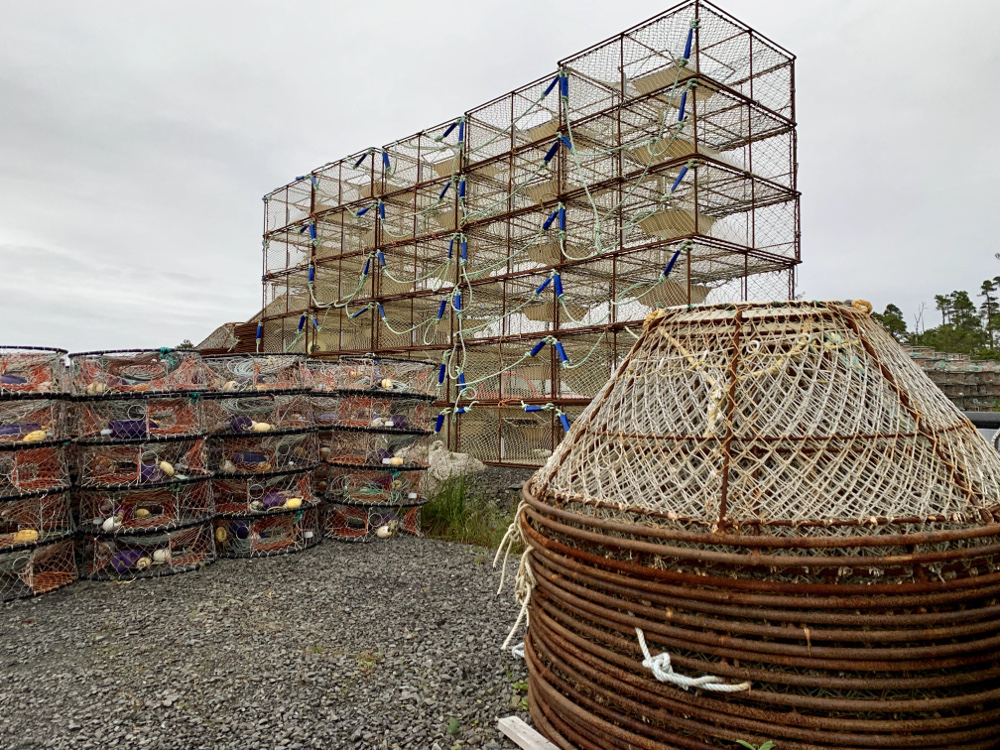
Red king crab fishermen in Southeast Alaska are getting a competitive commercial fishery this year — the first since 2017.
Red king crab is a low-volume, high-value fishery. The crab can bring in over $100 each. But commercial openings have been few and far between with just one in over a decade.
State regulations require at least 200,000 pounds of harvestable crab to be available for a commercial opener in the region. That minimum was set decades ago, when the crab was less valuable and the industry required higher volumes to make money.
For years, stock estimates have repeatedly fallen short of that threshold. But not this year. Instead, managers announced on Sept. 2 that over 211,000 pounds of crab will be available for harvest.
That estimate comes from surveys done by the Alaska Department of Fish and Game (ADFG), which checks crab stock in several bays to see if there’s enough to allow a competitive commercial opener.
“Even for some of our survey areas, we set more conservative harvest rates for a couple of our areas than we have in the past, and we still reached that 200,000 pounds,” said Adam Messmer, a regional shellfish biologist for Fish and Game.
He said they were preparing for a smaller commercial fishery, with new regulation changes that the state Board of Fisheries approved earlier this year. The smaller opener, which hasn’t been done before, is triggered when stock estimates arrive around roughly 120,000 pounds. But when ADFG surveyed the bays, they found enough crab had grown to actually allow for a competitive opener.
“I knew when we went out on the last survey that we needed at least two of the three bays that we surveyed that trip to be good,” Messmer said. “And we had one that was exceptional and showed a lot of promise for the future, and then the next bay was just as good.”
Messmer said the legal-sized crab were the highest they’ve been since 2003, and the mature crab were the highest since 1997; having significantly more legal-sized and mature crab in the water right now indicates the fishery is ripe for a commercial opener.
Compared to doing a smaller conservative fishery, where permit holders would get assigned individual catch limits (ICL), he said this competitive opener allows more crab to be caught.
“The ICL … it would produce an opportunity, but at a lot lower harvest,” said Messmer. “So even when we hit the trigger for the ICL, that’s not the amount that they’re actually going to get to catch. It’s actually reduced by quite a bit to be conservative … So you’re talking catching 65 to 70,000 pounds of crab compared to 200,000 pounds of crab.”
Messmer said this year’s red king crab fishery will be managed bay by bay. Some areas will stay closed. Some will have predetermined time allowances. Others will be managed in-season, with call-ins requiring fishermen to report their daily harvest to managers, similar to the golden king crab fishery.
He said the department will announce more information about the upcoming fishery, like which areas will be open and when, within the next couple of weeks.
The 211,573-pound harvest limit only accounts for the areas that will be open. The commercial fishery will open at noon on Saturday, Nov. 1.