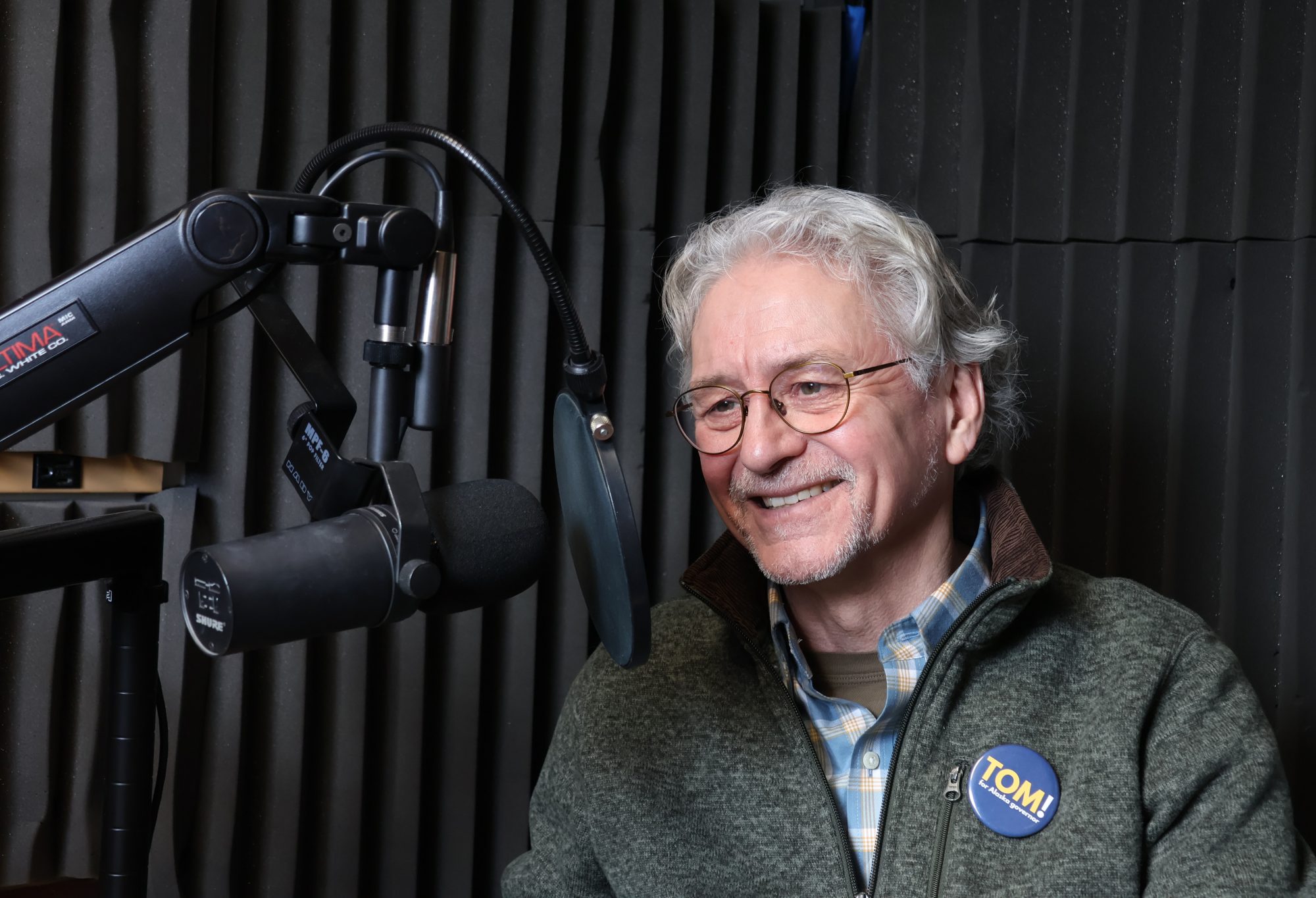
Former Anchorage State Sen. Tom Begich visited Petersburg on March 23 as part of his campaign to be Alaska’s next governor. He’s a Democrat, and the uncle to Alaska Congressman Nick Begich III, who is a Republican.
Tom Begich sat down with KFSK’s Taylor Heckart to talk about why he’s running. He started by addressing his plan for state revenue.
Listen to the short version here:
Listen to the long version here:
This interview has been lightly edited for clarity.
Tom Begich: The first thing is, I just want to touch on the influx of funds that’s going to come — whether it does or doesn’t fully come — from the war in Iran. That’s one time money. We’ve jumped from one time money to one time money. That’s not a fiscal plan, that’s one time money, and the best use of one time money is to set it aside and invest it for the future.
So putting that piece aside, I’ve been talking about a revenue plan that, in large part, has now been adopted by the State Senate Resources Committee. They’ve basically taken the governor’s revenue plan, removed it, put this plan in.
It starts with the internet fee that was voted by a bipartisan majority in the House and the Senate, and the Governor vetoed it, and the legislature was not able to override him in January. That will represent about $35 million annually coming from multinational or national corporations. It doesn’t come out of your pocket or mine, it’s $35 million, regular recurring revenue.
The second thing I talk about is a company called Hilcorp, that is what’s called an S-corp. We don’t require them to pay our corporate income tax. But all oil companies do pay that corporate income tax, except Hilcorp. When they purchased the properties and the operations of British Petroleum, they literally took $100 million out of our recurring income because they don’t pay corporate income tax. They’re the only oil company that doesn’t. I would basically block that exception, so that no other company can do that. That corporate income tax is a fair tax for what is our primary natural resource. So let’s collect that — what the Senate Resources Committee now says could be as high as $150 million in recurring income annually — not one time money.
So that’s 100 to 150 plus 35, that’s at least $185 million we’ve left on the table.
The third source of income is to take the oil and gas tax credits for Prudhoe, Alpine and Kuparuk, our legacy fields in Prudhoe Bay. They’re at eight dollars a barrel, the Senate Resources Committee says lower at five, I say lower it to zero. If you did that, I believe you’d raise at least $200 to 250 million, by most estimates. The Senate Resources Committee says double that, so they’re saying $400 to 450 million. But if you just take my more conservative number, you’re getting very close to half-a-billion dollars we’ve left on the table.
In terms of how we look at revenue, the first thing we have to do is get these three fairly easy-to-get revenue sources back into our revenue stream where they belong. And so that’s my primary budget plan.
Taylor Heckart: And speaking to this idea of taxes, you brought up quite a few different tax things. One thing I’m really curious about, this year the governor introduced some bills that would implement a state sales tax. Are you interested in any sales taxes or income taxes?
Tom Begich: No, let me go back to your first statement — I’m not talking about new taxes with any of these, these are existing taxes that people aren’t paying their fair share of. I want to be very clear about that. We should collect those taxes from the companies that operate here, that do not live here, they should be paying a fair share of taxes. Hilcorp’s based in Texas, all those other majors are not based in Alaska, they have offices here. And the internet companies aren’t based here either.
So I want to be really clear that that’s $400-plus-million that non-Alaskans should be paying in taxes to Alaska.
No, the sales tax is a non-starter issue. That’s why the Senate Resources Committee stripped that out of that revenue bill, because it doesn’t make sense. Here, if that tax happened, you’d be paying 10% in sales tax. That simply doesn’t make sense. It doesn’t make sense for Alaskans. It doesn’t make sense for people in Petersburg. It doesn’t really make sense for anyone. The sales tax is the wrong way for the state to go.
I won’t entertain an income tax until we’ve collected our fair share from the oil industry. They pit us against each other on that matter, and I’m tired of it. Those companies have to pay their fair share before we even walk down that road. If we do walk down that road, I’m more than open to that conversation, but I’m not going to do it before the oil industry pays their fair share.
You know, there’s 17 candidates in this race, all of us should be standing up to ensure Alaskans are getting their fair share from that industry. They have gotten more than their fair share from us for the last 40 years.
Look, 24% of Alaska’s workforce doesn’t live here, but they use our facilities. They use our state. They basically should be paying their fair share, and if they’re not going to, the companies that employ them ought to.
You know, some of these companies will say, ‘Well, I gave you $100,000 for the arts this year.’ Really? $100,000 is a pretty good return on investment when they’re pulling down billions. That is a small amount to give us back. And that, to me, is just the wrong approach here.
I am more than open to working with our oil and gas industry, but there is no safer place for them to be developing their products, to be producing their products, and to be exporting their products from, than the state of Alaska today. Right now, the most volatile regions in the country, in the world, are all areas where we have oil and gas producing nations. They’re all embroiled in conflict. We are not. This is exactly the time for us to negotiate a better deal with an industry that relies on us for stability.
Taylor Heckart: I’d love to move on to the topic of education. In Petersburg, and I’m sure in many other communities, we really really care about our school district. Like many districts in the state, when I talk to school administrators, they say if we don’t see an increase in state funding, we’re gonna have to start making really challenging decisions. So if you were to become governor, how do you propose the state’s able to fund schools while also giving districts certainty and stability?
Tom Begich: That’s a perfect question, because it follows right on the revenue question. The first thing is to disregard the lie that we don’t have the revenue to do this. I just laid out for you that we do.
In fact, that increase to the base student allocation that occurred last year that required a super majority to override was literally all about the fact that we could afford to do it. And that was $185 million in state funds, that’s what that represented. And so I’ve told you already that there are probably $400-plus-million out there that we should be collecting annually. We certainly could cover a full — and should cover a full — funding of education.
As part of that, we should also forward fund education, and there’s two ways you can do that. Statutorily, we should be dealing with the education budget separately from the operating budget. We should be dealing with it in the first, I think, 60 or 90 days of the legislature. We could do that by statute. If we did that, you’d take that piece off the table, now you’re not pink slipping teachers. You’re not giving school districts two weeks to come up with a comprehensive plan, because that’s when they find out what their budget number is before their fiscal year starts.
I’ve heard this complaint all the time, ‘Oh, school districts aren’t accountable.’ They’re not accountable because we don’t give them their money until two weeks before their budget’s due! That is not planning, that is not what I do at home, and it’s certainly not what any business does. They look at their year, they look at their projections, they look at what they know is coming in, and they base their budget on that. Our obligation is to ensure school districts have time so they can not just plan, but prepare, for any eventuality that might be coming.
Full funding, forward funding, ensuring that that is happening at the earliest time in the process, ensuring teachers have a defined benefit, so that when a teacher reaches their fifth year, instead of looking at the other 49 states that offer them a pension plan and leaving at the height of their skill, they decide to stay in Alaska because they can. If you do these things, you stabilize funding, you allow for a district to know when it’s coming, you ensure that it’s fully funded, so you don’t have arguments about, ‘Okay, what am I going to give up this year?’
You can’t argue with declining populations, that happens everywhere, but to not fully fund a school district is outrageous.
Taylor Heckart: So what I’m hearing from you, then, is in addition to funding, it’s also a matter of giving them time and incentivizing teachers to stay?
Tom Begich: That’s correct. You have to do both. It’s funding fully, it’s ensuring that funding comes early for planning purposes, and ensuring your workforce is stable. These three things mean that there’s stability in a kid’s life, parents don’t worry, and school districts have surety and knowledge of what the future brings.
But you also have to do good public policy as well, because you got to prove outcomes. We all know that. So it’s kind of like Maslow’s Hierarchy, right? You eliminate the basic needs piece, which is the funding piece, and then you get to focus on a higher quality.
Taylor Heckart: Moving on. The Alaska Marine Highway System is also a super big part of life, not just in Petersburg, but also in Southeast and coastal Alaska. But that system has an aging fleet, we have a shortage of certified staff to run those ferries, and we know the public isn’t happy. We’ve seen this through state funded surveys and through the AMHOB, which is the statewide Alaska Marine Highway Operations Board. As Governor, what is the path forward for the Alaska Marine Highway System?
Tom Begich: For too long the Marine Highway System has operated at the whim of every governor who’s come through. Everyone has a new idea of what a vessel should look like, even though they don’t actually operate vessels themselves. Everyone has a new idea of what the system ought to look like. Some of them take it for granted, some of them say it’s a luxury, and none of them realize it’s actually part of a road. It is the road system for Highway 7. The road is made up of ferries and highways, and they’re all interconnected.
In Southcentral, I don’t pay a dime to go from Anchorage to Palmer, but you do. You have the only toll road in all of Alaska, and pretty much the only one on the West Coast. This is the Alaska Marine Highway system, it stretches from Dutch Harbor all the way down to Ketchikan.
And understand this about that system: it should be separate, in its own authority, that has bonding capacity. It should have the ability to forward fund and plan, because they have bonding authority they could do that. It should be operated by a board made up of those chosen from the coastal communities with which it serves, instead of political appointees.
And they should operate under plans like the one the task force came up with in September, which laid out a 10-year-plan for replacement and repair of vessels. That was superb, but you can’t see that plan now, because [the] Department of Transportation hid it because they didn’t like the findings on Cascade Point.
So when we do invest in the ferry, we should do so with the needs to serve Alaskans first, not some company that may or may not build a mine for an out-of-state multinational that may or may not need to use a port facility that we would then fully fund. Why are we doing that? It’s a private company, if the product’s so good, pay for the thing yourselves. Our job is to facilitate your development, it’s not to pay for it.
Our job is to pay for things that serve the citizens of Alaska. I use the example of Kake, where I was told that the mammogram van didn’t make it in this year because that ferry got canceled. That means they don’t get to schedule one for another full year. Think about that for a minute. That means that no single woman in Kake will have the opportunity to find out in advance if they might have breast cancer. That makes it a life, health, safety issue.
If you do a ferry system that is in an authority, and then I’ve also proposed what’s called a general obligation bond, where it would be about an $850 million bond. I would take the first $200 million of that and I would use that to deal with the deferred maintenance for the ferry system that has been not just neglected but vetoed by the current governor to the point of at least $27 million in the last few years alone. I don’t know what the total amount is in his seven-and-a-half years. I can tell you $27 million in the last five. And the thing about that that’s so egregious, is that every time we don’t do that, the cost of repairing or replacing the vessel that is deteriorating ends up becoming so high that we can’t afford it. We have to go begging to the federal government to get more money for it.
And that brings up the last issue: when we build new vessels, they should be interchangeable. They should be able to dock at every port. We should be able to dock back at Prince Rupert and resolve and settle that piece. That alone would lower costs for groceries and building supplies in Southeast practically overnight, because it’s a railhead, which means you can get cheaper goods shipped in through Prince Rupert. That’s a dispute the governor should involve themselves in, they should resolve it, so we are once again docking at Prince Rupert. That is a mainstay of the ferry system.
I guess there is one last thing, and that is making sure schedules are not just maintained, but produced well in advance so that we can use the marine highway system in the summertime to encourage people to actually travel on it. That means also making the prices affordable, and stop thinking that the way you pay for the ferry system is ridership. There is no major ferry system in the world that does that. We do. We think that somehow the ridership will pay for the absolutely enormous costs of maintaining a highway. They certainly don’t think that in Southcentral, and they certainly don’t think that in the Interior, those folks don’t think for a minute that they have to pay to keep all their roads operating. That’s done with a combination of federal and state funds from gas taxes, etc. Why wouldn’t we think the same way about the ferry system? I do.
I just think it’s another one of our highways that needs to be maintained as such, but to do so through a separate authority will allow focus on the Marine Highway System, not as a stepchild to DOT (Department of Transportation), but as a standalone priority for coastal communities who would then have some authority directly over that system. That’s the way you fix the ferry system.