Sport anglers in Southeast Alaska can fish more Chinook (king) salmon this year than last year, with a daily bag limit of two fish for residents. Any wild king salmon harvested by sport anglers must be at least 28 inches in length.
The Alaska Department of Fish and Game this week announced updated sport fishing regulations for the region that went into effect April 1.
Jeff Rice, a state biologist for the Petersburg/Wrangell area, said the updated regulations in place for the fishery are “more beneficial” than last year.
“There’s more opportunity, and that’s due to the fact we believe there’s more fish around, and we’re hoping that that will be something that continues moving forward. So there is no negative news,” Rice said. “Everything’s either better or the same as it was last year … as far as what one’s allowed to catch.”
Resident sport anglers can harvest up to two wild king salmon a day. Last year, the daily bag limit was just one.
Meanwhile, nonresidents can harvest one per year. There is a brief window from now through June when they can harvest up to three king salmon in most Southeast waters; but otherwise, the nonresident annual limit is the same as last year — a single fish.
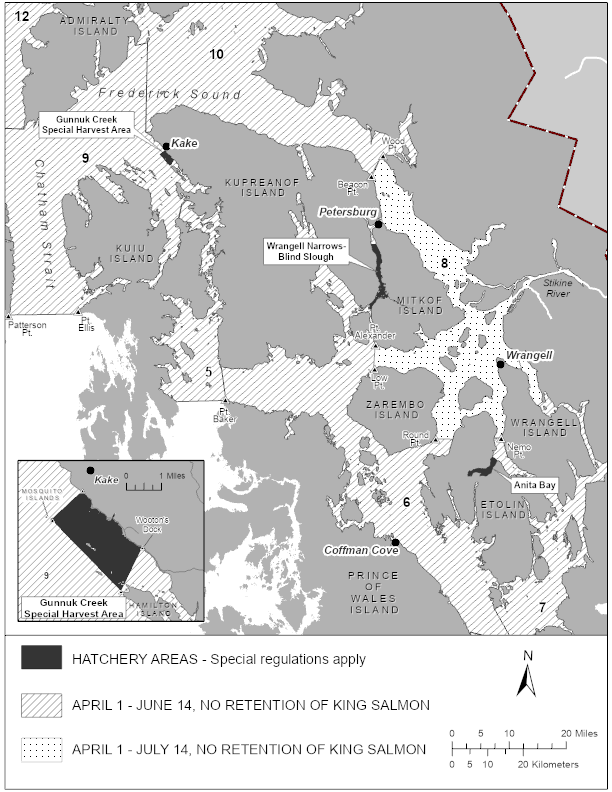
However, harvesting Chinook salmon in certain areas is currently prohibited until the summer for all sport anglers. They’ll need to wait until June 14 to harvest wild kings in most of the Petersburg management area. In waters by the Stikine River — around Wrangell and Petersburg, west of Mitkof Island — taking king salmon is prohibited until July 14.
Fish and Game also announced the amount of Chinook salmon allocated under the Pacific Salmon Treaty for this year, which plays into the updated sport fishing regulations.
The treaty is an agreement between the U.S. and Canada that ensures both countries get some fish. And anglers get a slice of that overall target.
Southeast’s sport fishing allocation, or how much fish the group is allowed to take, is 43,600 wild king salmon.
That’s more than last year, when the treaty allocation for all fisheries dropped by almost 40% from the year prior.
At the direction of the Alaska Board of Fisheries, and accounting for the allocation, the department prioritizes sport fishing opportunity for resident anglers over nonresidents.
“For nonresidents, we’re trying to give them as much as we can while always allowing a resident to go out and catch a king salmon,” said Rice.
Sometimes that leads to in-season closures. Last year’s restricted harvest brought managers to close the fishery to nonresidents for a few weeks.
But Rice said having more fish to work with this year shows promise.
“Hopefully that will benefit us … and everything works out so we can keep it open for everybody all the way through,” Rice said.
There are special regulations for hatchery areas — like the Wrangell Narrows/Blind Slough fishery, which opens May 15 — but hatchery fish are not part of the treaty allocation of Chinook salmon, so fish caught in those waters don’t count toward the bag limit for anglers.
Rice expects the department to announce specific hatchery regulations for fishing king salmon in the coming weeks.