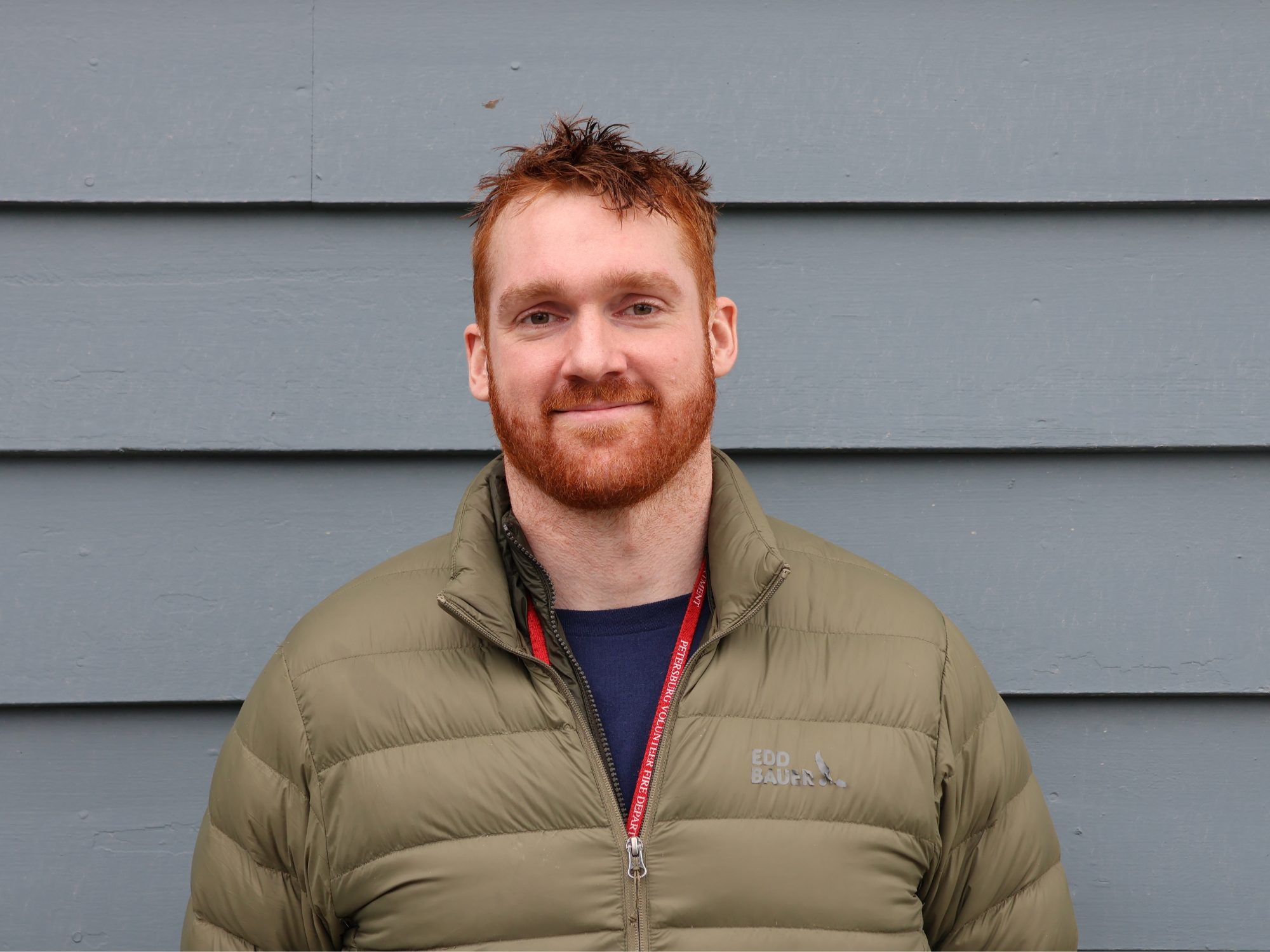
The Petersburg Volunteer Fire Department has a new full-time Emergency Services Coordinator. Ryan Gilkey, 35, is the department’s main contact for its EMS branch, responsible for a mix of administrative work, training and coordinating volunteers, and responding to emergencies.
Gilkey spent a decade working in business, then pivoted to work in emergency medicine following the COVID-19 pandemic. He spent about three years as an EMT in rural Washington before joining Petersburg’s fire department.
He moved to town in February with no prior experience living in Alaska, but Gilkey said he was excited about the nature and outdoor recreation opportunities that Southeast offers.
While he’s been in the role for several weeks, Gilkey told KFSK’s Taylor Heckart that he had a very memorable first day on the job.
Listen here:
TRANSCRIPT:
This transcript has been lightly edited for length and clarity.
Ryan Gilkey: My first day on the job in the fire department, we got a call during some storm, and it was because a cat got stuck in a tree. I thought they were pranking me, to be frank with you. That’s something you read in comic books, you know, “cat stuck in tree.” But we went and got a cat out of a tree.
Taylor Heckart: “We” as in, did you get to personally get the cat out of the tree? Or did you tell people to get the cat?
Ryan Gilkey: No, no, no, no, no. I got to hold the ladder, and the hero, [Emergency Services Director] Aaron Hankins, got to climb up the ladder and get the cat out of the tree.
Taylor Heckart: That’s a pretty high bar for your first day.
Ryan Gilkey: That’s right, it was a good welcome. I mean, this city has been very welcoming … it’s been a good experience so far. But that was also a very pleasant welcome to just be like, “Okay, I’m part of a small town fire department now,” you know, this is just part of it.
Taylor Heckart: Okay, so, just over a month in Petersburg. How has it been?
Ryan Gilkey: It’s been great. I spent a week in Juneau … but it’s been a lot of snow.
I’ve never had to shovel snow in my life. I realized that was like the distinction for me. I’ve lived in places where it snowed, and I’ve been in a lot of snow, but never have I been required to shovel snow to get out of places.
But I also learned the other day that apparently I got a little bit duped with the bugs here. I kind of got told that the wind keeps most of the bugs away. And then when I relayed that information yesterday, everyone gave me sideways glances and said, “I think you got lied to.”
Taylor Heckart: I think you got lied to too, I fear.
Ryan Gilkey: I’m looking forward to spending a lot of time outdoors. My stuff just got off the barge. I’ve still been moving in, but certainly the outdoors is what I would love to take advantage of shortly.
Taylor Heckart: And what are you looking forward to most with your role?
Ryan Gilkey: For its worth, and they deserve a massive shout out, some of the volunteers, they’ve been volunteering a lot of their time for a while. So they get huge kudos for having a pretty well-operating system already going.
What I came in and learned pretty quickly was I think the best way I can provide value is to just train at kind of a deeper level. There’s an old saying I like about what I would like our ambulances to be is: we’re not a transport agency, we’re a treatment agency. We are here. We can offer help. We can do things on-scene, if we have the time and it’s not critical. We’re not just here to drive you to the hospital, basically.
And so through training, hopefully we can do a lot more with that. But I would like to make those trainings basically more worthwhile. We’re going to start, hopefully, a course at the high school this fall or spring, and offer an EMT course there, and we’d be able to offer it to the community hybrid at the same time.
But basically, I’d like to go more in depth on like individual parts of Emergency Medicine. I think that would be very helpful. I’m finding out quickly that living here is kind of a different scene, and operating in an emergency medicine world here is a different world than where I come from.
Taylor Heckart: Very different from the lower 48.
Ryan Gilkey: Yeah.
Taylor Heckart: So what I’m hearing from you then is Petersburg’s got a great, strong base of knowledge, but you really want to dive deep into certain topics and help everyone understand that, and then also help with recruitment.
Ryan Gilkey: Hopefully provide a lot more opportunity for them to apply that knowledge. Like they seem to have it. But what I would like to do, one of the things I think would be exciting — and I’ve gotten requests from other people for — is community trainings, like a stop the bleed training. You know, we can reference specific things going on in the world right now that might make that more relevant than other times. But more or less, the concept of we should just have a consistent flow of opportunity to make our community more prepared.
So, any ideas people have, feel free to let us know, or let me know.