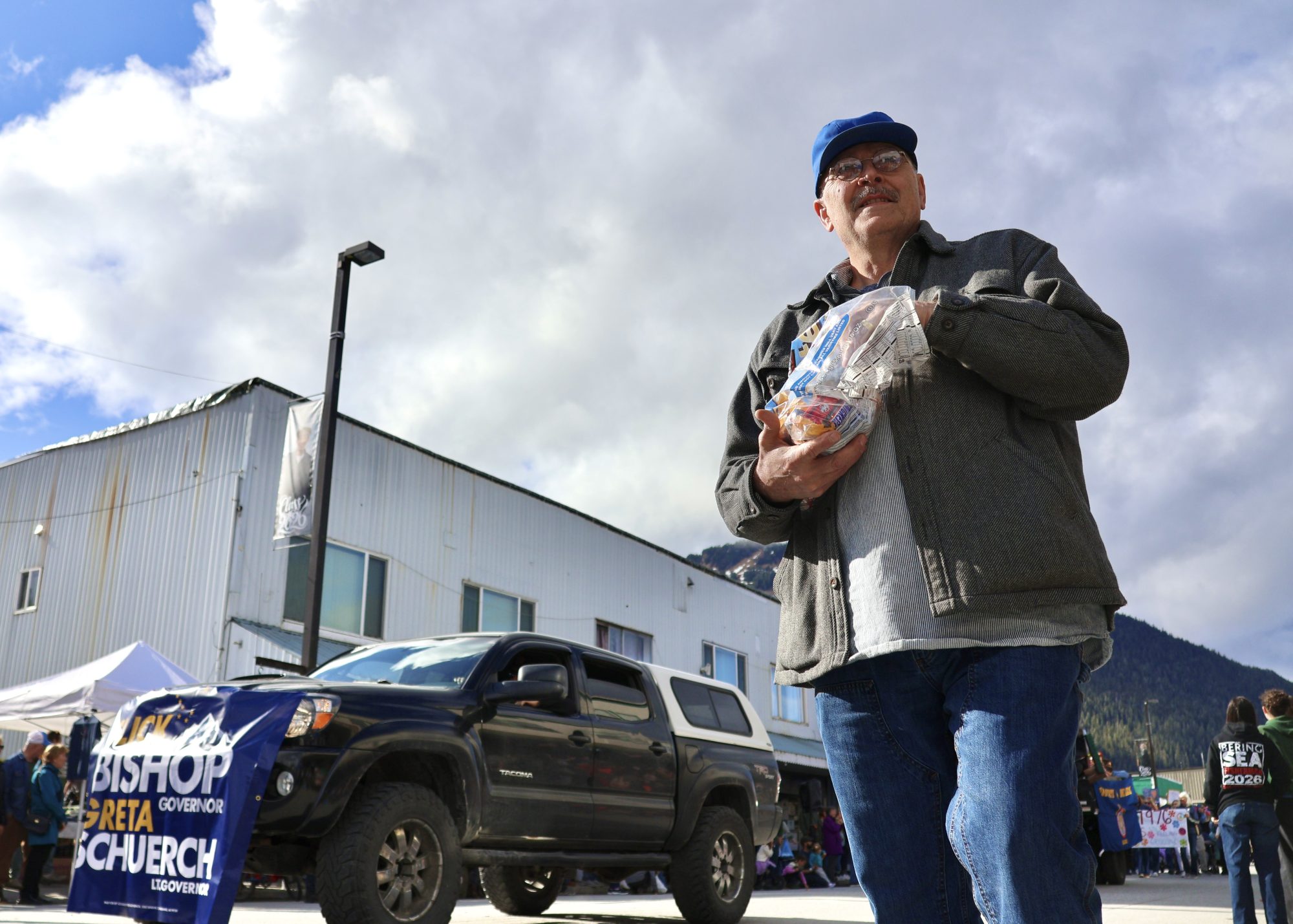
Republican gubernatorial candidate Click Bishop visited Petersburg last week to attend the community’s annual Little Norway Festival. Bishop is a former Fairbanks state senator, and served as Commissioner of the Department of Labor and Workforce Development from 2007 to 2012. While it wasn’t Bishop’s first time in Petersburg, it was his first time attending the celebration.
As the festivities ramped up outside, KFSK’s Taylor Heckart asked Bishop how he would stabilize the state’s budget and address declining revenue if he became governor.
Listen to the short version here:
Listen to the long version here:
This interview has been edited for clarity and brevity.
Click Bishop: For starters, I want to just frame the conversation on our platform: cheap energy, grow the economy, education funding, and fisheries.
But I’m going to tie your question in now to education funding, because it’s something that’s near and dear and important to all of us. You know, 13 years of outmigration of the wrong demographic moving out of the state, and my demographic’s the fastest growing. To be honest, we need to keep the young people at home. And a lot of people are moving anecdotally because of education funding, and we all know the debate around schools and school closures, etc.
But there’s a line in the [Alaska Department of Revenue] Revenue Sources Book, it’s called the Public School Trust Fund. You talked about the war with Iran — February 28 changed the world — and that Public School Trust Fund, a half a percent of rents and royalties off of oil and gas goes into that Public School Trust Fund, and there’s about not quite a billion [dollars] in there.
I want to raise that multiplier, and what that is yet, I don’t know. But theoretically, if you had another billion [dollars] in there, and you did a percent of market value draw, you could draw off about $50 million a year real comfortably, and not touch the corpus — not eat your seed corn, so to speak — and that would almost be like a BSA equivalent, adjusted for inflation every year.
The next thing is, you need to make sure you capture all the federal funds that you can capture. In the last two years — I won’t cast aspersions and blame the current administration — but they didn’t capture the Highway Working Capital Funds from federal highways. Contractors were in a bind, we had contractors for the first time in the interior that closed their shops for the winter.
You can’t leave any federal funds on the table, especially with this five-year plan on the Medicaid improvement, a healthcare transformation fund. It’s about $275 million a year, but you use it or lose it. So, I have got a small but mighty team that’s been working on that to make sure we capture all those federal dollars going forward.
I sat on the [senate] finance [committee] for 12 years, and I’m always looking for efficiencies. You can’t go in there, and look people in the eye with a straight face and say that you’re going to cut the budget. It’s cut to the bone. Now, can you operate efficiently? Absolutely. There’s a little bit more savings to be had, but there’s no billion dollar cuts in state services, it’s not there.
I want to expand the North Slope, you know, the president’s Executive Order 14153 and opening up the NPR-A [National Petroleum Reserve Alaska]. You have seen what has happened with that lease sale, $199 million, and we could talk a whole hour on the North Slope and the oil patch, but since February 28 it’s been a wake-up call to me for Alaska’s energy security.
Asia is in a bind. 25% of their capacity comes out of the Strait of Hormuz. It’s a tough situation, not only for them, but Western Alaska gets their fuel from Asia, refined fuel products. The Anchorage airport gets a lot of refined fuel products from Asia, and we talk a lot about food security in Alaska, and it’s important, but food and fuel go hand in hand. And I want to work towards energy security for Alaska.
So let’s double down on the North Slope. The exploration work looks good up there, we need more exploration, more discoveries, and get the pipeline filled back up.
Taylor Heckart: I’d like to move on to education, which you already talked about a little bit. In Petersburg, like many other communities, we really care about our school district. It’s really important to us, and when I talk to administrators, they tell me that without an increase in state funding, we’re going to have to start making really difficult decisions.
So, you’ve talked to this a little bit, but can you talk a little bit more about how the state could better fund schools, while also giving districts more certainty and stability?
Click Bishop: You know, I was in the legislature for 12 years, and there were periods of time when we didn’t increase the BSA [Base Student Allocation], but we forward funded it for a year. We’ve got to bring continuity back to funding, but also a lot of people are requiring accountability, and I don’t disagree with that. My wife here taught kindergarten for 25 years. When you talk about accountability and funding, it’s two different issues, so I won’t confuse the issues.
So, Public School Trust Fund. If we can get that multiplier increase and get it passed through the legislature, there is your annual BSA increase right there. That will solve the puzzle.
One of the bills that I ran, but I never brought it across the finish line, was something that’s near and dear to my heart. I’m a trades person, right? My whole career has been in construction, but you know, you’re running a $300 million a year deferred maintenance schedule, and that’s because we’re only getting 10, 20, 30 million, and we’re not making a dent in it.
You know, I had a district, if it was a state when I was a senator, it would be the third largest state in the United States, right? And in, I think, 7 school districts, people were taking money out of the classroom to try to fix the worst of the worst on the major maintenance. You can’t do that, classroom dollars are classroom dollars.
So, I’ve got a group of people I’ve been working with on education policy. It’ll be ready to go on day one of the administration. Typically, a governor gets elected, and then they pool up these working groups. I’ve been a part of two of those in my tenure – I was commissioner of labor. I’m working on the policy now on our four major points.
So, lastly, I want to work on the BSA. The BSA needs some work in one area that I’m very familiar with: workforce development. It was my stock and trade after I came out of the field as a rank-and-file construction hand. I ran my local union’s statewide apprenticeship and training program.
I’ve always preached the trades, and more so now than ever. Nothing wrong with higher education, I like it, it’s fine, but we don’t spend enough in the shop, for career and tech ed. I’ve not been to this school and have seen their shop, but I’ve been through the Wrangell shop, just as an example. They used to build a boat over there every year or two, and raffle them off, but the consumables have gone up so much, your metals, your welding rods, your wire for your aluminum, your gas, and it’s outpacing inflation.
Taylor Heckart: Let’s go to our last question about the marine highway, obviously a very vital part of our life here in Southeast Alaska, but the system has been suffering from an aging fleet and a shortage of certified staff to run those ferries. We know that the public is not satisfied because we’ve seen this through state-funded surveys. So, as governor, what is the path forward for the Alaska Marine Highway System?
Click Bishop: Well, I got asked the same question in Ketchikan at [the] public radio and at the newspaper, and I said my first goal is to take the marine highway system off the endangered species list.
As a kid that spent a lot of time in Southeast Alaska riding ferries to play baseball from one community to the next, and just as recently spending a whole week on the Tustamena, the rank-and-file that are working there are top notch. I would go on a marine highway before I’d go on a Carnival cruise. The food was outstanding, the crew is outstanding, we had a great time.
Now, I’ve been gone for one budget cycle from the Senate Finance Committee, but this ferry thing has been going on for a while. You get a change of administrations, and then the next administration comes in, and they got a new widget, right? We got to get a plan that will stand the test of time, meaning administration over administration. That’s the true measure of success.
First off, I’m going to sit down with the marine highways and say, “Okay, show me everything you’re doing on recruiting.” Because when I first came in to the [state] Senate from the Department of Labor, I asked the deputy commissioner of marine highways, and I said, “So what are you guys doing on negotiations? Is labor management sitting down, talking to each other at the table?” And I’m talking 10 years ago, and they said “No,” and I said, “Well, you folks should be at the table talking to each other, looking for efficiencies.”
Because anybody can govern when oil’s at $120 a barrel, right? It’s easy, anybody can do it, but when it starts getting tight, then you start seeing the issues that we’ve seen.
The marine highway system, it’s important to Alaska. I’ve seen some old surveys, 70% of the people in Fairbanks support the marine highways, and you go, well, why is that? Because there’s a lot of churning of the workforce, and the military moving in and out. And they get on the ferry in Bellingham and ride it up.
And the Columbia, it’s going to be back in service here, and they’re booked clear through the first or second week of July before there’s an opening. We need that mainline ferry up or running now, but you know we’re still short a crew. Covid changed the world, and we got to get past that.
So I’ll be working with the Marine Highway, and I want to know what they’re doing, how they’re doing their recruitment.