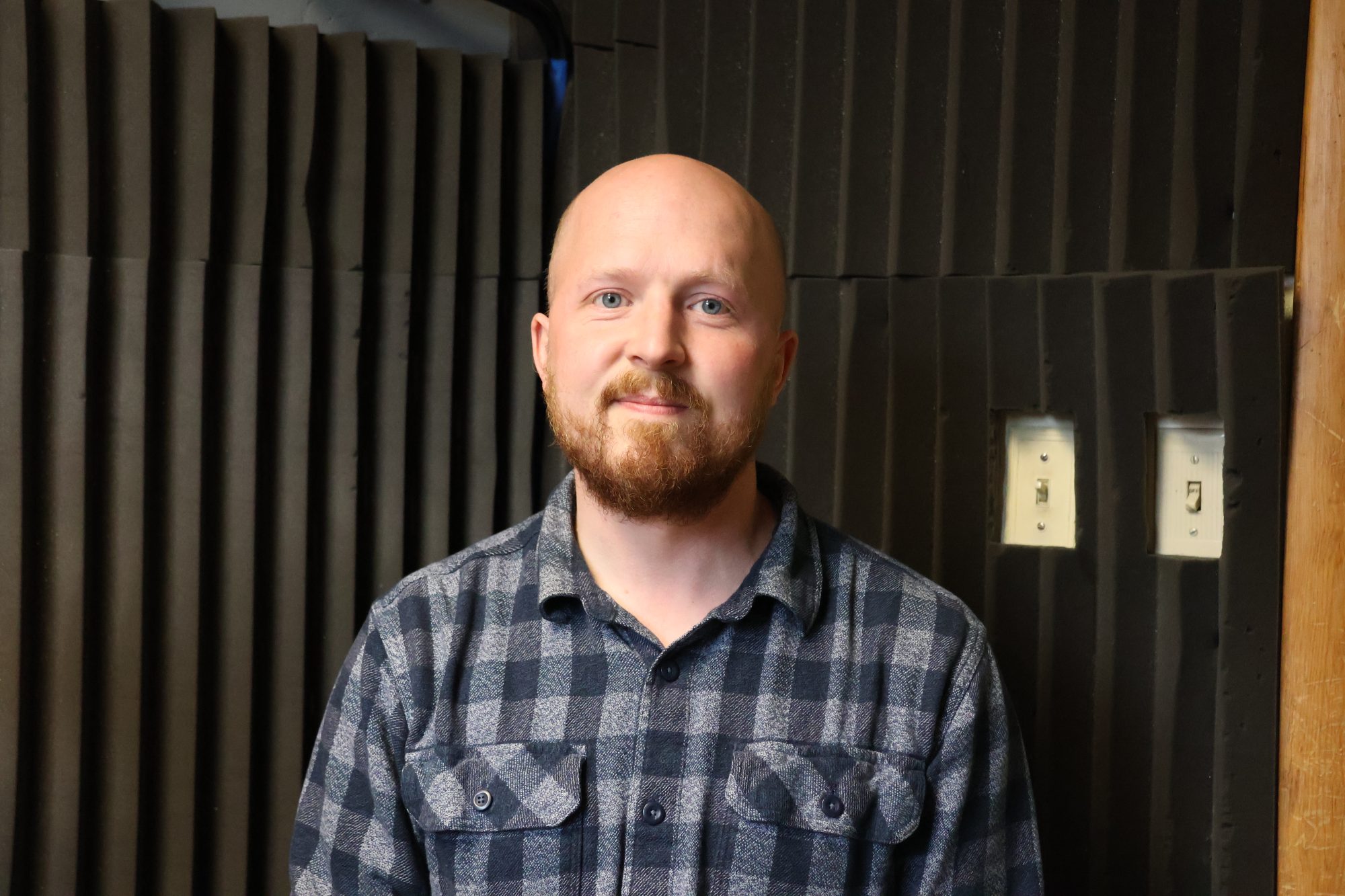
Former Alaska Representative Jonathan Kreiss-Tomkins visited Petersburg on July 5 as part of his campaign for governor. Kreiss-Tomkins served in the Legislature for a decade for a Southeast district that included Sitka and other small island towns – and Petersburg for eight of those years after redistricting.
The Democratic candidate sat down with KFSK’s Taylor Heckart to talk about what he thinks it will take to balance the state’s budget.
Listen to the short version here:
Listen to the long version here:
TRANSCRIPT:
This interview has been edited for clarity and brevity.
Jonathan Kreiss-Tomkins: I want to see the state get a fair share from our oil resource, which was the same issue that motivated me to drop out of college and run for the Legislature against an eight-year Republican incumbent back in 2012. And, unfortunately, that issue is still as relevant today as it was 14 years ago.
Right now, one of the three major oil and gas companies in Alaska doesn’t pay a nickel of corporate income tax. I think that makes no sense, and I think the overall oil and gas structure shortchanges Alaskans and ultimately Alaska communities. So that needs to be remedied as well.
In addition, I would support what I consider to be a reasonable, sustainable permanent fund dividend. I supported a dividend between $1,000 – $2,000 when I was in the Legislature, but not these sort of “promise the sun, the moon and the stars” kinds of dividends.
And if you can do those things held in balance, you’re able to provide reasonable, adequate services to Alaskans and balance the budget.
Taylor Heckart: And to that PFD idea, I think that’s really interesting. So, if you were to become governor, would you want a cap on the maximum amount that the PFD could be? Can you talk about what you mean by reasonable?
Jonathan Kreiss-Tomkins: For the 10 years I was in the Legislature, I supported dividends in the context of whatever oil prices were that allowed for the budget to be balanced. That was year by year; it depends on oil prices and other budget variables.
I think going forward, the dividend formula needs to be rewritten to be a percent of market value of the permanent fund itself, which is kind of a wonky turn of phrase. Basically, it means that you’re indexing the size of the dividend to the size of the permanent fund itself, and that’s different than how the formula currently exists in law. I think if we do that, it would take a lot of the volatility out of the dividend size and provide more stability year to year in our budget process.
Taylor Heckart: Let’s talk about schools. As I’m sure you know, in Petersburg, our community really cares about our school district, and like a lot of districts in the state. When I talk to school administrators, they tell me that if we do not see an increase in state funding, we’re going to start making really difficult decisions.
How do you propose the state would be able to fund schools while also giving districts certainty and stability?
Jonathan Kreiss-Tomkins: Over the last eight years or so, the state has effectively cut education funding year over year over year, and the result is right now across Alaska, I think a lot of communities, a lot of parents, have lost faith in the quality of their schools — despite the great efforts of the people who work every day in our school districts. And it’s largely a function of divestment and cutting funding.
So we need to get funding back up to par. It’s that simple. The Legislature has tried to do that. The governor has frustrated, if not outright blocked, those efforts through the power of the veto pen. If I’m governor, I’m going to work hand in hand with the Legislature to get education funding back up to par, so school sports aren’t being cut, electives, AP courses, foreign languages, music, etc. The costs that really enrich our schools aren’t being left on the chopping block.
Also, we need to pass a retirement plan for teachers, so they can stay in the profession and actually have a future in the profession. Right now teachers across the state are either exiting the profession or they’re leaving Alaska for another state, because Alaska has one of the worst retirements for teachers in the nation. Our teacher turnover rate is 21% right now. The national turnover rate is 7%. That sort of 3x teacher turnover, where kids don’t have continuity, districts don’t have continuity, is largely a function of our failure to provide teachers a reasonable retirement,
Taylor Heckart: When you say that, I think about the discussion in the Legislature this year about a pension plan for teachers, so that would be something you support?
Jonathan Kreiss-Tomkins: Yes, that’s what I mean by a reasonable retirement: a defined benefit plan like the state used to have for 45 years until it was changed to our current system in 2006. We’ve had 20 years of this current system, and it’s pretty clear based on our failure to attract and retain professionals, not just in schools, but also in state agencies and ranks of civil service, that it’s just not competitive. And it’s kind of financial self-harm to be a teacher, basically relative to what people can do in other states or in other professions.
The last thing on schools is, I’m a huge believer in forward funding. Every year school districts, including Petersburg’s district, have to basically guess how much money is going to come out of Juneau for education. It creates incredible uncertainty and guessing about how to budget here in Petersburg, because the single biggest revenue item in a budget is state education funding. That’s a big giant question mark. How are you supposed to pass a budget?
It’s super dumb, and it happens every year. Districts have to basically pass a budget built on a guess, and then revise it when they know the actual number. It can all be avoided by forward funding by having a separate education funding track, where the Legislature is required to pass education funding by an earlier date.
So that’s another process improvement I’m a big believer in.
Taylor Heckart: Let’s move on to the [Alaska] Marine Highway. Also a big part of our life here in Southeast, of course, but we know that the system has been suffering from an aging fleet. We have a shortage of certified staff, and we know that the public is not happy about this. So, if you were to be governor, what is the path forward for the Alaska Marine Highway System?
Jonathan Kreiss-Tomkins: Twofold. I think we need to reinvest in mainline vessels. The big blue canoes of the last 50 years have been amazing, but are at the end of their useful life, and the state needs to reinvest.
I’d like to champion capital funding for new mainliners via the general obligation bond funding mechanism that the state has: every 10 to 20 years the state passes a bond package, and we’re going to be due here in the next couple of years. It’s an opportunity to make these generational investments that benefit the state for years and decades to come. And I think prioritizing funding for new, mainline ferry vessels makes a lot of sense.
The other thing I would like to see is taking the ferry system out of the politics of DOT [Department of Transporation], and right now the management of the ferry system is fundamentally political. It reports directly to the governor through the commissioner of transportation — who is a political appointee — and I think a lot of the management dysfunction in the system over the last 20+ years can ultimately be attributed to governance failure, where you have a different administration every four years or eight years with a radically different idea of what the ferry system should look like. And every time they have a different idea, they make 50, 100, 150 million dollar funding decisions that then get reversed or thrown out the window four years or eight years later when there’s a different governor. As a result, you just have this sort of patchwork system of different management visions every time there’s a different administration and they don’t interoperate, and that creates dysfunction, which is what we now have.
Fast ferries? We spent a ton of money on fast ferries. Where are they now? Mallorca, not in Alaska. We built new terminals just for the fast ferries. All that money, effectively wasted because there’s that management vision.
Next governor, you have the Tazlina and the Hubbard. The design for those vessels changed three different times over different administrations, because each administration had a different idea. It’s just insane, and the result is a system that doesn’t work for Alaskans or commerce or industry.
The solution is creating an independent management board for the ferry system that has marine transportation professionals, community leaders, including from Southeast Alaska and coastal Alaska, labor, and other key stakeholders on the board. And that board is appointed by the governor, confirmed by the Legislature, but otherwise insulated from the changing politics in Juneau, and just focusing on making the system work, and have independent fiduciary control of the system, and I think that is the underrated but incredibly important reform that the system needs,
Taylor Heckart: In our last few minutes, are there any other important things to say about your policies — what you’re looking at as governor — that’s important for folks in Petersburg to know about?
Jonathan Kreiss-Tomkins: I was a champion for the commercial fishing industry in my 10 years in the Legislature. I was endorsed by United Fishermen of Alaska. In this campaign, I’ve been endorsed by a couple of commercial fishing organizations.
I strongly believe in restoring balance to the [Alaska] Board of Fish. That balance has been completely lost under this governor. As a legislator, I was in the trenches fighting on Board of Fish confirmation votes, and know firsthand just how much politics and how much sort of anti commercial fishing sentiment has sort of seeped into the board process and we’ve completely lost the balance between user groups that has historically existed I don’t think KRSA, Kenai River Sportsfishing Association, should have undue control over the Board of Fish, which arguably they do. It should not be the norm that their agenda change requests out of cycle for the board of fish, or board-generated proposals at the board of fish, which has become the norm.
In my administration, that will come to an end, and commercial fishermen once again will have a seat at the table in balance with other user groups. But right now things are out of balance, and that is an incredibly high priority for me and consistent with my record as a legislator for a decade.