Heath Whitacre was at home chopping wood when he noticed he had a bunch of missed calls.
Whitacre is a trained volunteer for the Petersburg Marine Mammal Center, a local volunteer-run nonprofit that helps rescue and respond to distressed wildlife. His teammates were trying to get a hold of him because there was a two-year-old whale entangled in a gillnet in Frederick Sound near Petersburg. It was about 11:00 a.m. on July 28.
“A lot of the members of the team work during the daytime,” he said, “and so it took a little while for us to scramble out there.”
The whale was near Frederick Point on Mitkof Island, towards the Stikine River. The Stikine River has a lot of glacial runoff into the sound, so the water is really silty.
When Whitacre reached the whale by skiff, he saw that the young humpback was tied up in the gillnet, which was still attached to the fisherman’s boat.
Whitacre’s crew was just freeing the net from the boat when Toby Bakos, the stranding coordinator for Petersburg Marine Mammal Center, arrived.
Bakos and his crew tried to get up to the side of the whale with a GoPro camera to get a better look at how badly the whale was tangled. But, the whale was so far down towards the Stikine that the water was too murky to see anything.
“We just didn’t have any luck,” Bakos said.
After almost eight hours out on the water, the crew had to retreat. Before they left, Whitacre attached a telemetry buoy to the net – a bright green buoy floating above water – with a tracking device that beams back the whale’s location to the team in real time. Then, they called up the federal whale rescue expert, Ed Lyman.
Lyman is the Large Whale Entanglement Response Coordinator for the National Oceanic and Atmospheric Administration, or NOAA. He’s been rescuing whales for decades, and works with communities in NOAA’s Alaska Marine Mammal Stranding Network to free entangled whales, train communities on how to rescue whales, and investigate how the whale got trapped so situations like this can be prevented.
Lyman arrived in Petersburg on July 29, the following day. He’d just been teaching a training session on whale entanglement in Tenakee Springs, a tiny town on nearby Chichagof Island. Based on what the Petersburg team reported, he had a pretty good idea of how the whale got entangled. He estimated that the whale was probably an adolescent, around two years old.
“This youngster comes along, tried to punch through the net, and gets partway through, and then panics and twirls,” he said
Lyman said the net then wrapped around the whale’s flukes or tail fins.
“And at this point it’s entangled,” he said. “It’s enough of a wrap, it’s entangled in the gear.”
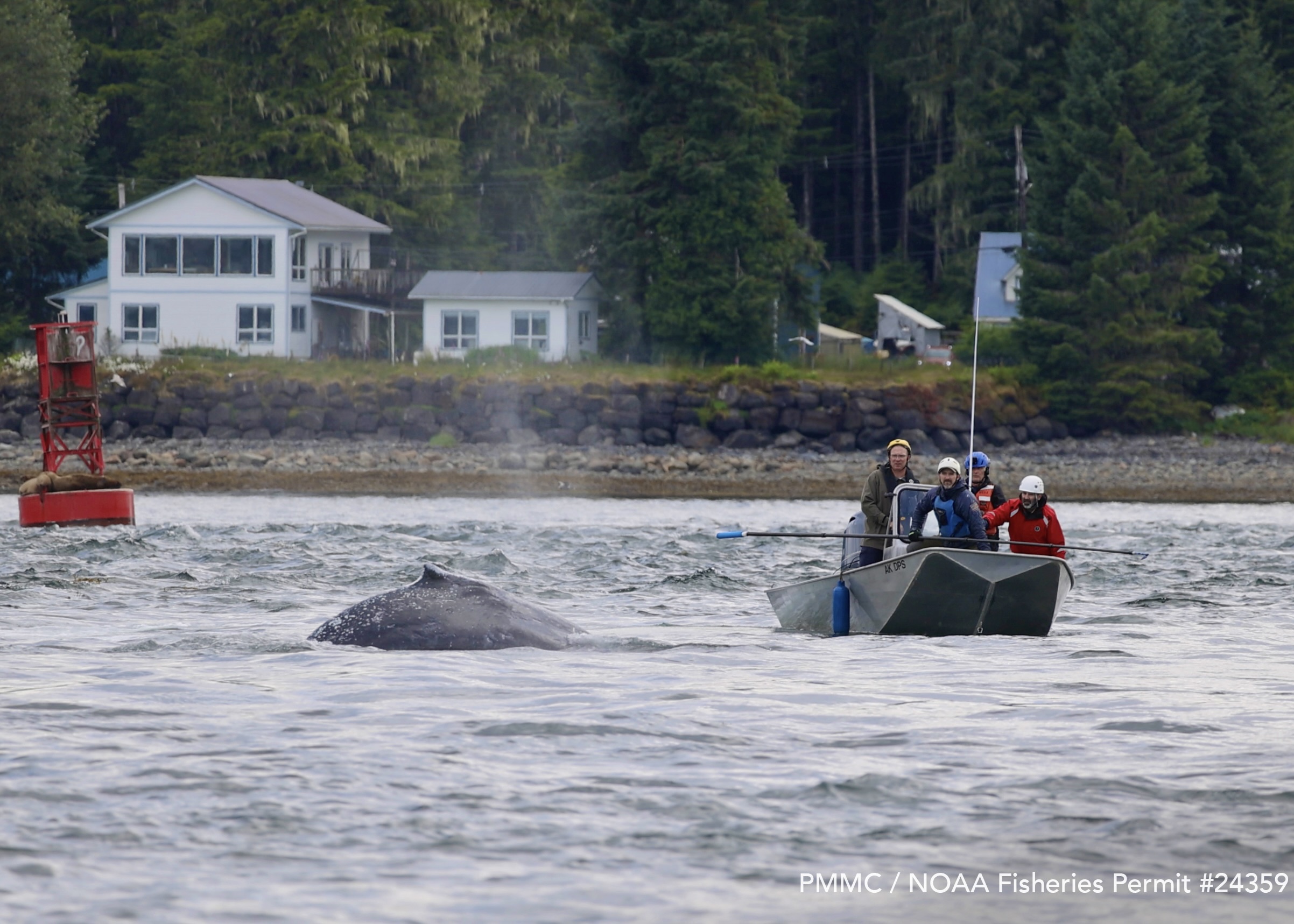
When Lyman got off the plane in Petersburg, a sort-of Avengers team was assembled: the group of trained volunteers like Whitacre and Bakos, another group who offered their boats as support, Petersburg’s Alaska State Trooper who offered his boat as the main rescue boat, and Lyman.
They held a brief meeting, assigned roles, loaded up with whale-rescuing gear, then set off to find that green telemetry buoy.
Whitacre, Bakos, and Lyman were on the main boat tasked with freeing the whale. Whitacre’s role was to cut the net. His cutting tool wasn’t fancy.
“It’s basically a long telescoping pole with sort of a homemade Spyderco knife,” he said.
Bakos stood right behind Whitacre on the boat, holding onto him.
“I was just trying to keep him from falling off the bow,” Bakos said.
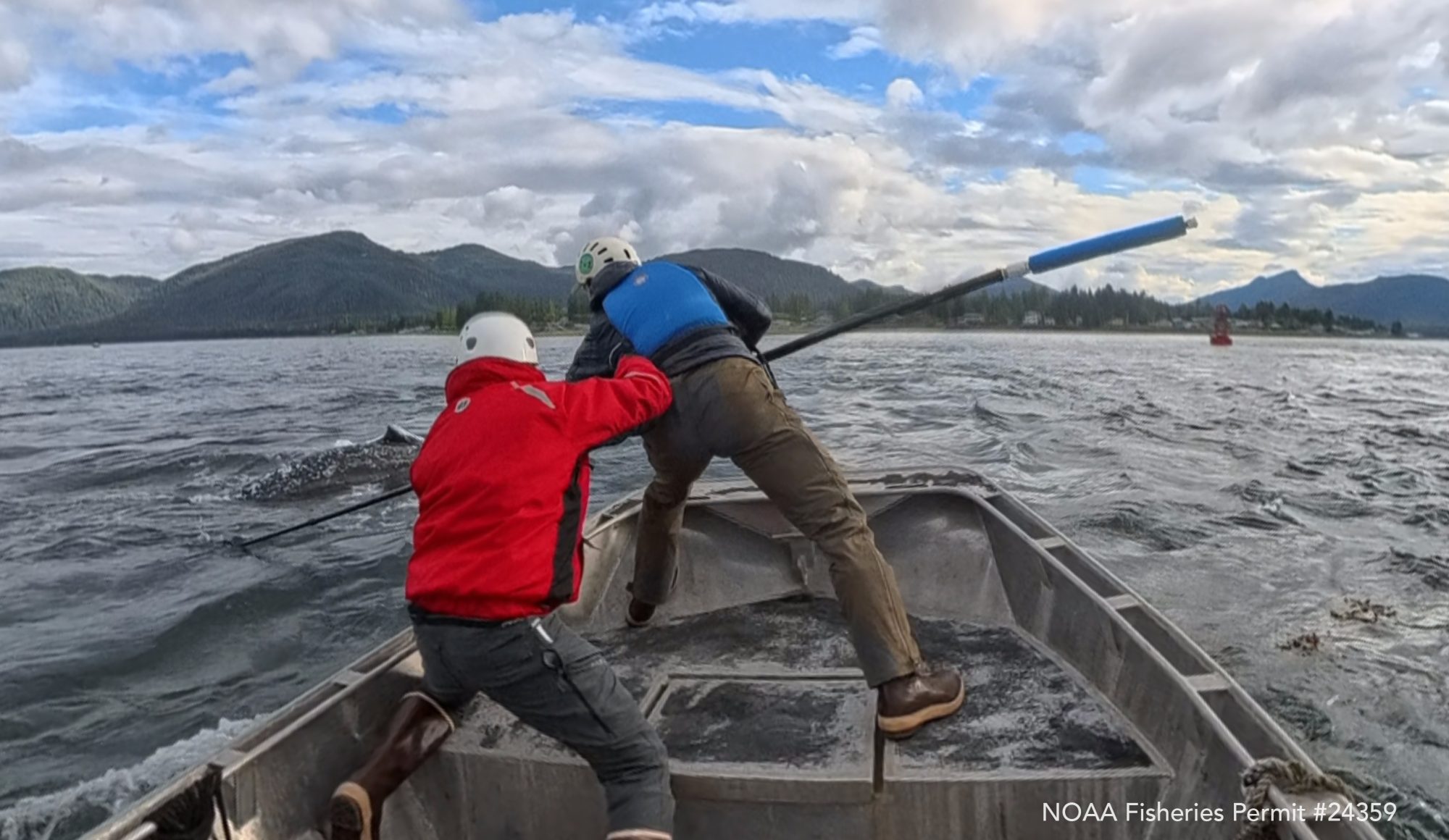
Whitacre said it was hard to cut the line because the whale was not happy.
“The whale was really moving away from us and being evasive,” he said. “So we changed tactics and had to be a little more aggressive getting in on it.”
Bakos said the whale kept diving below the surface, meaning they had to make over 30 attempts to cut the line.
“There were many misses,” he said. “We couldn’t even see the tail most of the time.
After two hours of following the whale in and out of the main channel in front of Petersburg, they got a hit.
“Suddenly the line popped up to the water,” Bakos said. “The buoys stopped moving, and we saw the whale cruising off, and we were like, ‘I think we got it.’ It was pretty cool.”
After the mission was over, the crew gathered in Petersburg’s harbor for a debrief. They stood around the gillnet that trapped the whale, which was laid out on the dock.
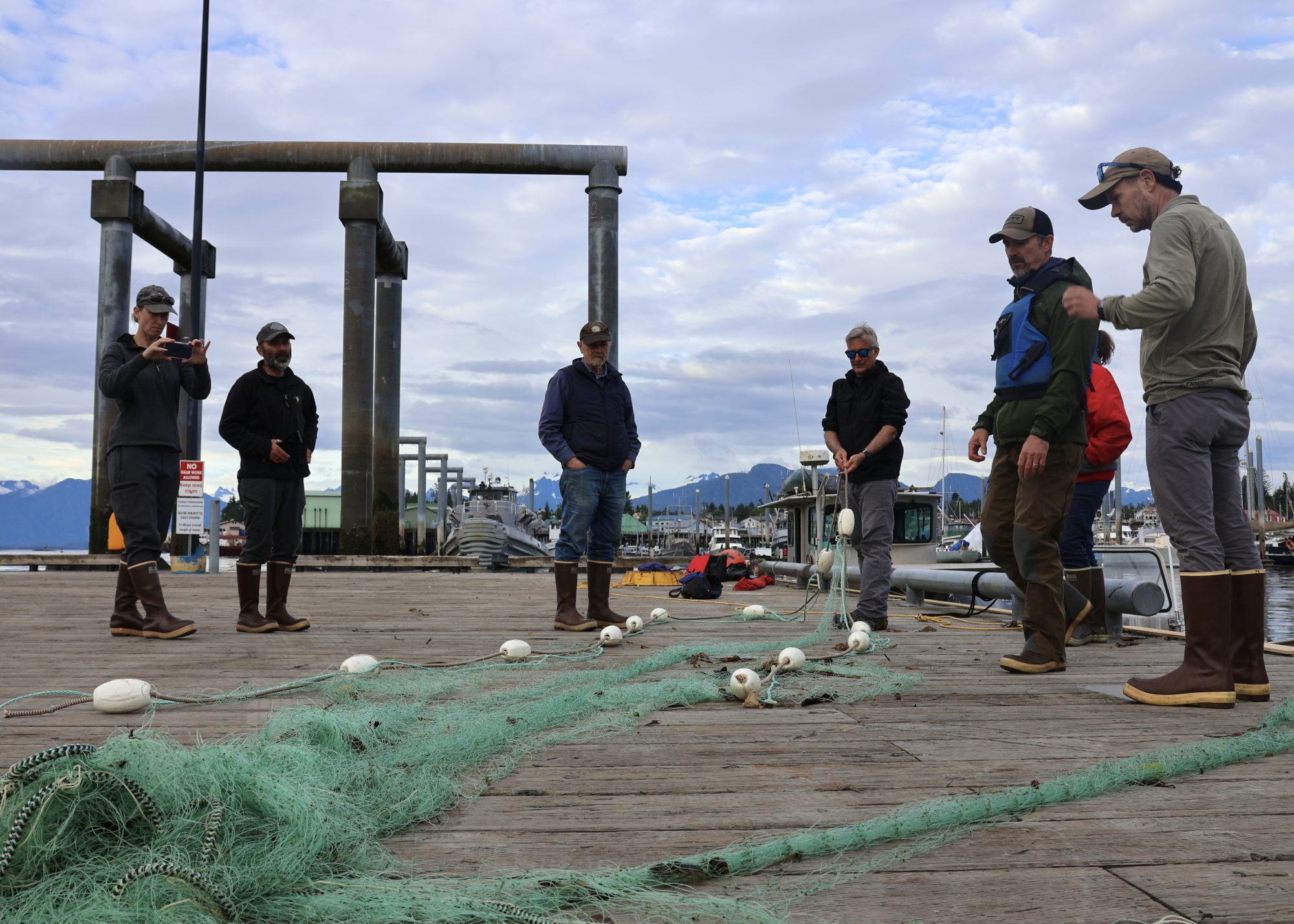
Ed Lyman, the federal whale expert, said that it was great working with the Petersburg team.
“They have a long history here of working with the community, working with the fishermen, and boy, that’s really refreshing,” he said. “You need those key people, and Petersburg had a lot of those key people.”
And for Whitacre, who made that crucial cut of the net, this was a big deal.
“This was actually the first one that I got to cut,” he said, “so I was pretty excited about that.”
As the sun began to set behind the mountains surrounding the harbor, the crew loaded up the gear into their cars and headed home.