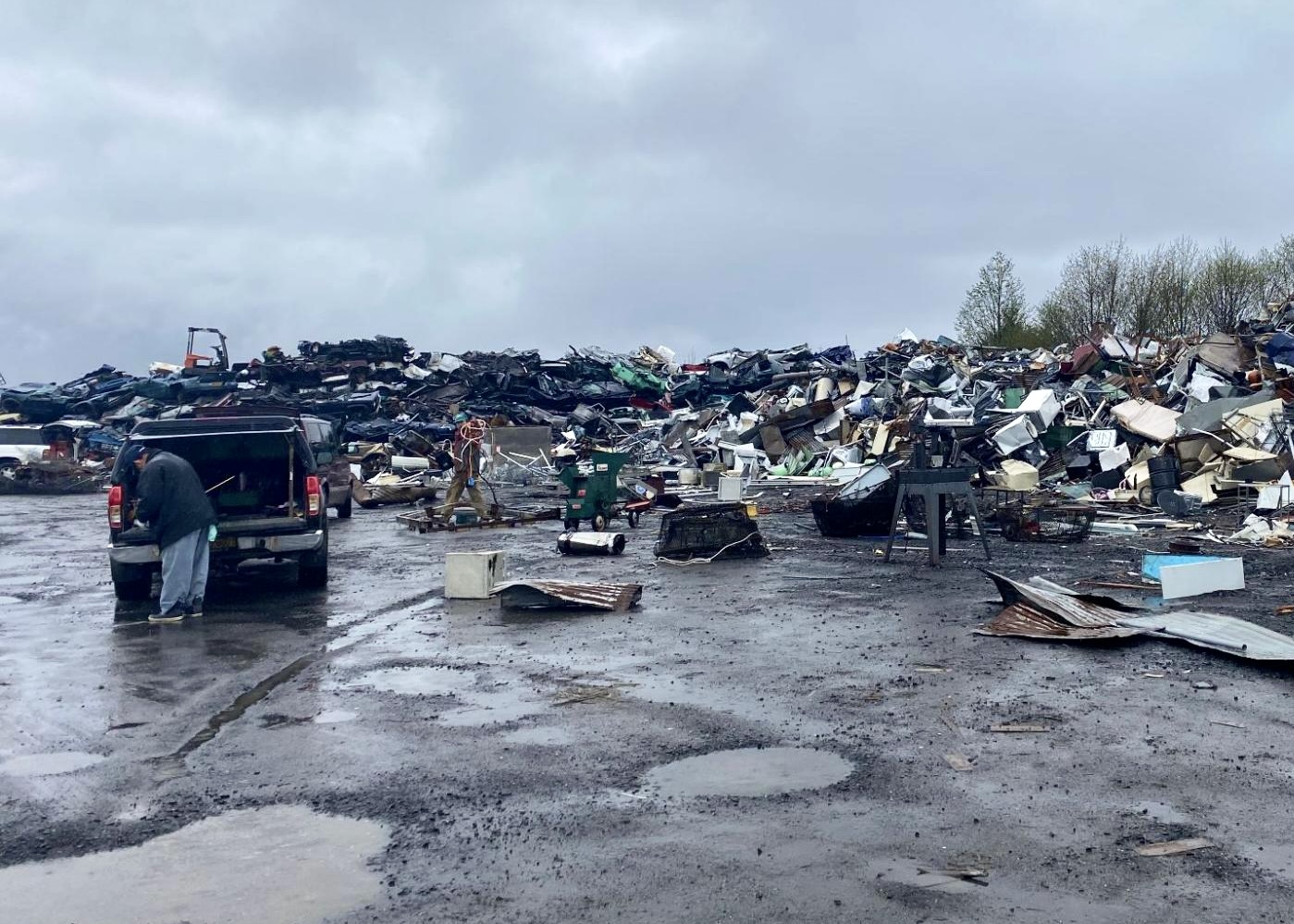
As the saying goes, one man’s trash is another’s treasure. On Mother’s Day last month, a number of locals looked for keepers among a large hill of jagged metal at Petersburg’s local dump.
Olen Nordgren popped the hood of a trashed car.
“I’m looking for parts for my truck,” he said. “And then I got my mother-in-law a boat. She wants different seats, so I’m gonna go check out that boat over there.”
Nordgren was one of several people at the dump, equipped with wire cutters, sledgehammers and chainsaws, participating in the Borough’s salvaging program.
It’s a $10 flat fee; users have to sign a waiver and weigh out as they leave.
Local artist and metalworker Josef Quitslund said he has salvaged weekly for over 15 years, and estimates he collects about 10 tons annually from what he calls “dump church.”
“It’s amazing the stuff people throw away,” Quitslund said. “It’s always kind of a fun mystery as to what treasures one might find, intended or otherwise.”
Quitslund pointed out a pile of pallets, logs, and plywood near the entrance. In the past, he’s found redwood and mahogany to use for his projects. He said he no longer needs to cut firewood out of the forest.
Andrew Edfeldt was nearby with a chainsaw, dressed head to toe in bright orange rain gear.
“They’ve got a bunch of logs laid out for salvagers, and it’s $10 all you can eat,” Edfeldt said. “This is a super good deal. I don’t have to drive out the road. I don’t have to drag logs out of the woods.”
Some salvagers also “high-grade,” a process of separating valuable metals, like copper, aluminum, and brass, which can be sold and sent off the island.
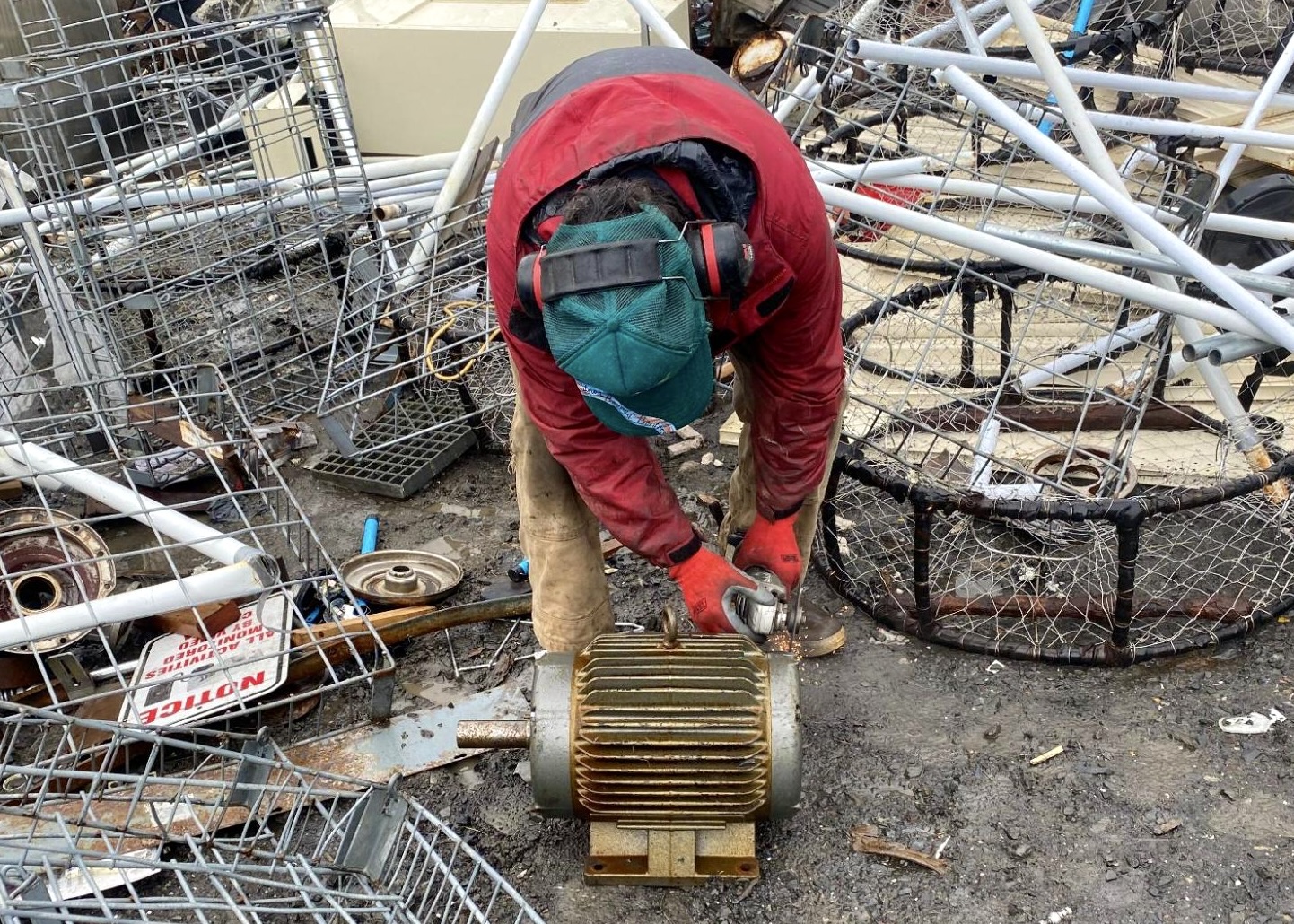
Quitslund spotted an old industrial motor. It was full of copper, but required some dismantling with a sledgehammer and an angle grinder, which he said was much easier than “digging it out of the ground.”
Local nonprofits have also benefited from recycling materials from Petersburg’s dump. But as some programs became less active after the COVID-19 pandemic, some piles at the landfill have gotten bigger.
Aaron Marohl with the municipality’s public works department said at a Petersburg Borough Assembly meeting last summer that the aluminum pile had grown “exponentially.”
“There’s often items discarded into it, which cannot be recycled,” he said. “It’s unmanageable at this point, and so our staff would be thrilled to have it gone.”
The Assembly approved a resolution at the meeting allowing the Friends of Petersburg Bike Park to collect aluminum and sell the scraps as a fundraiser. Pat Blair, the coordinator of the nonprofit, recently confirmed it is an ongoing project.
According to Borough policy, salvaging of aluminum, brass and copper is allowed on a “by weight” basis, and permittees must pay the Borough the current market value per pound. Marohl said in an email that the profitability of reselling salvaged metals has drastically reduced over the years as market demand has fallen off and shipping costs have increased.
The Borough sells about 500 salvage permits each year and estimates that 66.5 tons, equally split between salvaged wood and metals, are removed from the landfill.
The Borough manages the town’s discarded waste by having it removed from the island, spending hundreds of thousands of dollars each year to do so.
But what can’t be barged out, like cars and large equipment, stays at the local landfill. Some salvagers see that as an opportunity. Israel Collison said the program is a community resource.
“Shipping cost is half the cost of everything now up here,” Collison said. “I think having a yard where you can go get parts and things or stuff you need without having to drop a ton of money is pretty vital in this community.”
The salvagers said they’ve found chainsaws, a gold ring, a mini four wheeler, and a brass statuary of leaping dolphins.
The Petersburg Borough’s public works department runs the salvaging program on Sundays, 9:00 a.m. to 3:00 p.m., and on Mondays from noon to 3:00 p.m.
Ketchikan has a similar program, and Wrangell used to have one before it covered its landfill.