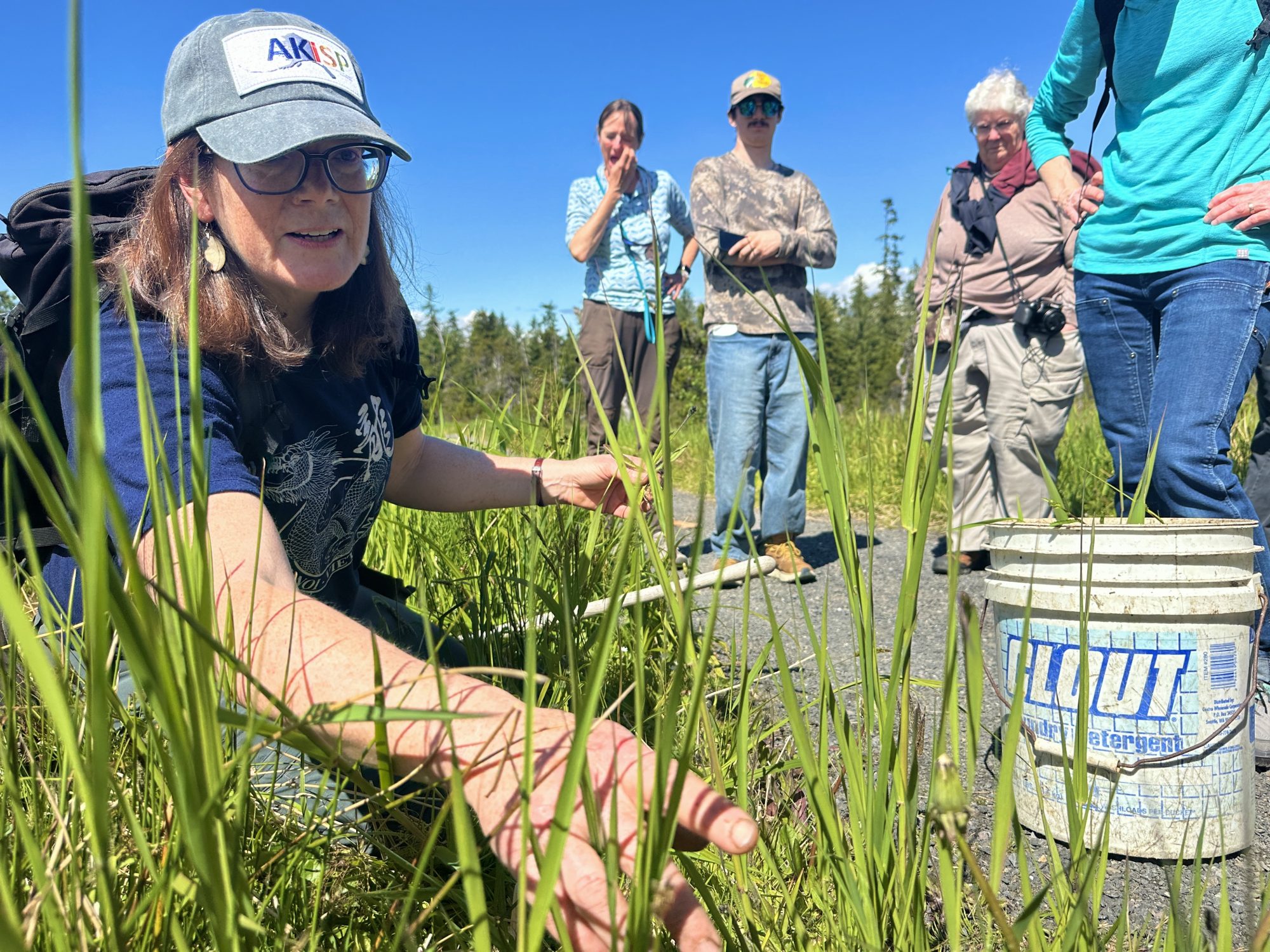
It’s invasive species awareness week in Alaska, encouraging people to report, prevent, and learn about the state’s problematic plants.
Joni Johnson is an invasive species coordinator for the U.S. Forest Service in Alaska. She led an informational group hike at a popular trail in Petersburg to teach locals how to identify and remove invasive plants in the area.
At the Raven’s Roost Trailhead, about a dozen people and a dog walked together up its gravel path, surrounded by muskeg — wet, spongy, mossy bog with short bushes and trees.
“Looking up the trail, you’ve got the sphagnum peatland off to our left, you’ve got sphagnum peatland transitioning into forested wetland to our right,” Johnson told the group. “One of these things does not look the same, and it’s not the gravel trail. It’s the stuff beside it.”
Reed canarygrass
Johnson walked off the trail, put down her bucket and shovel and pulled out of the ground a weed called reed canarygrass.
“It gets robust,” she said. “It’s tall, it loves this. No competition for sunlight, fresh gravel trail, and it’s big and beefy.”
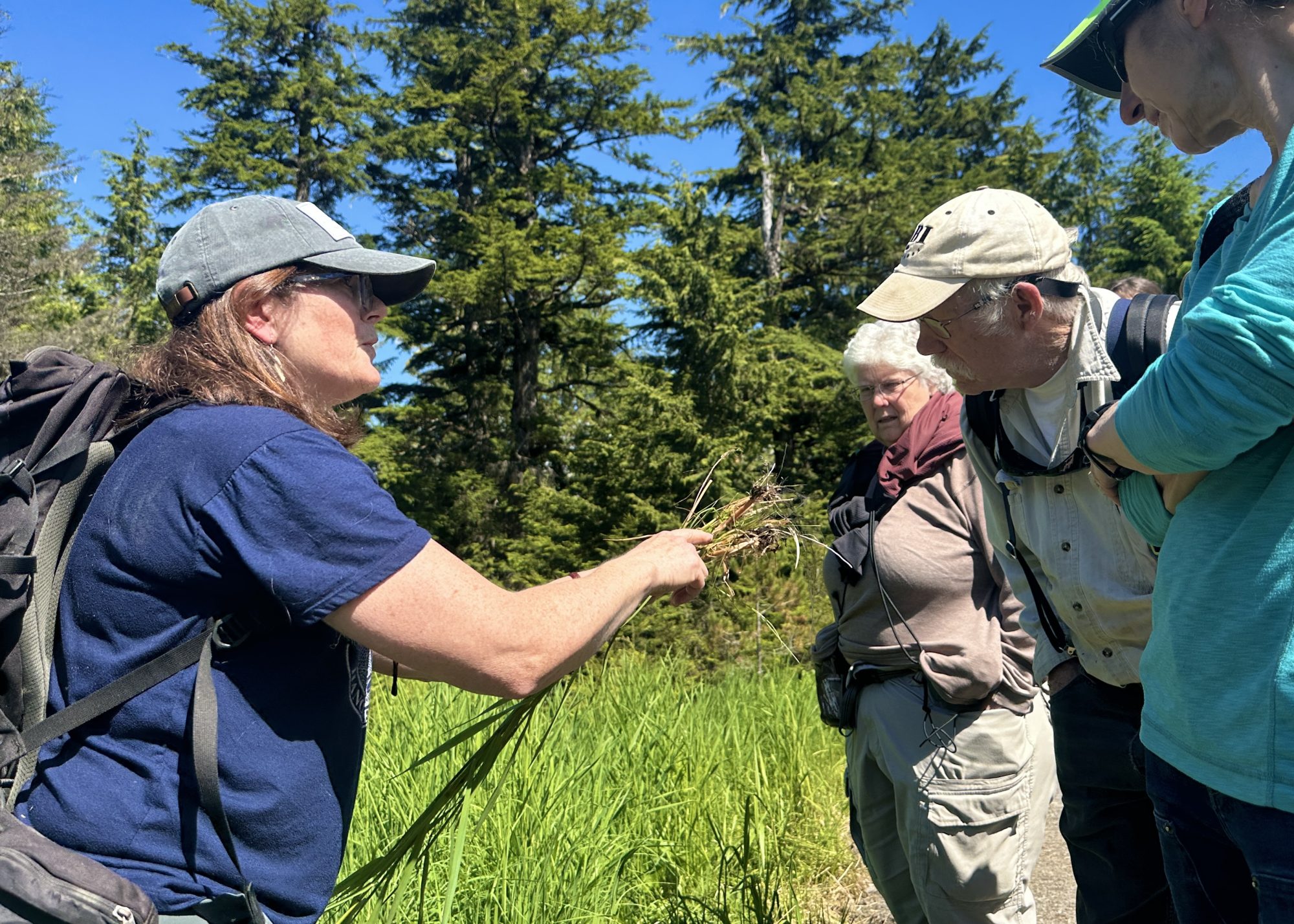
Reed canarygrass can grow up to six feet tall by late summer. It’s dense, which can cause problems for wetlands by displacing native plants and disturbing how water flows. It’s highly invasive, hard to control and is nearly impossible to eradicate once established because it spreads both by seed and by creeping rhizomes, cloning itself from its shoots underground.
The presence of reed canarygrass is prolific around the lower part of Raven’s Roost Trail.
“If you’re gonna try and pull reed canarygrass here, you’d spend your life doing it,” Johnson said.
Even so, she said it can still be worth doing. To check if a plant is reed canarygrass, pull out a strand and look for the color pink. Johnson said it’s the only grass in Southeast Alaska that has the rosy shoots.
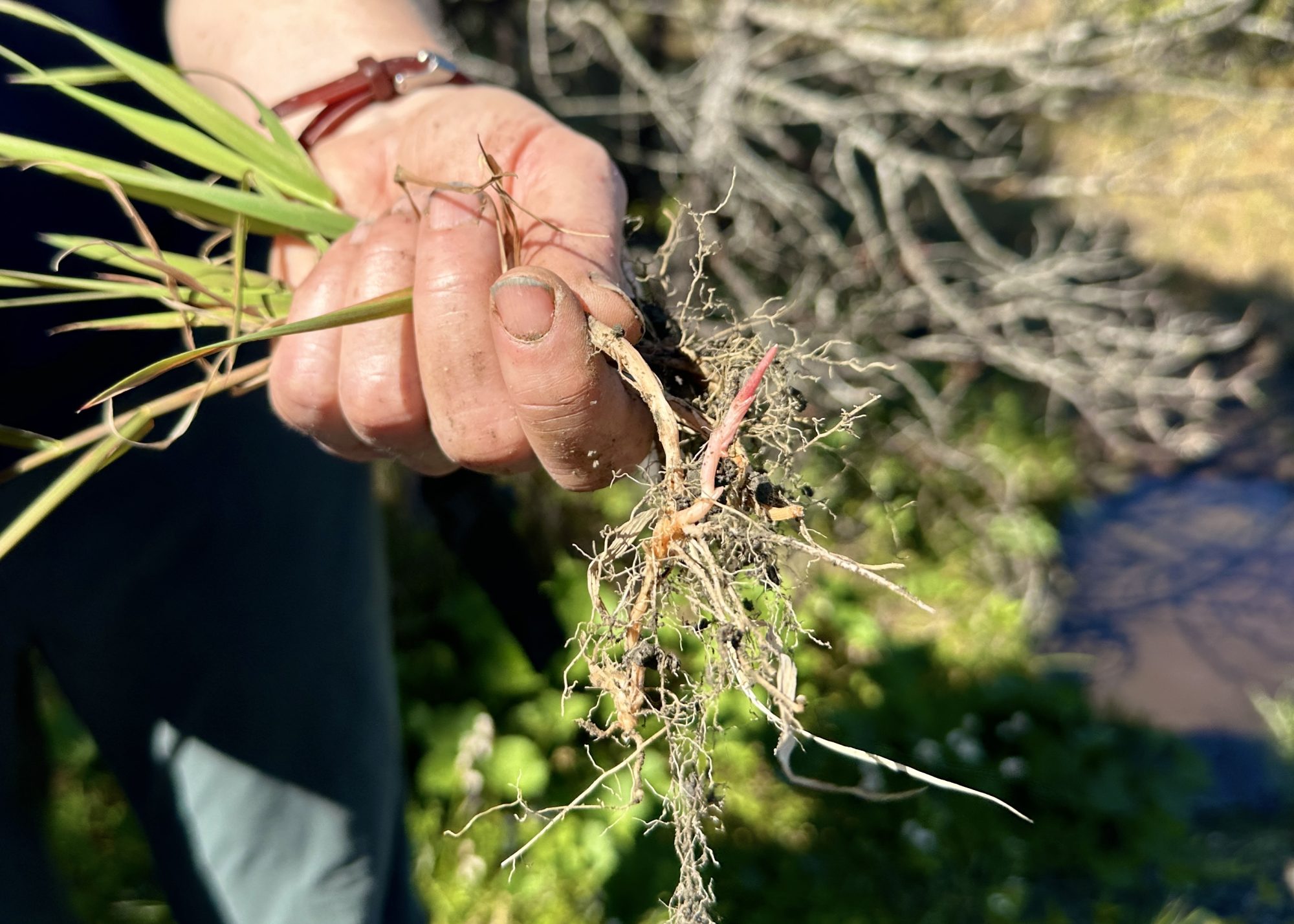
Reed canarygrass was one of several invasive plant species Johnson identified on the trail. The group did a “treasure hunt” for others.
Oxeye daisy
When in bloom, oxeye daisy has a “showy” flower with inch-long white petals and a yellow center. Johnson showed the group what it looks like without the flower, passing around a stem with a few spoon-shaped, toothy leaves on it.
Oxeye daisy can grow densely and crowd native plants, which is bad for biodiversity.
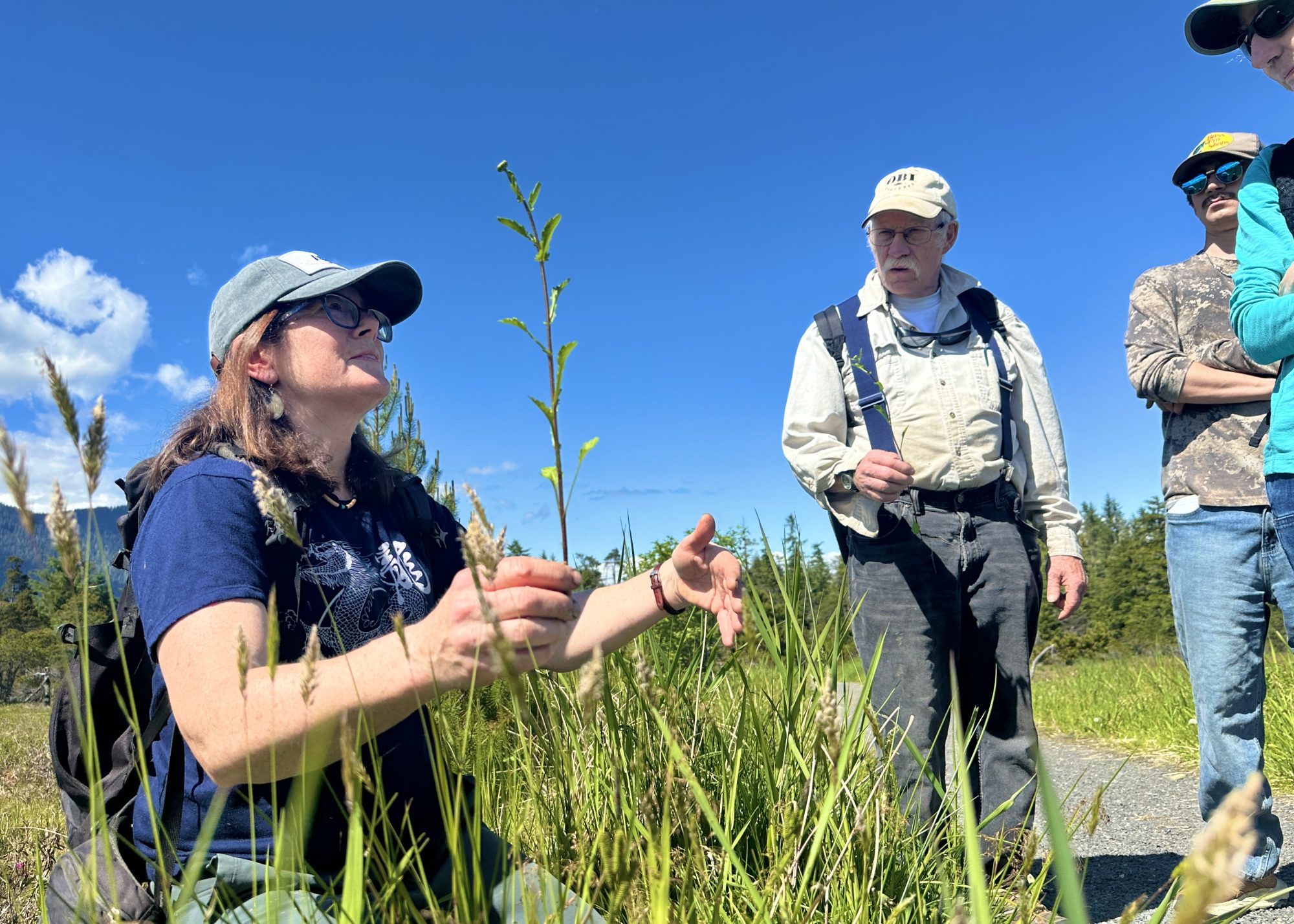
“This trail was thick with oxeye daisy in 2016, and hand-pulling did the trick,” Johnson said, ripping up another stem. “If you can get the root system, great. If not, just breaking it off as far down as you can is good.”
It’s pretty hard not to notice some invasive species once you start.
“Once you see one, then there are more,” Johnson said.
Orange hawkweed
Moments later, Johnson spotted another invasive plant.
“Oh! Oh my gosh! See, we didn’t even go two feet,” she said, laughing with the group. “So, this is the orange hawkweed. There is a ton of it here.”
At least in Petersburg, she said all orange-flowered daisies are likely the orange hawkweed. She said Mitkof Island has a few kinds of hawkweed, and Wrangell has several.
Like the oxeye daisy, the orange hawkweed’s iconic reddish-orange flower wasn’t yet in bloom at the time of the group hike.
Johnson dug out a sample for the group to pass around: a hairy stem with a gray, wooly head and a cluster of hairy leaves near its root.
Orange hawkweed can spread aggressively. It is a spiteful species, where trying to get rid of it can make it spread more.
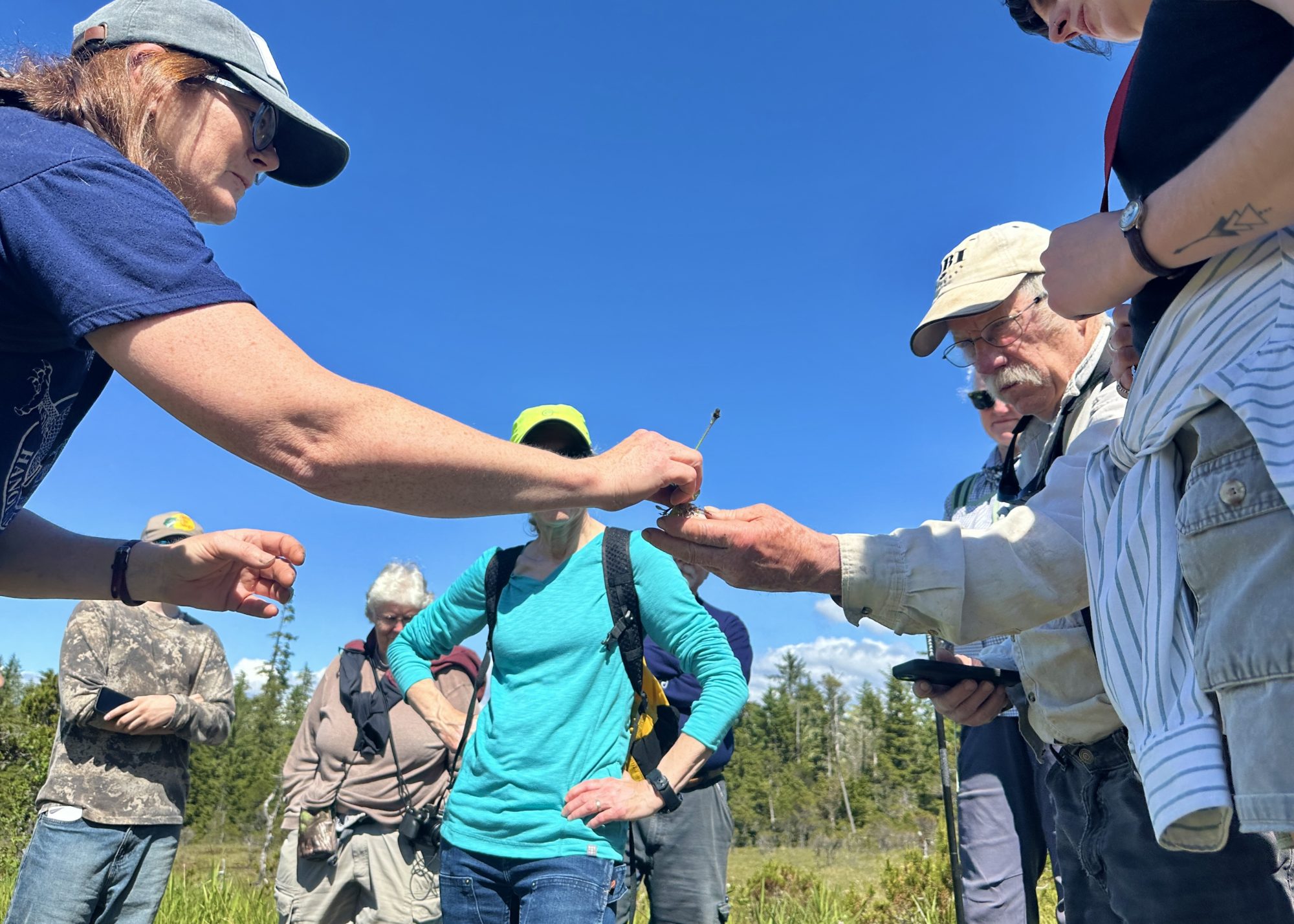
Tackling the spread of invasive species is difficult. That’s why Johnson encourages people to pitch in. She is spearheading a new adopt-a-trail program in Petersburg for the Raven’s Roost Trail in an effort to combat the problem plants growing there. She said the more people willing to keep an eye out for invasive species and help pull plants to prevent their spread, the better.
“It’s whack-a-mole,” Johnson said. “So the more people that are willing to play whack-a-mole, the better we are at preventing the march of the invasive plants up the hill, which is the goal.”
Reject, accept, direct
Depending on the plant and the place, Johnson considers three concepts when dealing with invasive species: reject, accept, or direct.
“What do you do?” she said. “Whether it’s an invasive species, or hydrology is changing, temperatures are changing — where do you put energy, and where does it make sense?”
Rejecting a plant looks like pulling and trying to get rid of it without exception. Acceptance means letting the plant stick around.
To direct means accepting the plant in one part of the area, but trying to reject it in another. For example, the reed canarygrass is established in one part of the Raven’s Roost Trail, but it’s not too late to try preventing it from spreading further.
“Early detection, rapid response. We can see it, we can pull it, and we’ll probably have to pull it again and again. It’s whack-a-mole,” Johnson said.
Pull, bag, throw away
“Pull, bag and throw it away,” are Johnson’s directions for disposal. Do not dump the plants on beaches or roadsides.
Johnson stresses that it’s important to take plant waste where it belongs, whether it’s pulled from the trail or from a person’s yard. In Petersburg, she said the plants can be taken to the baler and tossed in the compost pile.
Johnson also encourages residents to be careful what is brought into gardens and yards because it can spread. She said when the Forest Service built the Raven’s Roost Trail, they brought in soil to help with revegetation. But plant seeds were in the soil, and some seeds can survive several years before sprouting.
“And that’s how this stuff got here,” she explained. “The soil obviously was from somebody’s yard.”
With more and more people keeping an eye out for the invasive plants, Johnson points to a number of resources for learning which ones might be present in an area, from plant identification apps, to educational pocket guides to asking Forest Service staff questions. People can report their invasive finds online.
“Be weed warriors,” Johnson said at the end of the hike. “Sounds cheesy, saying that. But weed warriors, here we are.”
With questions, or to join the Friends of Ravens Trail program, contact Joni Johnson by emailing joni.m.johnson@usda.gov
Informational booklets are available at the Forest Service building downtown.