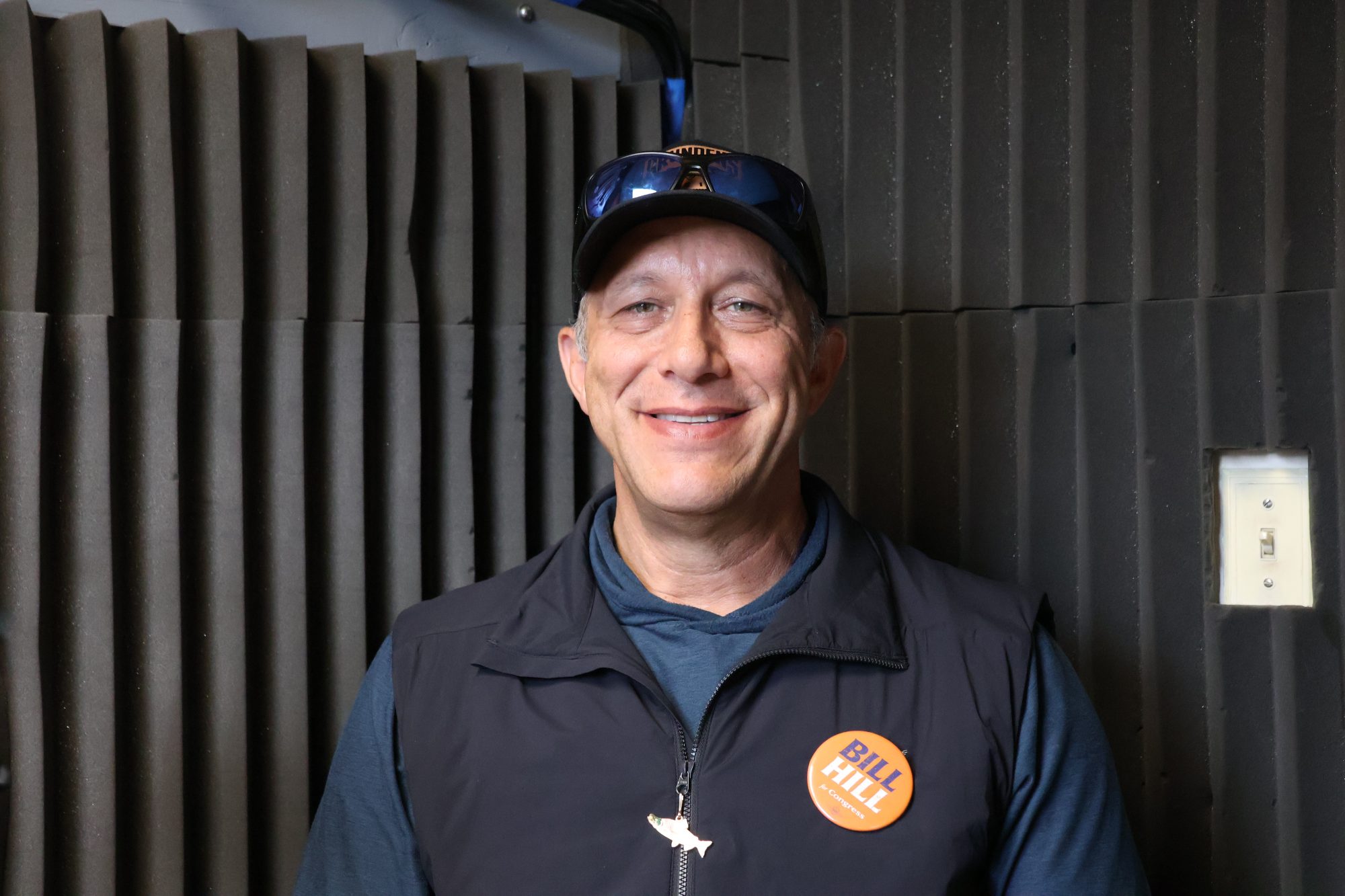
Independent U.S. House Candidate Bill Hill visited Petersburg on Aug. 5 as part of his campaign for office. He’s running against Republican incumbent Nick Begich and 13 other active candidates.
Hill is Dena’ina Athabascan and from the small village of Naknek in Southwest Alaska. He’s a commercial fisherman and spent 25 years working in education. He sat down with KFSK’s Taylor Heckart to talk about his background, policies and priorities.
Listen to the short version here:
Listen to the long version here:
TRANSCRIPT:
This interview has been edited for clarity and brevity.
Bill Hill: I’m Bill Hill, I’m a lifelong Alaskan. I’m a Dena’ina Athabaskan. I live in Naknek, out in Bristol Bay, home of the greatest sockeye salmon run in the world.
Started out my life in Kokhanok, a little village on Iliamna Lake; there were just over 100 people there. Real Bush frontier: chopping wood, packing water, outhouses. No electricity, no TV, no telephone, no radio, just a lot of time outdoors working as a family, and it was just a really great life to grow up in.
When I was a sophomore, [I] moved to Naknek, and Naknek has been my home base for most of my life. I’ve also had the opportunity to live in Fairbanks, Juneau and Anchorage across my life, but Naknek has been home, and that’s where I started working.
At eight years old, I became a setnetter, commercial setnetter, with my mom, my aunt Gloria and two my brothers. At 12, I was good enough to join my father on the fishing boat, so I started fishing on the boat at 12, and I still do that to this day. [I] feel very fortunate to have been able to get out and fish for about eight or 10 days this summer in Bristol Bay. I own a drift gillnetter, and that’s how I pay the bills. But it’s also just really rewarding to be out there and is a part of who I am.
But over the course of my life I’ve also been involved in construction, everything from laying sewer lines to building houses. Building the infrastructure of your community is just a really important aspect of, I guess, being a part of Alaska.
And then finally I joined the family profession. Both of my parents were educators, and so I became an educator and spent 25 years as a teacher, a principal, and a superintendent. That’s just amazing work. And I helped build some career and tech ed programs in our region that are still thriving to this day, and really providing different pathways for students. It was just really important to me to build education systems that serve our students long term.
And then finally, I’m a small business owner with my wife Diane. We operate a textile commercial fishing company out in Bristol Bay, Bristol Bay Brailer. We make brailers for the commercial fishing industry. So I’ve had a wide variety of occupations in my life, and that’s just a smattering, I’ve had a lot of other things too.
But most importantly, father of four, grandfather (Chada) of seven, going on eight. And that’s really a big reason why I’m running, because I think our children and Alaska’s children need somebody in Congress who’s going to represent them every single day, and who’s going to you know challenge the powers that be on things that are going to hurt Alaskans and advocate for Alaskans every day on the things that will be good for them.
Taylor Heckart: Bill, tell me about your priorities and what you’re campaigning on.
Bill Hill: Well, I’m really campaigning on, I think, the issues that most Alaskans care about.
I’m campaigning on the fact that you know the cost of living is just getting out of control. I’ve had the opportunity to work really hard in my life and do really good work. I want my children and grandchildren to have the same opportunity. I want them to be able to build good lives on that, and I see that opportunity slipping away in our state.
Also, I want to make sure that not just Alaska, but our nation, is a place where we can have the surety that we can grow and thrive. I think there’s a lot of corruption that’s happening. We also need to tackle corruption. I don’t believe things like stock trading by congressmen should be happening. I think we need a complete ban on it, not just a patchwork of bills and laws that say that you can’t, but still allow you to do it.
We’re proud to be endorsed by [political action committee] End Citizens United. We need to get the dark money out of our election system so that our voice counts as much as a corporation’s voice, as much as a billionaire’s voice, that Alaskans can have their desires met through the election process, and it’s not impacted by big money from corporations that we don’t know about.
Third, let’s protect the Alaska way of life. Broadly speaking, that’s things like protecting our access to waters, lands, fish, game — all these things that we really enjoy in a great state. We live in such an amazing place, and you know, a drive through your community this afternoon just shows that you live in one of the most remarkable corners in this state. Let’s protect access to all of our natural resources.
Let’s protect access to some rights that I think are very important to Alaskans. For me, Second Amendment rights. This January, I went out and got a caribou for my mom, a subsistence hunter. Being able to do that is really important, and so Second Amendment rights are really important.
And then, by and large, I don’t think that the government has any business being involved in a lot of our health decisions. So, supporting a woman’s right to choose is a part of everything as well. Because at the end of the day, Alaskans should be making their own choices. Government overreach shouldn’t be making those choices for them.
Taylor Heckart: You brought up cost of living at the top. I know there are a lot of ways people think about addressing cost of living. For you, what do those steps look like?
Bill Hill: First and foremost, our current member has voted time and again against health care. It’s increased the cost of healthcare to Alaskans to the tune of about $900 a month for those impacted by the loss of the ACA [Affordable Care Act] premiums. I talked to one young lady down here in Southeast who went from paying just over $400 a month for her growing family to over $3,000 a month, and that’s untenable. I know my family could not absorb an increase like that.
We’re asking people to go without healthcare — is essentially what we’re doing — because they’re choosing between housing and healthcare, groceries and healthcare, you name it. But at the end of the day, when healthcare is too expensive, the emergency room is the only healthcare that’s available to you, and that’s wrong.
We had the opportunity to implement a lot of renewable energy systems in the state of Alaska. Projects have been designed, the funding had been lined out, but a lot of it got clawed back with the One Big Beautiful Bill.
I spoke to a group of union workers in Fairbanks, and they were telling me how they had developed these training pipelines to install wind systems and battery systems in Fairbanks, and it got clawed back. And so, hey, they had people trained to do the work. The work was all lined up. The funding was accounted for, and at the end of the day, it got pulled out from under them at the last minute.
So, I think we can make a lot of headway on things like healthcare, pursuing healthcare for everybody at a reasonable cost, and installing renewable energy systems.
I know that in Southeast, you’re very fortunate to have a lot of hydroelectric power. In many parts of the state, that’s just not a reality. You know, 14 cents a kilowatt hour is a dream in many places in the state of Alaska.
In my neck of the woods, this spring before the first fuel barge, we were paying $6.70 a gallon for gasoline. It’s up close to $9 a gallon now. Communities around mine, which is sort of a hub community, the smaller villages are expecting to pay $15 a gallon or more for heating fuel this winter, which means that people are going to be driven out of their homes and communities.
We all love living in our own little corner of Alaska. We don’t want to leave. But when the economics of living there mean that you have to leave, you know, that’s a terrible place for us to be, especially in such an energy-rich state.
So, let’s find ways to implement renewable energies. I was in Kodiak this spring; they are 98% renewable. But one of the things that really struck me was not just that they were 98% renewable, but was the fact that they were having their first rate increase in 30 years. The stability that renewable energy can bring to communities is also just a really important aspect of everything.
So, let’s make sure we find a way to decrease the cost of healthcare. Let’s decrease and stabilize the cost of renewable energy in our state. Let’s find ways to decrease the cost of groceries. You know, where I live, you know, the local store, a bag of frozen chicken you could get at Costco for maybe $14 is $80 in my hometown.
Taylor Heckart: That hurts.
Bill Hill: That hurts, but subsistence is really important to us. So maybe we can develop some community centers that would be cold storage, for instance, would be really good for a lot of communities where you could harvest salmon in the summer and store them all winter, process moose and caribou, you know, build those sort of systems that could help reduce the cost of living, and then finding ways to reduce the cost of the supply chains as well. There’s some work to do.
But I think we need to have people who truly understand what life is like in Alaska leading these conversations in Washington D.C. and people who are so connected to the issues that it hits them personally on a on a daily basis, and that’s what I commit to doing for Alaskans, is to think about every decision with Alaskans first, not what the party bosses think, but what Alaskans need.
Taylor Heckart: What do you think Alaska’s House representative can do better at serving Alaskans right now? Are there things that Alaskan issues you feel like are being ignored at a national level?
Bill Hill: Well, I think some of the actions that have already been taken have hurt Alaskans. We talked earlier about healthcare and the cost of healthcare in Alaska, and the fact that he voted multiple times to increase healthcare to Alaskans, says to me that he’s not connected with Alaskans.
The fact that he voted to cut things like funding for public radio, which is really important in Alaska, to me that shows he’s not connected to Alaska.
The fact that he voted against renewable energy projects, Alaskans deserve an energy all of the above energy approach, and you know that shows that he’s serving corporations and not Alaskans.
And so I think we need somebody who’s down there to think about Alaskans first. Party bosses and parties should not be a part of that equation. Let’s have someone who really thinks about our lives first.
Taylor Heckart: And we’ve talked about some of the things that you disagree with when it comes to the federal level. Are there any issues that you think are going right right now federally that you agree with?
Bill Hill: Well, there’s been a lot of workI think that we can all agree is good for Alaska, and some of that has been the result of work across multiple administrations: multiple people in Congress and in the House and in the Senate. Some of the bills that have come out around, you know, the idea that the current administration supports the fact that corporations should not be buying single family homes. I can get behind that.
The fact that our DC delegation and the administration have brought a lot of work to Alaska, a lot of projects to Alaska. I can get behind that because Alaska is a pro-development state. You know, those are things that I could agree on.
Taylor Heckart: We’re kind of wrapping up the questions I have here because I know we only have so much time. Is there anything else that’s important to talk about, either where you differ from Nick Begich right now, or about your platform that’s important for folks to know?
Bill Hill: Yeah, I guess if it hasn’t been made clear, I am an independent. I’ve been a lifelong independent, and I voted depending on what I thought was best for myself, my family, my community, my region, and my state in every single election. And I feel like if we have people who are just voting. The party line every single time, then Alaskans are not a part of what they’re doing, and I think that that’s wrong.
I think we need people in Congress who are going to make sure that when they vote, they’re thinking of Alaskans first, billionaires and corporations last, and you know party bosses last as well.
We need to make sure we have a focus on Alaskans because I truly believe at the end of the day that our government has turned away from helping everyday Americans, hardworking Alaskans, and it’s there just to serve you know billionaires and corporations. I mean, there’s never any problem finding another corporate tax loophole, you know, or fighting another war. There’s never a problem with finding money for things like that. But if we want healthcare, if we want good schools, if we want childcare or anything like that, it always seems like ‘oh, you know, you guys are asking far too much,’ or ‘oh, we’re going to have to dip into Social Security’ or some of these other things that they are now now calling entitlements, even though we’ve all paid for those over the course of the years.
So, I hope people know that as an independent, I’ll work very hard for them, regardless of where they stand on the political map, and I will be their representative every single day, and my door will be open to you.