Petersburg’s first day of school for most students is Tuesday, Aug. 25, which means that teachers are busy preparing for the year ahead. Several new instructors are joining the district this year.
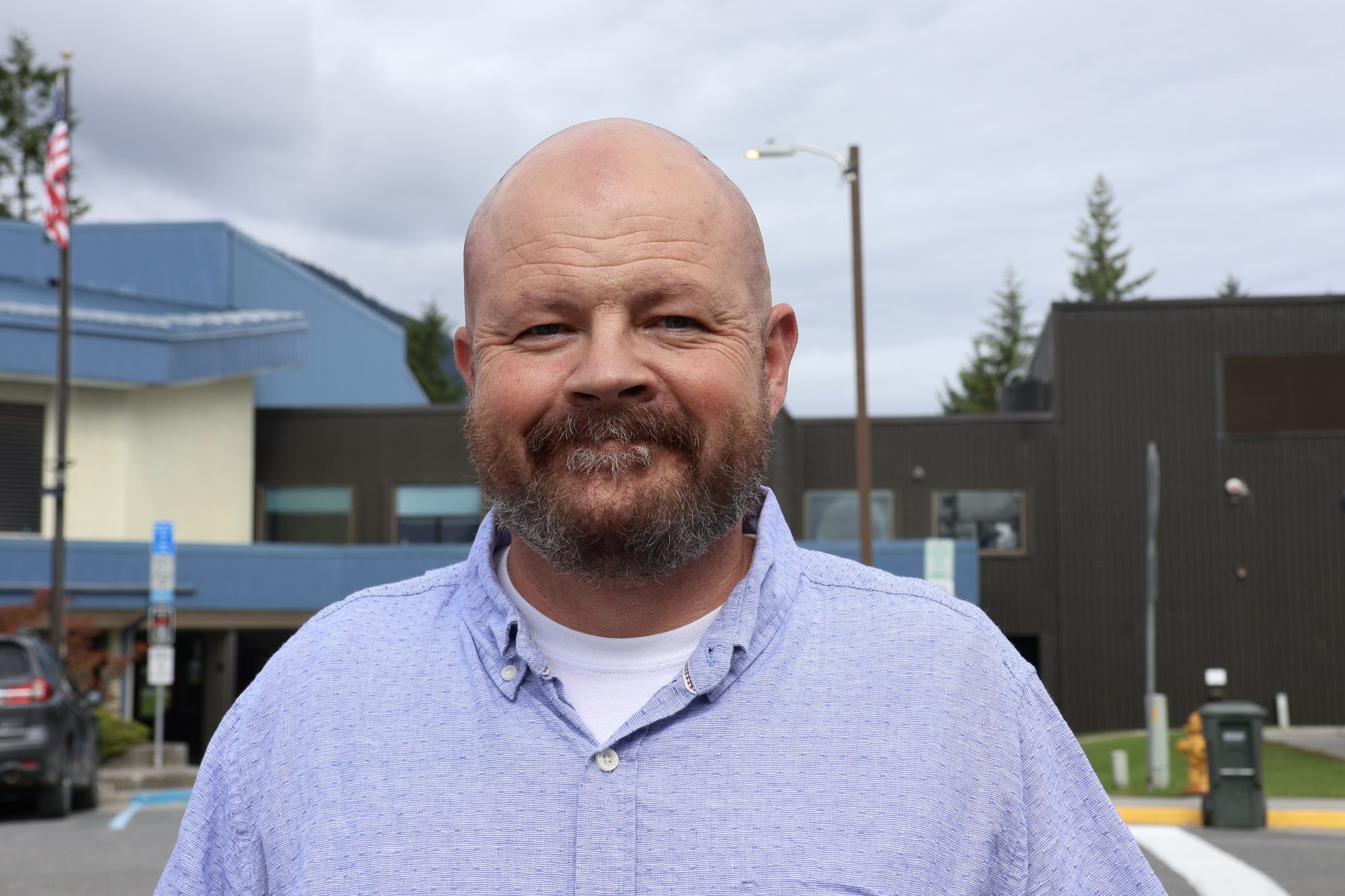
One is Daniel Warila. He will be teaching 6th and 8th grade history at the middle school. Warila moved to Petersburg from Corvallis, Montana. After years in the Air Force, he worked as a forensic scientist before becoming an educator.
Warila has a background in studying world history and ancient warfare. He told KFSK’s Taylor Heckart there’s a lot he’s looking forward to this school year.
Listen here:
Find more interviews with new Petersburg teachers here.
TRANSCRIPT:
This interview has been lightly edited for clarity and brevity.
Daniel Warila: With sixth grade kids, I’m allowed to play a lot. They can interact with history, which is something you need to do as a history teacher. Otherwise, you get the glazed eyes where they stare off and they go, “Okay, just memorize the facts and move along,”
So, I tend to do things like have them separated into city states when you get to the Greek section, and they attack each other just like the Greeks did back then. They have to pay attention to their resources, why they have beef, what they’re currently doing, and it all has to be from the actual realm of what we’re studying.
So, I tend to immerse them quite deeply in that. And then my eighth graders, even though they try to pretend like they don’t like to do it, they really enjoy the warfare part because let’s face it, brawling with your classmates is not something you generally get to do in a history scenario.
They tend to all really enjoy the immersion parts. Of course, I do have normal assignments, but for me, I focus more heavily on the group interactions and the projects. I don’t know how it is here, but at my previous schools that I’ve taught at, they have little cliques that kids get stuck into. When I separate them out and make them work together as a tribe, city-state, empire, they have no choice but to take their mortal enemy or their best friend and stab that person in the back or embrace them and conquer. And it’s on their grade, so they can’t bail because this person is my best friend since kindergarten.
Taylor Heckart: It sounds like you have a hands-on approach.
Daniel Warila: Yeah, and mixes things up quite a bit. I really like that because let’s face it, if we’re left to our own good, most people will stay in their tiny little bubbles and be happy in their little bubble. Then that leads to headbutting later when you don’t realize that the person next door to you is exactly the same as you are, just with a little bit of extra flavor.
Taylor Heckart: I love that. What brings you the most joy when it comes to teaching?
Daniel Warila: Oh man, the light bulb moments.
I spent the last several years subbing in multiple different schools and school districts, and I’ve had kids repeatedly tell me in their own words that they’re not smart enough to figure something out. And when I sit them down and I talk to them, they choose some sort of arbitrary metric for their intelligence, like “I can’t read at this level,” or “I don’t understand this exact thing.”
But, when I point out the fact that they have an absolute genius level intellect in this entire other area, they don’t realize that applies to how they are as a person. So, I like to watch that click inside them, and then they just basically glow. And then they destroy whatever assignment they were struggling on because they now realize that there’s a way over that.
So the light bulb moment for me is always huge when they figure out that they’ve got this and they just go off on their own.
And, as a teacher, I know there are some teachers who like to helicopter a lot. I really don’t. I really like it when the kids start taking over and just going for it, because in history, if you don’t do that it becomes one of those subjects — a friend of mine used to say, “you memorize the facts and then afterwards you flush them.” And you never remember them again because it’s not important, which leads to problems down the road because history’s cyclical.
If you don’t remember what you learned, you might make the same mistakes that have been happening for hundreds of years.
Taylor Heckart: Ahead of the school year, is there anything you want students or their parents to know about you?
Daniel Warila: For the students, I tend to have a lot of fun in my class, but if they decide that they don’t want to have fun, I can also be the grumpy teacher who just hands out a lot of work. So I prefer if my students work with me on the fun assignments, so I don’t have to be the grumpy teacher.
As far as parents go, I know it sounds a little sketchy with a hands-on environment, but it works, and your kids will be giving you Greek facts and Polynesian facts that you probably don’t want to know, but they’ll end up being pretty fascinating.