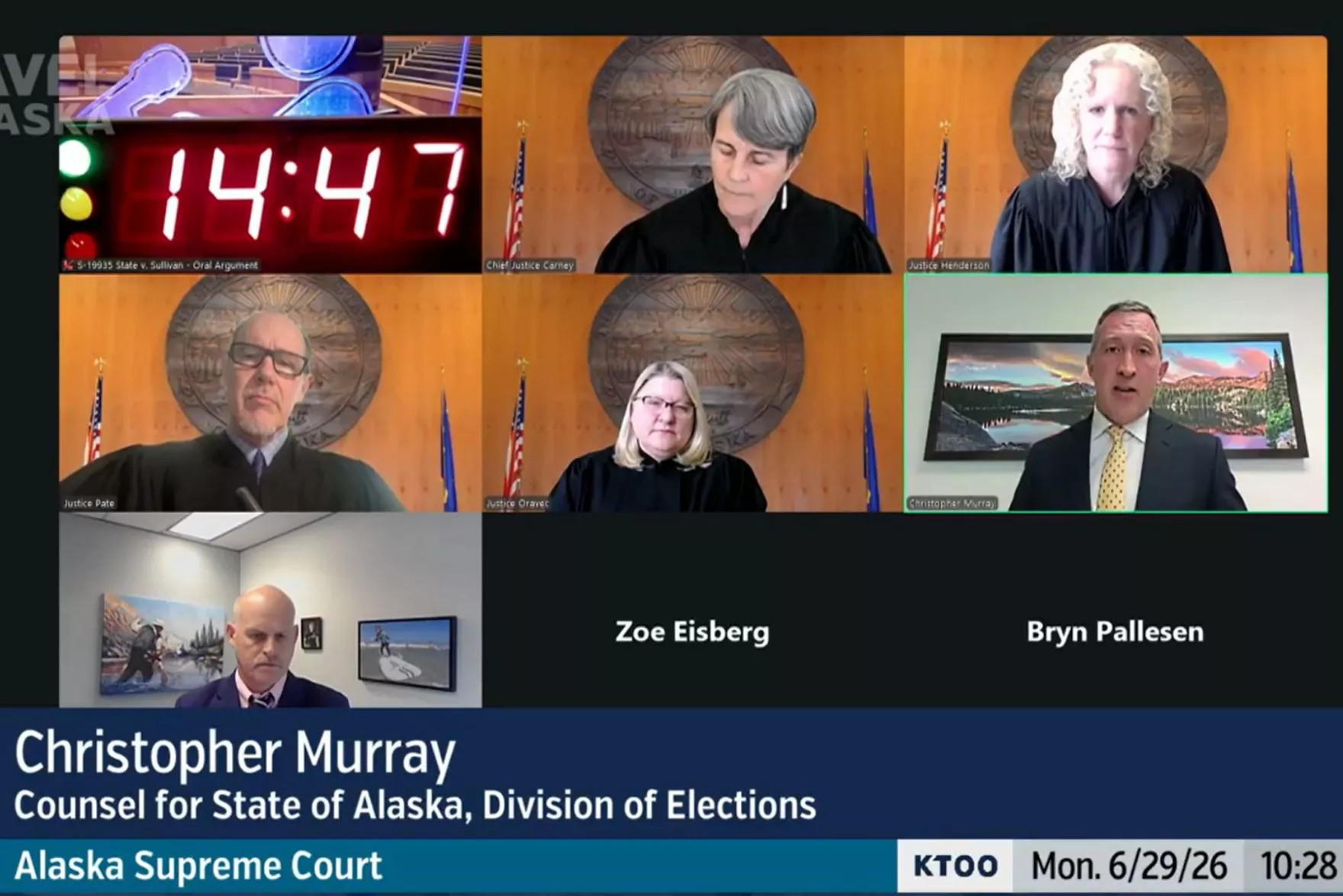
The Alaska Supreme Court issued an order Monday afternoon that Dan J. Sullivan, a retired teacher from Petersburg, must be included on the ballot for Alaska’s U.S. Senate seat. The court sent the case back to the Division of Elections to decide how the challenger’s name will appear.
Monday’s order, which was released about three hours after oral arguments concluded, was barely 100 words. Chief Justice Susan Carney said the court would issue a longer opinion later.
The Division of Elections kicked Petersburg Dan Sullivan off the ballot because he shares a name and chose the same party as the incumbent Republican, Sen. Dan Sullivan. The division said his aim was to confuse voters.
The justices, during oral arguments Monday morning, repeatedly returned to the idea that the division could just differentiate the two candidates with, for example, middle initials.
Carney said that the division, by expelling the candidate, had chosen “the most extreme remedy possible.”
“Why not use one of the lesser ones?” she asked the private attorney representing the division, Christopher Murray of Colorado.
The case has attracted national attention, in part because of the novelty of it, but also because Sen. Sullivan and his Republican allies see it as an unfair threat to his reelection, a devious way to draw votes away from an incumbent. In a close election and a closely divided Senate, control of the chamber could be at stake.
Fourteen other states filed a friend-of-the-court brief to support the state’s decision.
Murray argued that the Division of Elections was justified in disqualifying Petersburg Sullivan because it concluded he meant to confuse voters, in part by choosing the Republican Party only when he filed to become a candidate. And, Murray said, when the division later asked how he wanted to be identified on the ballot, the challenger wrote “Dan S. Sullivan.” The incumbent is Dan S. The challenger is Dan J. The Petersburg man wrote another email hours later to correct himself.
Murray argued the inaccuracy is telling.
“That’s not an innocent mistake, or random mistake,” Murray told the justices. “There’s a lot of other letters in the alphabet that could have been a typo. The fact that he picked the middle initial of the sitting United States senator that he’s purporting to genuinely challenge — we don’t think that the division is obligated to not notice that as very, very troubling.”
Justice Aimee Oravec said it’s fine for the division to notice.
“The issue is whether that justifies booting someone off the ballot versus mitigating, which you’re clearly authorized and empowered to do,” she told Murray. “There’s a lot of different ways you can distinguish these two candidates on the ballot, short of precluding access to the ballot to begin with.”
A Superior Court judge ruled Friday that the division was wrong to give the second Sullivan the boot, teeing up the division’s appeal.
The Supreme Court agreed Petersburg Sullivan has a right to be on the ballot. The Division of Elections must decide how the challenger’s name will appear “within the confines of existing Alaska ballot design law.”
The division has argued that middle initials aren’t sufficient.
“Two identical names, differing only by one letter, would be confusing and misleading to voters and run the risk of voters inadvertently selecting the candidate they did not intend to vote for,” the division said in its brief to the court.
Before it was ordered Monday afternoon to let the challenger on the ballot, the division proposed to identify him as “Sullivan, Daniel James Jr. (Nonpartisan)” while listing the senator as “Sullivan, Dan (Registered Republican) Incumbent.”
“They can’t do that,” the Petersburg man’s attorney, Jeffrey Robinson, argued Monday morning.
“There’s no authority for the proposition that in order to avoid confusion the director can change the party affiliation,” Robinson said.
The Division of Elections has said it has to begin preparing ballots Tuesday at noon.
Editor’s Note: This story has been updated to include the Alaska Supreme Court ruling.