Alaska has a history of destructive earthquakes, landslides and tsunamis. As the risk of natural disasters increases with climate change, it’s important for Alaskans to know how to prepare.
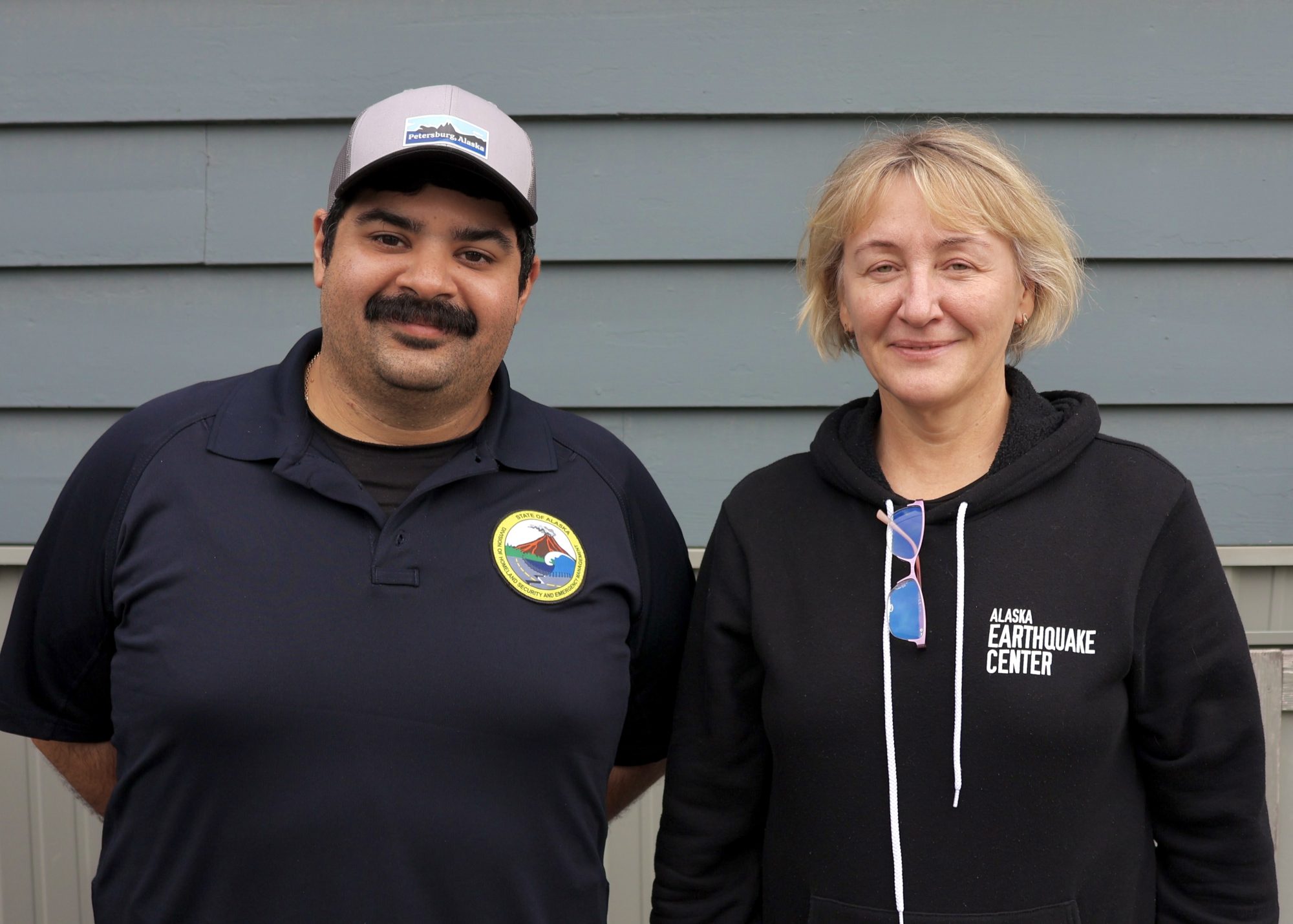
Alaska Earthquake Center tsunami modeler Elena Troshina and Alaska Division of Homeland Security emergency management specialist Mike Lucio visited Petersburg to give a talk about tsunami and emergency preparedness on Aug. 27.
KFSK’s Baiz Hoen spoke with them about the risks Petersburg and other Southeast Alaska communities face. Troshina said it’s “extremely important to not underestimate tsunami warnings.”
Listen here:
For more information and step-by-step tips on how you can prepare for an emergency, check out KFSK’s emergency preparedness series.
To find Alaska Earthquake Center’s resources about tsunamis, visit earthquake.alaska.edu under the tsunami tab.
For emergency management resources from the state, check out ready.alaska.gov.
INTERVIEW TRANSCRIPT:
This transcript has been lightly edited for clarity and brevity.
Troshina: There is no such a thing as a false alarm. Every tsunami warning is there for a reason. It takes time to actually assess the parameters of the earthquake, and it takes time to cancel a tsunami warning because there is a protocol for that. So yes, you will be inconvenienced for a couple of hours, but it’s okay.
Hoen: Can you tell me a little bit more about how tsunamis are created?
Troshina: Tsunamis can be made by different sources. For example, the most common one is an underwater earthquake, and those earthquakes usually happen in so-called subduction zones, which we also call Ring of Fire, and Alaska is one of the major subduction zones in that Ring of Fire.
Another source of tsunamis which is very relevant to Southeast Alaska are tsunamis generated by above water and underwater landslides. And so that fault that crosses Southeast Alaska called Fairweather Queen Charlotte Fault, earthquakes on that fault can trigger huge underwater landslides as well as above water landslides.
And Alaska has the world record of the highest wave ever recorded in Lituya Bay in 1958, and this is exactly what happened. The strong ground shaking initiated the collapse of the mountain into Lituya Bay, and that chunk of rock generated a splash that is higher than the Empire State Building.
And quite recently, on August 10 of 2025, there was a similar collapse of the mountain slope in Tracy Arm, and that collapse generated the second-largest wave ever recorded. So basically, we have the world record for the two highest waves in Alaska.
Hoen: Mike, and maybe both of you could answer this, what have past disasters taught us about how to prepare for the next one?
Lucio: I think especially with Alaska being so dynamic with disasters, we see more here than pretty much every other state combined. Alaska’s also kind of leading the country in many ways in its preparedness.
We have really resilient people here, and I think there’s so much of that shared history of disasters that people know that things happen here. And we may not necessarily know exactly when or why, but we know things happen, and that has given us a leg up in many aspects.
And I think all of Southeast Alaska is kind of wary about landslides in general.
The tragedy in Wrangell and Ketchikan and pretty recently we had Sitka before that, we’ve had Haines. We’ve had a lot of communities that have had these landslides, and a lot of them were weather-related, but it’s always those things that we have to keep in mind.
Everywhere we travel I’m always looking up the hills to see where the scars are, because we know they’ve happened. We know they’ll continue happening. It’s unfortunately one of those things that we try to be as prepared as we can for it, but we just don’t always know when it’s gonna happen.
Hoen: Are there any tips or advice you want to give to locals here or in Southeast Alaska that they can start thinking about right now?
Troshina: I would like to mention the fact that even if you have a three-feet wave, it doesn’t mean that it’s not dangerous because one of the major tsunami hazards are strong currents or whirlpools in the harbors. And that three-feet wave can pretty much destroy the harbor.
Lucio: On the emergency management side, being in Alaska, we don’t know when we may suddenly be cut off from our barges. We may suddenly lose our internet. There’s a lot of different things that have happened, and basically we always remind people that you may wind up suddenly not having access to the things that normally we have.
And so that good, better, best is basically do you have supplies for several days, do you have supplies for a week, and then the best is do you have supplies for two plus weeks. And that’s way easier said than done. Everything is expensive. And we always say, you know, just take a little bit, and maybe you’re really strong in one component, you’re weaker in another, and that’s okay. Know your neighbors, know your community, know the people who can support that community in times of need.
The first people on the ground are going to be the last people on the ground, too, your neighbors, your neighborhood. And having that preparedness level together makes us all stronger.
Hoen: This is just a little tangent. That huge glacial outburst in Nepal — do you work with glacial outbursts at all?
Troshina: No, this is something new to me. I’ve never worked with something like that in Alaska, so maybe it’s time to start looking into that because I think due to the climate change, there will be more unusual events in Alaska.
Lucio: Yeah, the glacial lake outburst flood in Juneau is one of those things that a few years ago, you didn’t think about. It wasn’t a consideration, just the glacier was naturally, um, lowering the water levels through a normal process, but that process has now changed. And I think Juneau is an incredible example of resiliency and preparedness and mitigation and action over the course of several years. So many entities, I can’t even name them all, just all working together to figure that out, ’cause they don’t have a choice in the matter. You have to figure it out. You can’t just keep flooding homes every year. So it goes back to that preparedness and resiliency model that we push so hard.