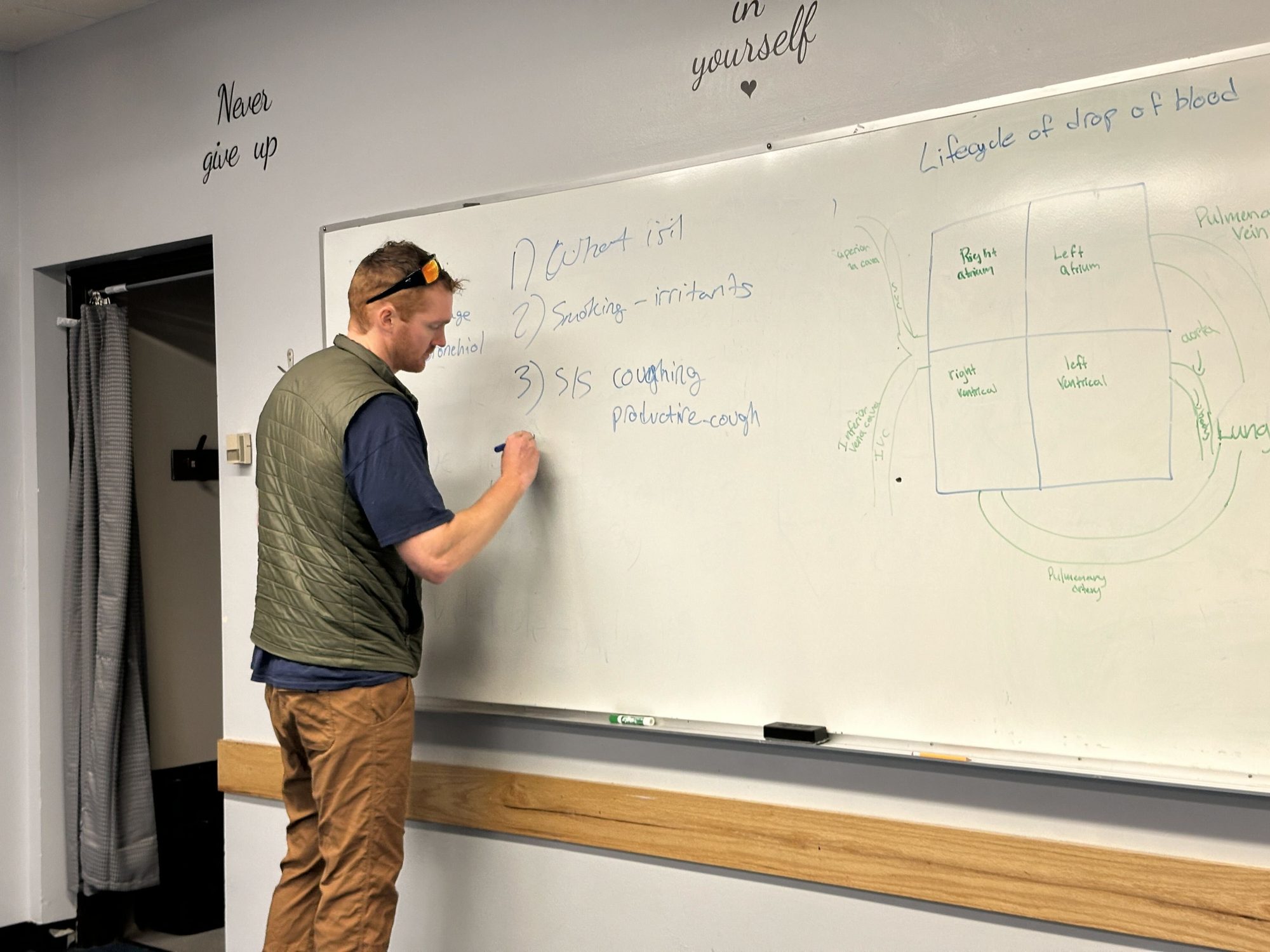
Five Petersburg high schoolers are trying out a new course this semester: an Emergency Trauma Technician certification class.
KFSK’s Taylor Heckart sat down with Petersburg Emergency Services Coordinator Ryan Gilkey, who is helping teach the class. Gilkey said it’s a program that requires less hours than an EMT certification, and it’s built with communities like Petersburg in mind.
Listen to the interview here:
Gilkey said he’s interested in offering Emergency Trauma Technician courses to the broader community, but he needs community interest first. If you’re interested, you can contact him at rgilkey@petersburgak.gov.
TRANSCRIPT:
This transcript has been lightly edited for brevity and clarity.
Ryan Gilkey: So the ETT, the Emergency Trauma Technician, was created in Southeast Alaska very specifically for some of these communities like ours. We might have a lot of resources available to us, but at the same time, any sort of real incident has to leave by plane, right? There’s just a ruralness or remoteness to where we are.
They have designed the course so the minimum age is 14 to get certified as an Emergency Trauma Technician in the state of Alaska. There’s no maximum age, but in the course right now we have age ranges 14 through 18. We have five students.
Taylor Heckart: Is this a semester or full year class?
Ryan Gilkey: Yeah, this is another good thing about the way this ETT thing is set up. So, it’s one semester long, and give or take every semester has like 65 hours of classroom work. For the state, the ETT requires 40 hours of classroom work, just at minimum, anything extra is great. So we’ll obviously have time for review and to help solidify it.
But, long term as well, an EMT course in and of itself requires a minimum of 140 hours. So, you just can’t fit it into a semester. You could fit it over two semesters, and that’d be fine. But the way that this ETT program is set up is that you can bridge to an EMT, and that bridge to an EMT is like another 60 hours, another 70 hours.
So it’s just a little more than maybe a coursework class, but it would allow us to offer ETT one semester. Next semester, if there’s enough interest, we’ll just do the [EMT] bridge program. We could kind of have that as a revolving door as students over the years show interest and have different levels of certifications we can offer, different next steps, especially for the older students because I think to be an EMT there’s a minimum age.
Taylor Heckart: What are you guys going to be looking at this semester? What are the kids going to be learning?
Ryan Gilkey: At the highest level, you’re going to learn how to keep someone alive. That’s kind of the goal, right? And then obviously we’re learning how to call for help in remote areas and learn what type of help you need.
But in all the ways that it matters, learning how to keep someone alive and stable as best as possible until they can get to further care.
Taylor Heckart: So conceivably, could these kids graduate this class and then decide they want to volunteer at the fire department?
Ryan Gilkey: Yes, that’s the plan, especially for, like — no debate, the ones that are 18. I was like, if you guys wanted to — obviously check with your parents, just because you’re in high school — but, you could start jumping on the ambulance.
We just went over the ambulance. I parked it in front of the high school today. We took them into the back and gave them an intro to it. You’re gonna learn lots of stuff.
But the goal is, by the end of this course, you can jump on the ambulance and add value right off the bat. You could do that here. You could do that at any other town you move to.
Taylor Heckart: Wow, that’s a pretty impressive thing to be able to do by the end of a semester.
Ryan Gilkey: That’s the hope. Yeah, it’d be very cool, and that’s what the ETT was created for. And so, hopefully we can take advantage of it and get them there.
Taylor Heckart: What are you most excited about for this course?
Ryan Gilkey: A couple things. I always thought to myself, like, if you really want people to be interested in something, you have to start when they’re young because you have to help them understand why this matters. That’s what I’m excited about.
I mean, weaving in the history of Alaska, the amount of plane crashes we’ve had here, boat incidents. Just the summer, unfortunately, there’s been a lot of incidents out in the fishing boats.
But you know, these are the things that these people will get up to.
Taylor Heckart: I always hear we need more volunteers for EMS. Do you think this class can help address that need?
Ryan Gilkey: For what it’s worth, I guess maybe this is a good point to make very clear: this has nothing to do with getting volunteers, in my mind. I mean, if nothing else, they’re very young, and I don’t know if their families would be comfortable with it, right? There’s plenty of conversations we had there.
If they would like to, wonderful, right? And we’ll certainly try to prepare them for that. But this is about them.
You know, if nothing else, let’s pretend some kid wants to get off the island and never come back. I mean, I’ve applied to college. I’ve been to college. If I was reading an application and I saw some kid was certified in emergency medicine, maybe an EMT by the end of this year? I mean, he’ll be able to step into any town in America and add value right away if he wanted to. When I was 18, I don’t think I could say that.
So I think it’d be very cool, and would help them if they want to leave and wherever they end up being.