Listen to the story:
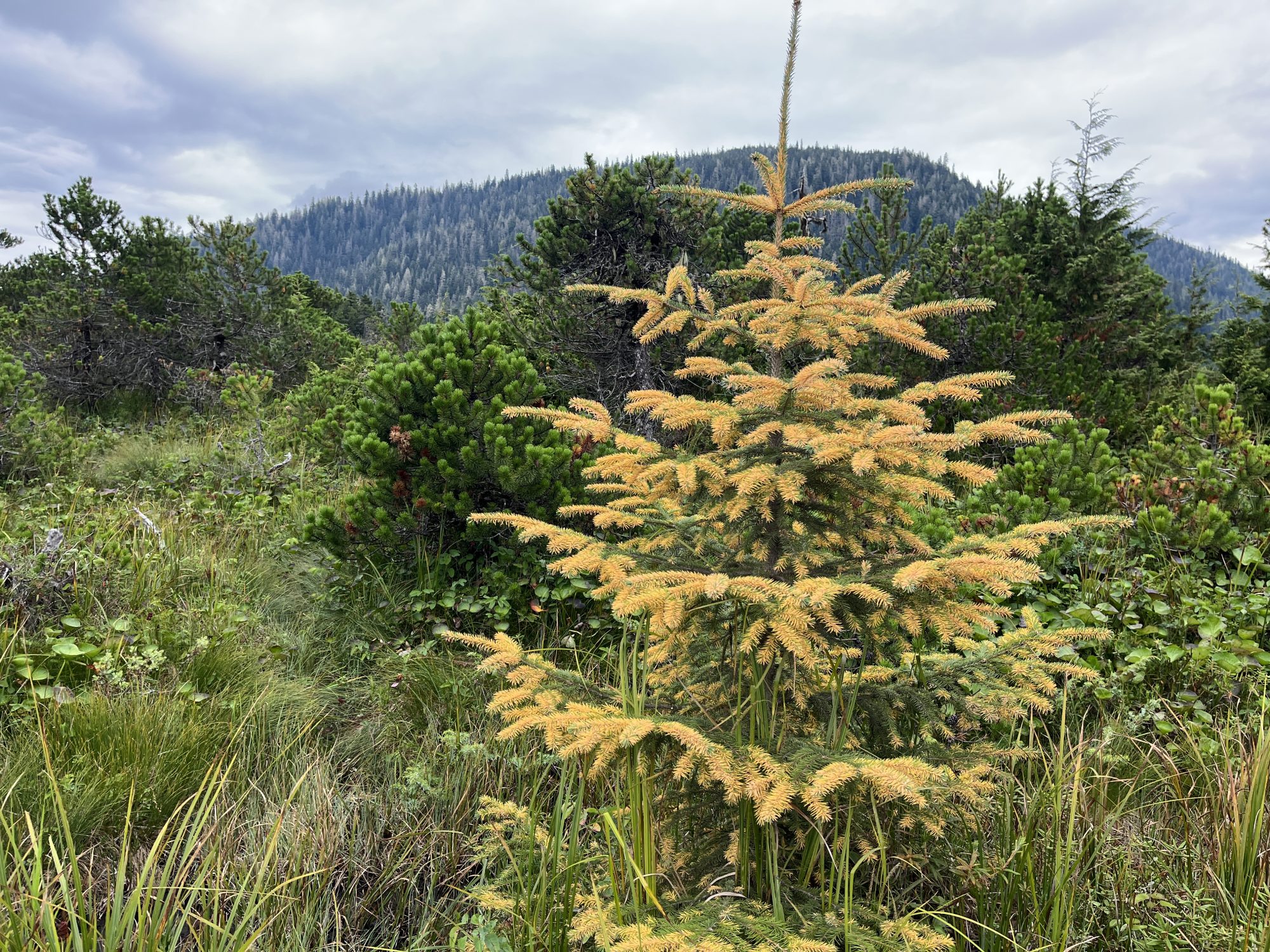
If you’ve been walking trails near the muskeg lately – the boggy wetlands in Southeast – you might have noticed some spruce trees not looking so great. Earlier this summer, the green needles turned a bright yellow-orange. Now, they’re more rusty colored. So, what’s the deal?
According to Robin Mulvey, forest pathologist with the U.S. Forest Service, it’s a fungal outbreak known as spruce needle rust that is spreading among spruce trees in the Tongass National Forest.
Mulvey said this summer’s outbreak is the largest she’s seen in her 15 years working in Juneau. It’s even on her new running shoes.
“I ran on a trail through the Mendenhall Valley, and I’ve washed my shoes a few times, and the bottoms of my running shoes are still bright orange,” she said. “I had spores all over the windshield of my car, on my patio, and I think of it more like a big pollen here. That’s kind of the level of damage, and it’s just a phenomenon that we can track and enjoy.”
The fungus is mostly cosmetic and doesn’t hurt the trees. The infected needles will die and drop off, and next year, they’ll put out new green growth. It’s a natural cycle. But the cycle requires one other part – nearby Labrador tea, also known as tundra tea. Spruce is just the temporary host.
“All of the spores that are being produced on Sitka spruce right now, they can’t infect spruce,” Mulvey said. “They have to only infect Labrador tea.”
How does that even evolve?
“That’s a great question,” Mulvey said. “There are a lot of diseases that have this type of life cycle. This is just one. So, we have another one that goes between Western hemlock and blueberry leaves. We have another one on one-year-old needles of Sitka spruce that doesn’t have an alternate host; it just goes from spruce to spruce.”
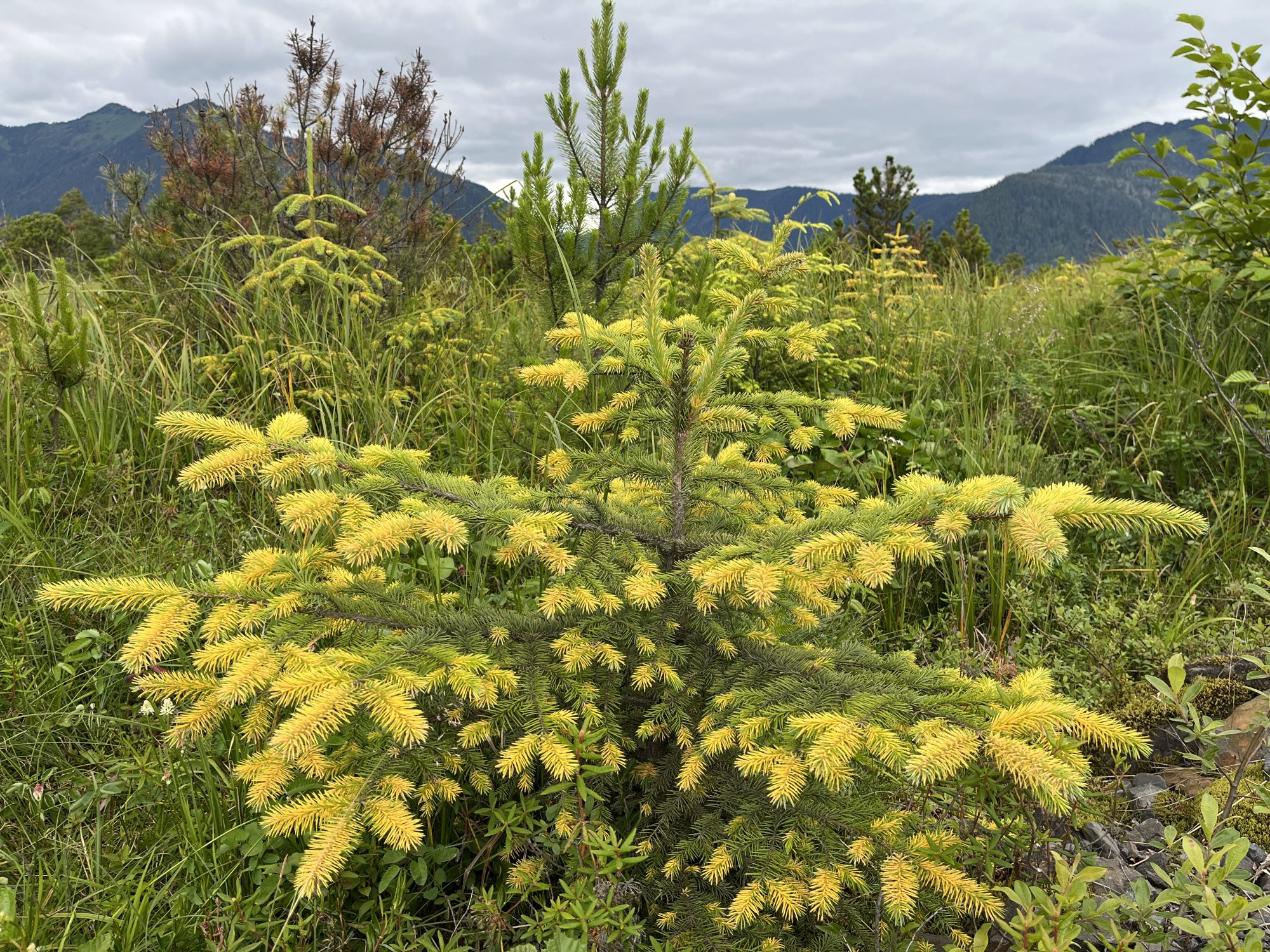
So, with the right environment and perfect weather, these spruce needle rust spores are produced on Labrador tea leaves in early summer; they float through the air onto new spruce shoots, which turn yellow and then orange as summer goes on. That’s the “fruiting” stage of the fungus, Mulvey said. Then the spores blow back to Labrador tea, where it overwinters on the top of the leaves, turning them purple to orange.
“And most people, when they think about disease, they have a negative connotation with that. When there’s disease in humans, that’s a bad thing,” Mulvey said. “But in the forest, these fungi are part of the ecosystem, and they’re just playing their role; it’s just doing its thing. And so we can kind of appreciate that process.”
Although the Labrador tea is infected by the fungus, it’s not harmful to humans. But it’s still a good idea to harvest plants without spots or discoloration, Mulvey said.