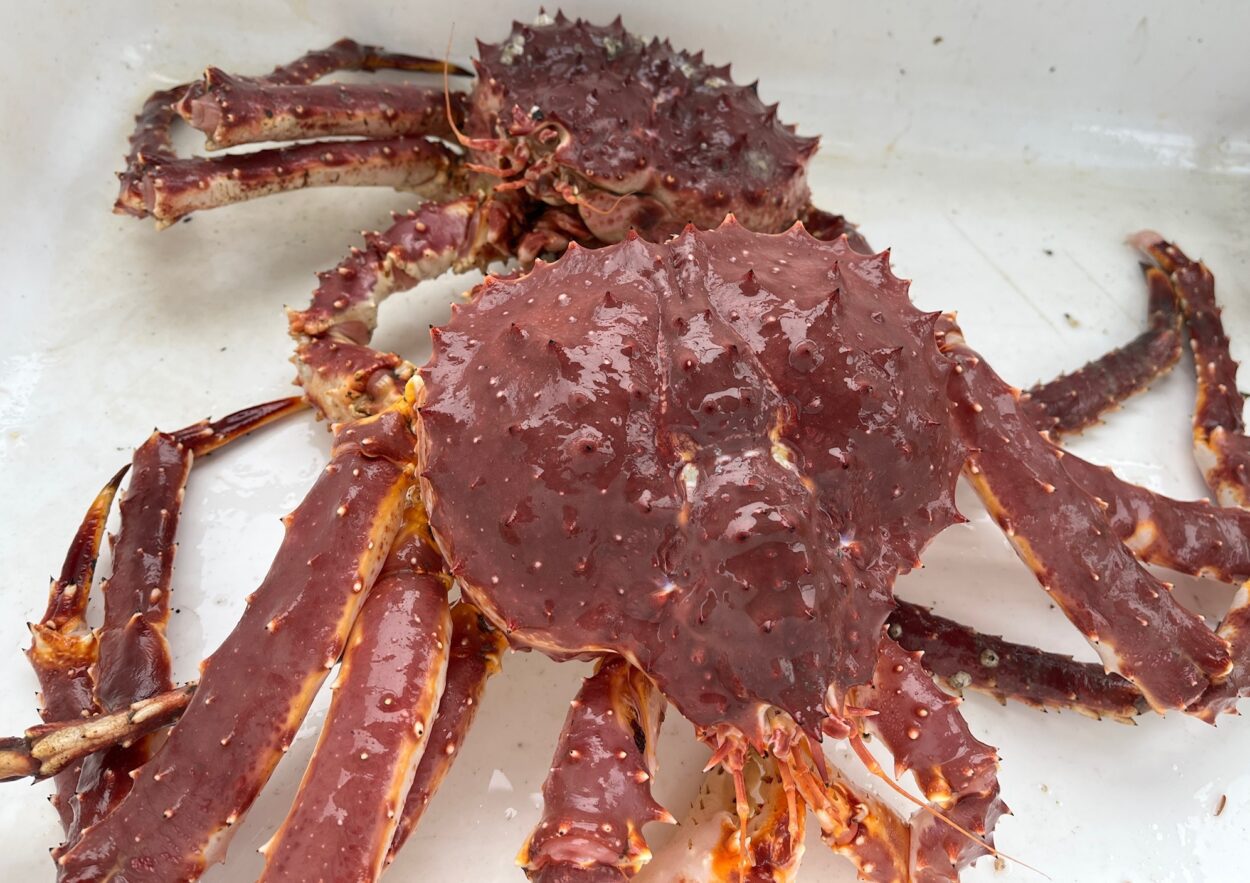
Southeast Alaska’s first consecutive commercial red king crab fishery in decades opens Nov. 1.
Expectations for the season are underpinned by knowledge from last year’s fishery.
“I definitely think guys are excited. I think they know what to expect after last year,” said Adam Messmer, regional shellfish biologist with the Alaska Department of Fish and Game.
Messmer said the upcoming fishery will be managed much like last year, with some changes based on what fishermen and state managers saw that season.
“We got a little bit better handle on where crab was coming out of, and where crab wasn’t coming out of, and where there was effort,” Messmer said.
That’s after the region had its first commercial red king crab fishery in nearly a decade. The back-to-back openers are riding a pulse in the crab population.
Last year, managers split up non-surveyed areas into smaller ones to spread out the fishing effort and manage it more closely.
“We’ve never managed it the way that it was managed this last year,” Messmer said.
The state only surveys seven bays, and uses fishery data to inform estimates for the other areas. But, because there hadn’t been an opener in a long time, Messmer said last year’s harvest limits for those non-surveyed areas were set using historical catch data from all years.
Harvest limits have now been updated for the upcoming fishery, using information from last year’s season.
“Now having a year’s worth of fishery and seeing what’s happening real time across the non-surveyed areas, we were able to go back in and adjust the poundage to those areas.”
There will again be 10 areas opening this year, each with its own harvest limit. They’ll be managed individually based on how much harvestable crab are in each spot.
Seven areas will stay open until their harvest limits are met. Three other areas — Gambier Bay, Seymour Canal, and certain waters near Juneau — will have time limits. Messmer said those three spots have a “decent surplus” of legal crab.
“We’re definitely being conservative in all three of those areas,” Messmer said. “And hopefully be able to do this for the next couple years, and bide time before another large [population] pulse comes through.”
The waters near Juneau will again be open for 24 hours this year. Messmer said the harvest limit for the area has been met in that timeframe for the last handful of openers.
Seymour didn’t have a timed opener last year. Messmer said many boats went to Seymour and quickly caught the area’s crab. Managers closed it, but it was overfished.
“I believe we closed the quickest we’ve ever closed before,” Messmer said. “And we still ended up going quite a bit over in that area.”
Seymour will be open for just 56 hours this time, based on how quickly fishermen caught crab there last year.
Fishermen had the opposite problem in Gambier Bay. They caught about half the allowed amount during last year’s initial day-long opener. That’s why Gambier will have a slightly longer window this year, open for 28 hours.
The state has tagged some crab in the Seymour and Gambier areas to gather data. Fishermen who catch legal-sized tagged crab should leave the tag in for port samplers.
“Unfortunately, we don’t have a reward system or anything, but it does give us information on growth increments and movement data,” Messmer said.
This year’s total harvest level is just over 213,000 pounds — a bit higher than the fishery had last year.
With 22,235 pounds of crab available, Eastern Frederick Sound’s limit went down by about 17,000 pounds this year. That’s after managers closed the area early last season because less crab were showing up in pots.
“There was still a bit of effort, and we didn’t want to remain hammering on that,” Messmer said. “That’s kind of why there’s a decrease.”
With 25,015 pounds of crab available, Northern Chatham Strait is getting the biggest increase: almost 19,000 more pounds of crab than last year. Messmer said the area’s previous limit was quickly caught and over harvested. “I don’t think anybody was really anticipating there being that much crab in that area, but it definitely warranted an increase for this year,” Messmer said.
Among all 10 open areas, the highest amount of available crab is in Northern Chatham Strait, Seymour Canal, and North Stephens Passage this season.
The fee-free registration deadline for the red king crab fishery is Oct. 2.
Participating permit holders will need to tell managers what area they’re starting in before the fishery opens this fall. Fishermen are also required to call managers daily so they can keep tabs on the fishery and close areas when their available stock gets caught.
Messmer said he expects the consecutive season to be relatively similar overall, and hopes the weather cooperates.
Details about each area can be found in the Sept. 11 announcement on Fish and Game’s website.