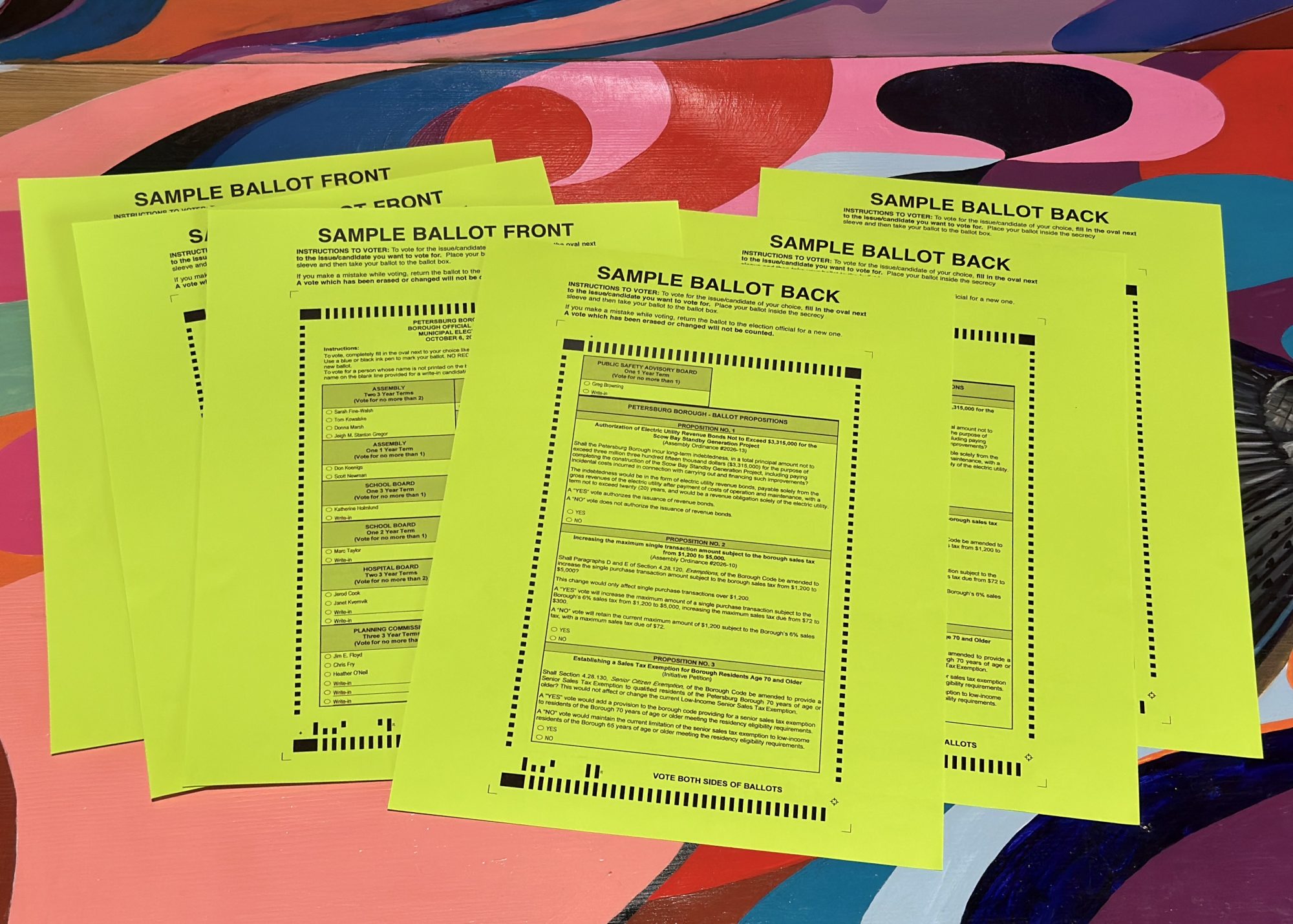
This Tuesday, local voters will decide whether to approve three different propositions on the Oct. 6 municipal ballot. All three ballot measures deal with money.
Proposition No. 1
Prop 1 comes from the Borough’s power department. It would authorize a $3.3 million revenue bond to help pay for a diesel generator project in Scow Bay, a few miles south of town.
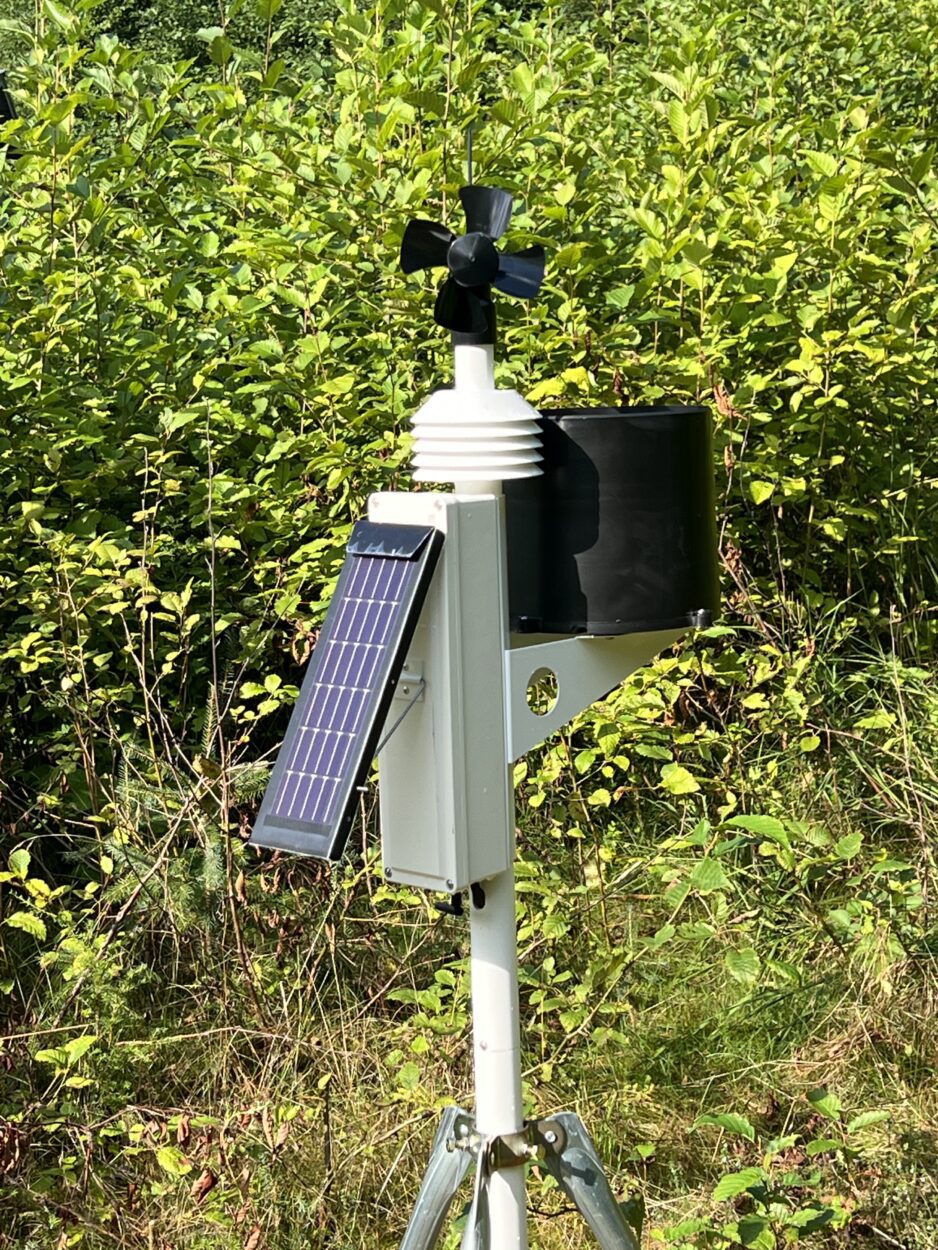
The Scow Bay Standby Generation project expands the Borough’s fleet of diesel generators that provide power when local loads are high or hydropower is lost.
“The one thing about power is that it’s never 100%,” said Karl Hagerman, former Utility Director, in a June interview about his career. “To have a standby diesel fleet is pretty much imperative for communities in our situation, and having enough standby diesel power is also imperative.”
Hagerman said a 2021 study of Petersburg’s power system determined the town would need more diesel generators.
But the price tag of the project has almost doubled since it started in 2022.
Construction costs skyrocketed and caused a steep budget shortfall that this bond would fund, if approved by voters on Tuesday.
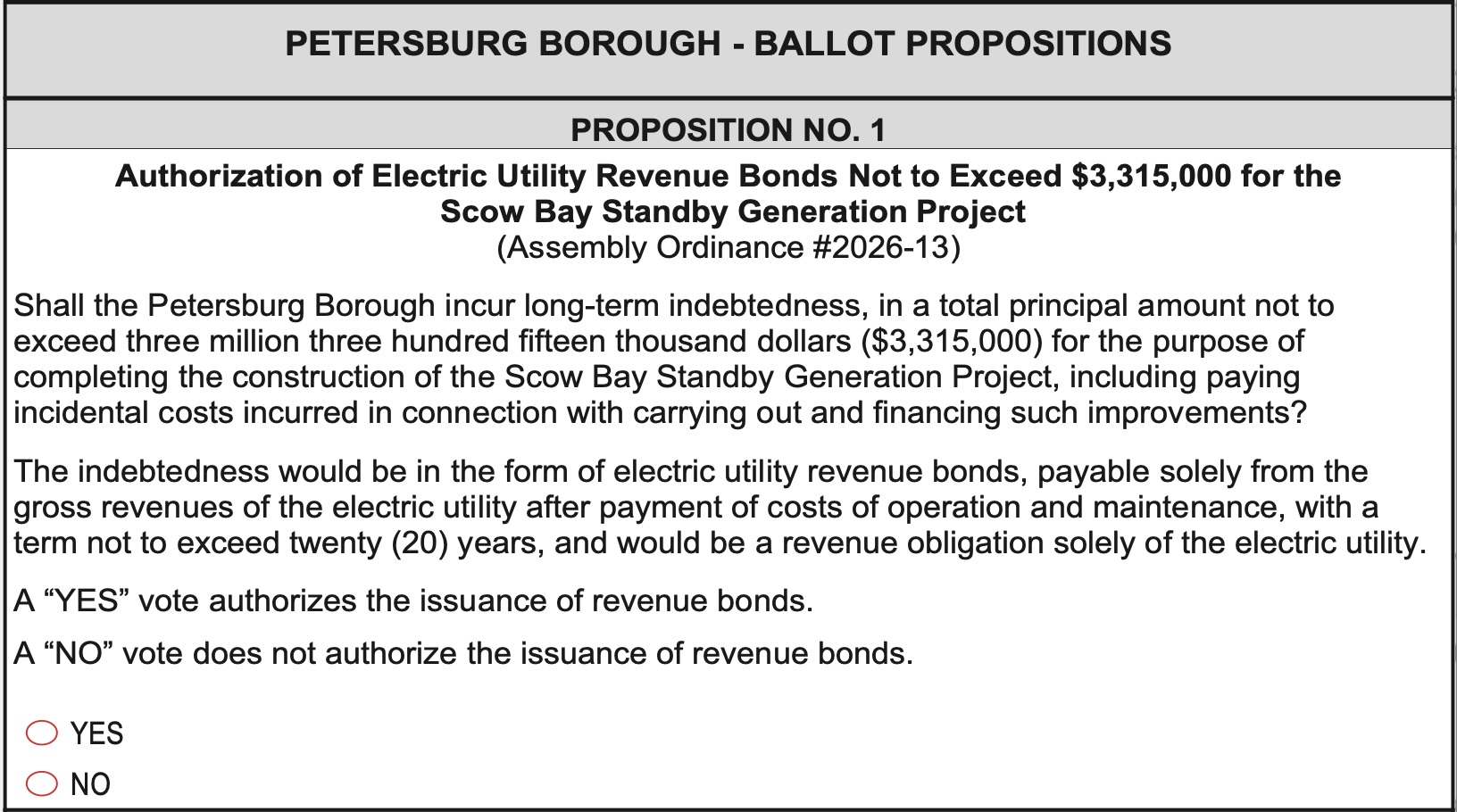
The proposed bond would be repaid solely through revenues of the electric utility. In other words, money from local utility bills.
But department officials say approving Prop 1 does not mean another increase to electric rates.
“Are we talking, then, a rate increase to cover this?” Assembly Member Jeff Meucci asked Hagerman during a June meeting.
“No,” Hagerman replied.
The Assembly agreed to increase Petersburg’s electric utility rates earlier this year. But Hagerman said this proposed bond was already accounted for in the rate study, and approving the measure would not cause an additional increase.
The Petersburg Borough Assembly passed the measure this summer, sending it to voters to finally decide.
Proposition No. 2
Prop 2 would raise Petersburg’s sales tax cap.
Currently, sales and services are taxed on the first $1,200. So, tax on a single purchase is capped at $72 max.
In other words, a purchase over twelve-hundred dollars is taxed $72 at most.
Approving Prop 2 would raise that maximum cap to $300 by changing the taxable amount to $5,000.
In other words, a purchase over five-grand would be taxed $300 at most.
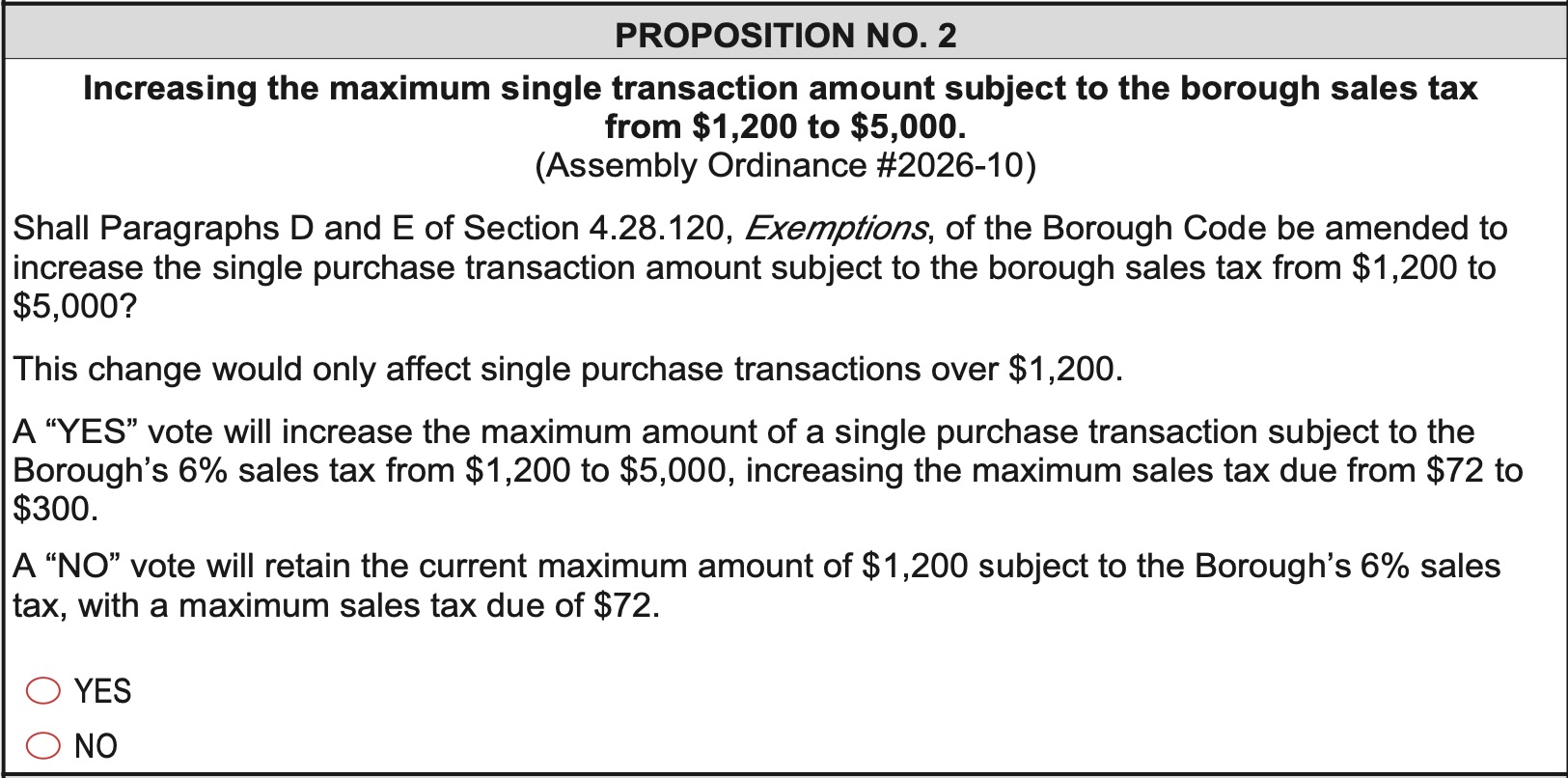
Borough officials say Petersburg has the lowest cap among major towns in Southeast Alaska. The cap has been adjusted just once since it was established nearly 70 years ago — raising it from $1,000 to $1,200 in 2002.
Assembly Member Bob Martin spoke in support of Prop 2 during a recent meeting.
“Whatever they intended back then has sailed past us so far in order of magnitude,” Martin remarked. “So, bringing that up to $5,000 is a very reasonable thing to do.”
Martin is a commercial fisherman.
“I think a lot of us don’t ever hit the cap,” he said. “I bought over $10,000 worth of fuel for my boat this summer. Every penny was fully taxed. If I bought it on one day, I would have paid $72 total on tax … So I’m strongly in favor of raising the sales tax cap.”
But Assembly Member Scott Newman, a pilot who owns a local float plane business, held a different perspective.
“I spend about $100,000 in fuel in a year. And if, every time I go and get fuel in my little tank, I have to spend $300 in sales tax, who’s going to pay that? I’m not paying it. The customer’s going to pay for that,” Newman said.
Revenue generated from raising the cap would support essential Borough services.
The measure was on the ballot two years ago, but failed by five votes.
Now, local voters will weigh it again.
Of note: Prop 2 on Petersburg’s municipal ballot is not the same Prop 2 residents might be seeing on yard signs and mailers.
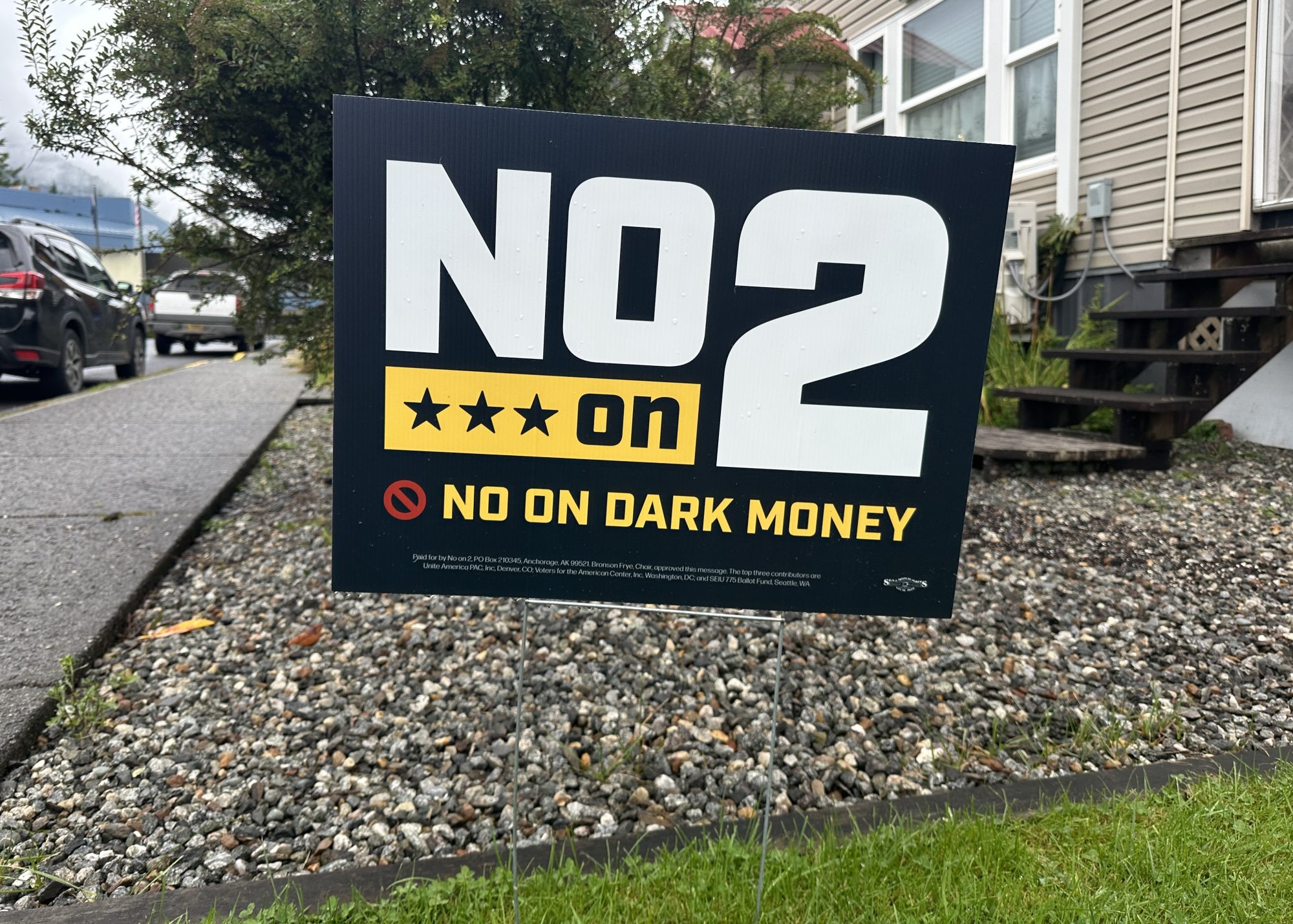
Local poll workers said some early voters have been confused about Prop 2, because it shares the same shorthand name as a different measure in the state’s general election, which happens in November.
They are separate issues for separate elections.
The Borough Assembly passed the measure with a contested vote, putting it on the ballot for voters to decide on Tuesday.
Proposition No. 3
A citizen initiative is on this year’s local ballot as Prop 3.
It asks voters if the Borough should add a sales tax exemption for seniors age 70 and older, regardless of income.
By a thin margin, voters decided last year to end the town’s exemption for any seniors age 65 and older, and replace it with one limited to just low-income seniors.
The change dropped the list of roughly 487 participating seniors to about 60 people.
Prop 3 would not affect the current sales tax exemption for low-income seniors.
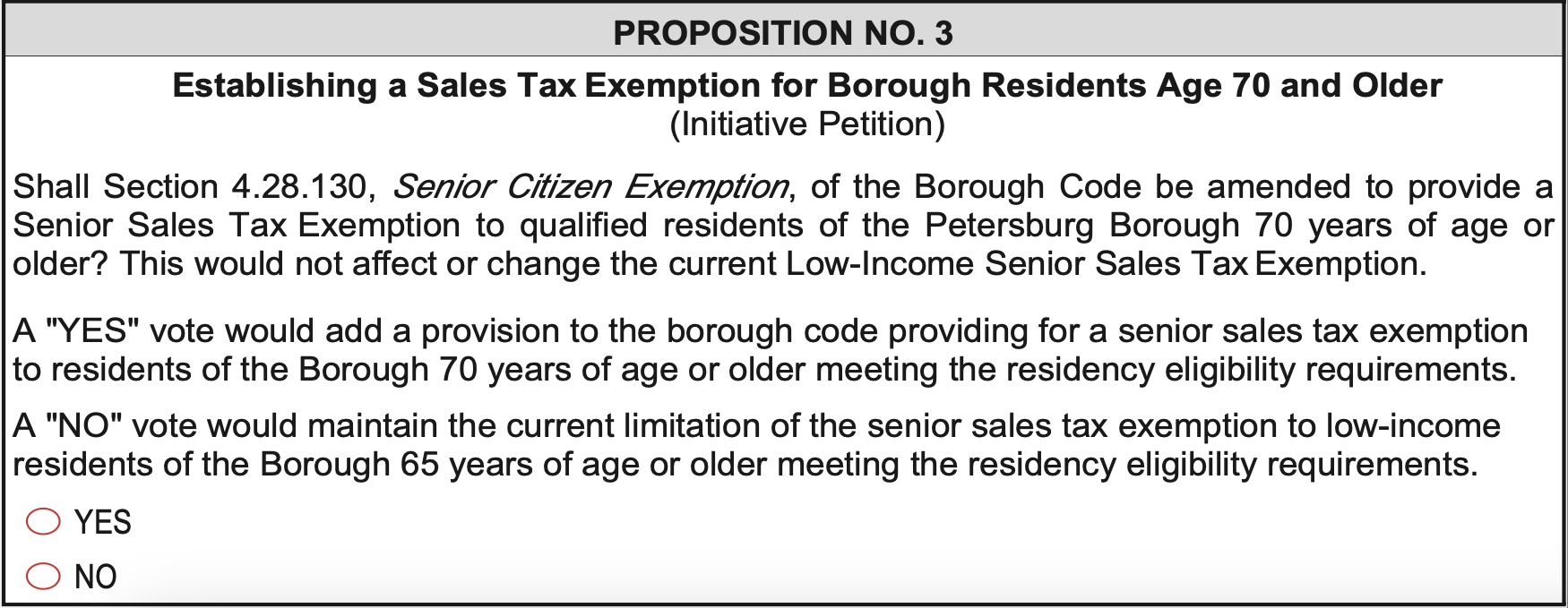
Sales tax is a way the Borough garners funds for public services amid rising costs and limited revenue. Over a quarter of Petersburg’s population is now senior-aged.
According to sales tax observations shared by finance officials, the Borough made an additional $250,000 in sales tax revenue within six months after limiting the senior sales tax exemption.
Before the change took effect in January, exempting the participating seniors cost the Borough about $400,000 a year in lost sales tax revenue.
Approving Prop 3 and installing an exemption for seniors age 70-and-up is estimated to remove at least $350,000 in Borough revenue.
That’s a similar figure as cited last year because about 80% of seniors who participated in the old exemption are above the age of 70.
Petersburg’s municipal election is Tuesday, Oct. 6.
Voters can cast ballots early in the municipal building until noon on Monday, or on Tuesday from 8:00 a.m. – 8:00 p.m. in the Parks and Recreation Activity Room.
Find more information about Petersburg’s 2026 election in KFSK’s Voter Guide, or on the Borough’s website.